

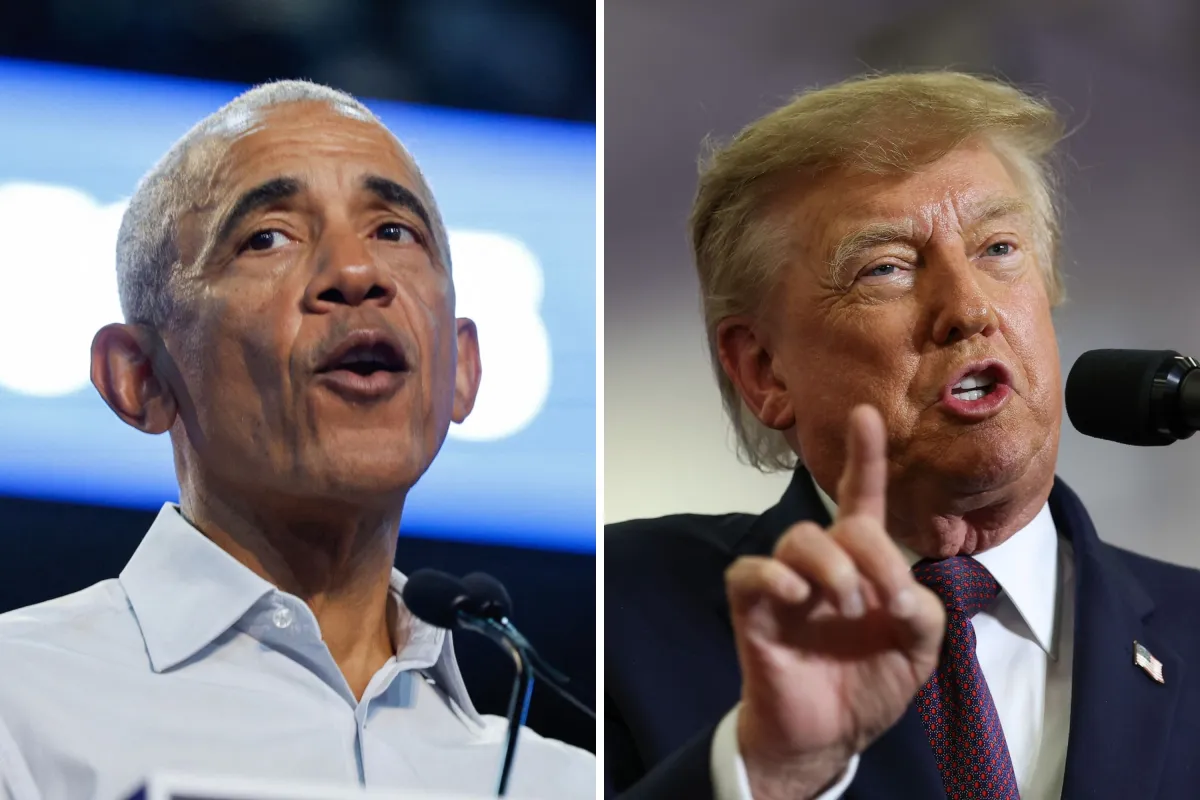
On a Wednesday that felt more like a thunderstorm waiting to break, with the midterm elections just days away, President Donald Trump and former President Barack Obama took to stages in two different states, striding through the storm of American politics as if summoned by the same urgent clock. Trump appeared at the Shoemaker Center at Ohio University in Chillicothe, a building filled to the brim with supporters who had come to see him back Republican gubernatorial candidate Vivek Ramaswamy and incumbent Senator Jon Husted. Obama, meanwhile, stood before a swelling crowd roughly five hundred miles south, at The Arena at Southlake in the Atlanta suburb of Southlake, Georgia, where he lent his voice to Democrat Jon Ossoff in his Senate race and to Keisha Lance Bottoms, the former Atlanta mayor seeking to become governor. The two presidents did not meet, but their words collided in the national imagination. Each rally was a mirror of the other—one reflecting the raw, defiant energy of the conservative base, the other reflecting the anxious, hopeful pulse of a Democratic coalition that sees Georgia as the battleground that can redefine the map. In a sense, these were not just campaign stops. They were competing versions of the American story, told in front of live audiences and amplified through the screens of thousands of phones. The people who came were not merely spectators. They were participants in a ritual older than the republic, one that reminds us that politics is not just policy and polling but flesh and blood, memory and desire. The arena walls were the same, but the atmospheres could not have been more different. In Ohio, the mood was one of restoration, of taking something back, of pushing forward with the conviction that the country’s best days are tied to its truest traditions. In Georgia, the mood was one of continuation, of guarding a fragile progress, of believing that every vote is a brick in the wall against a tide they fear. And yet, for all their differences, the people in both crowds shared something primal: the need to be part of something larger than themselves. That is the human heart of politics, and it was beating loudly in both places.
Inside the Shoemaker Center in Chillicothe, the atmosphere was a furnace of enthusiasm long before Trump walked to the microphone. The local news outlet WBNS 10TV estimated that around 2,500 people filled the venue, but numbers never tell the whole story. The crowd was a mixture of seasoned rally-goers and newcomers, people who had driven from nearby counties and some who had traveled for hours. They wore red hats, carried signs with slogans that had become familiar refrains, and scanned every doorway for the first sign of the president. Walter Curt, a conservative-leaning commentator, was among those documenting the moment. He posted video and photographs to X with the kind of breathless excitement that defines the final stretch of a campaign: “Outside the Chillicothe Rally. Completely full inside. President Trump arriving to speak shortly.” The post captured what words could not: the long lines outside, the families huddled together in the cold, the sense of anticipation that hung in the air like static. Inside, every seat was claimed, and latecomers lined the walls, craning their necks for a better view. There was laughter, there were chants, there were moments of quiet waiting when the crowd seemed to hold its breath. The speech itself was built around Ramaswamy and Husted, but the real subject was loyalty—loyalty to a movement, to a man, to an idea about America that refuses to bend. Some in the crowd had been at Trump rallies since 2016 and spoke about them the way other people speak about family reunions. They remembered the first time they heard him speak, the way it made them feel seen. They talked about the economy, about the border, about the sense that the country had drifted from its moorings. They were not all the same kind of person. There were retired factory workers, young college students, grandparents holding grandchildren on their hips. What united them was the belief that this election was more than a choice between candidates; it was a crossroads, and they had chosen their side. When Trump finally emerged, the arena erupted in a roar that seemed to shake the walls. For the people in that room, the moment was not about statistics or polls. It was about feeling the presence of a leader who, in their eyes, had never stopped fighting for them. And in that emotional swell, the number two thousand five hundred felt like a crowd of millions.
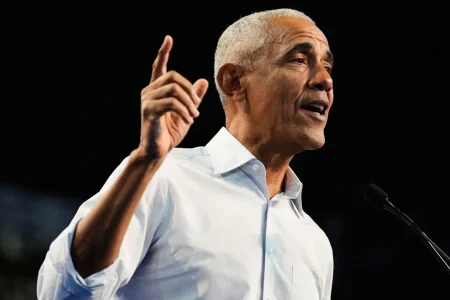
Hundreds of miles away, in Southlake, Georgia, former President Obama stood before a crowd that was, by most accounts, larger and more diverse. The Guardian reported that between 3,500 and 4,000 people attended the rally, though early estimates from supporters suggested the true number was much higher. The Arena at Southlake, a sprawling complex with seating for more than 8,000 guests, offered plenty of room for the crowd to expand, and by the time the event began, the space was alive with movement and sound. Seth Taylor, a 2024 Democratic National Convention delegate, captured the scene in real time on X. Before the doors even opened, he posted: “I’m waiting in line outside the Obama-Ossoff-KLB rally here in Clayton County, Georgia. The doors don’t open until 4 and this crowd is already way bigger than any of Trump’s rallies here in Georgia. Let’s go!!!” The message was emphatic, full of the competitive energy that both sides bring to the game of crowd comparisons. Later, from high in the stands, Taylor posted again: “My view from the nosebleeds inside the Obama-Ossoff-KLB rally here in Clayton County, Georgia. There’s like 10,000 people inside the arena! Let’s go!” The claim was impossible to verify, and perhaps it was an exaggeration—the arena’s capacity and the complexities of counting a moving crowd make any number suspect. But the exaggeration itself was a kind of truth. It expressed the feeling in the room, the sense among Democrats that their energy was real, that their side was not asleep, that the enthusiasm gap so often talked about in conservative media was a myth. The crowd at Southlake was a mosaic of the new America. There were Black families who remembered civil rights struggles and white progressive students who had grown up in the shadow of Obama’s presidency. There were Latino voters, Asian American voters, suburban women, and young parents holding children who would not remember the day but whose futures were the reason their parents came. Obama spoke with his characteristic cadence, weaving policy and personal story into a single fabric. He talked about Jon Ossoff’s integrity and Keisha Lance Bottoms’s vision, but he also spoke to something deeper—the idea that democracy is not a house that tends itself. It requires constant care. The crowd leaned in. Strangers exchanged hugs after sharp lines. A woman near the concession stand wiped tears from her eyes. In the nosebleeds, people stood and swayed, not because they could see everything, but because they could feel it. The rally was hopeful, urgent, and deeply human. It was, in so many ways, the exact mirror image of the event in Chillicothe: same fervor, different faith.
Taken together, the two rallies formed a kind of national Rorschach test. Every observer saw what they wanted to see. For conservatives, the Chillicothe crowd was proof that President Trump remained the most powerful force in the Republican Party, capable of lifting candidates like Ramaswamy and Husted to victory. For progressives, the Southlake crowd was proof that the Democratic base was awake, energized, and ready to defend Senator Ossoff and back Keisha Lance Bottoms. The social media posts from both events became political ammunition. Walter Curt’s video from outside the Ohio rally was shared as evidence of Republican strength. Seth Taylor’s posts from inside the Georgia arena were shared as evidence of Democratic momentum. But here is the thing about attendance figures: they are notoriously unreliable. No official numbers were released for either rally. The Arena at Southlake, with its multiple facilities under one roof, made even the most careful estimate feel like guesswork. A crowd can be counted in many ways—by ticket scans, by fire marshal estimates, by aerial photographs, by the wild eyes of enthusiastic supporters. And every method tells a slightly different story. What matters, perhaps, is not the count but the feeling. In Chillicothe, people believed they were part of a wave that would crash over Washington and sweep away the establishment. In Southlake, people believed they were holding the line against a rising tide of extremism. Both sides could not be right, but both sides were sincere. That is the strange beauty of a two-party system. It makes rivals of neighbors and believers of skeptics. It fills arenas with people who would rather stand in line for hours than sit at home in silence. It turns a midweek rally in Ohio and an afternoon event in Georgia into symbols of something far larger than any one candidate. And it explains why the midterms are never just about the candidates on the ballot. They are about the kind of country each voter imagines and the future they are trying to build. As Newsweek noted in its coverage, the White House and Obama’s office did not respond to requests for comment outside regular working hours. The story was still developing, and the night was young.
But if you zoom in close enough, past the famous names and the flashing cameras, you see what makes a rally feel so different from a televised town hall. You see the people. In Chillicothe, there was a man who had driven from West Virginia the night before, sleeping in his pickup truck outside the arena just to be certain he would not miss the doors opening. He said he had never attended a political event before, but something about this election felt different. “I want to see with my own eyes that someone is listening,” he said. In Southlake, a nineteen-year-old college student waited in line for four hours with her grandmother, who had voted in every election since 1964. The grandmother told her about a time when Georgia’s voting booths were not so welcoming to people who looked like them. She said the line was not a hassle. It was a privilege, paid for by sacrifice. Those stories do not make the headlines, but they are the headlines. Political rallies are part county fair, part church revival, part family gathering. They are spaces where strangers find a fleeting community, where grievances are aired and where hope is manufactured in real time. There is the smell of popcorn and coffee, the sound of a child asking why everyone is shouting, the sight of an older couple holding hands while someone on stage speaks about freedom. There are volunteers passing clipboards, T-shirt vendors selling slogans that will be outdated by next Tuesday, and first-time voters who are just beginning to understand that democracy is not a gift but a task. For a few hours, the ordinary world falls away. People forget their rent payments and their tiredness and their doubts. They wave flags and sing along to songs, and if they cry, it is because they believe something important is at stake. The presidents come and go. The candidates give their speeches and pose for photographs. But the people linger. They take selfies, trade phone numbers, make promises to meet again at the polls. That is the human side of politics. It is not found in focus groups or spreadsheets. It is found in the tremble of a voice when a speaker says, “This is the most important election of your lifetime.” It is found in the way a crowd can feel like one body, one heartbeat, one page in a story that is still being written. On Wednesday, in two arenas separated by miles and ideologies, that heartbeat was strong.
Now, with the midterms on the doorstep, the memory of those dueling rallies will be carried into the voting booth. The images are already burned into the national imagination: President Trump raising his fist to a roaring crowd in Ohio, former President Obama smiling calmly at a sea of uplifted hands in Georgia. But in the end, the men on stage will not cast the decisive votes. The decision belongs to a nurse finishing a night shift, a welder on a break, a teacher who left a stack of papers ungraded, a retired veteran, a cashier, a student. They will wake up early, stand in line, and, with a mark on a ballot, choose a future. The rallies were preludes—important, emotional, but still preludes. What follows is the quiet work of democracy, conducted in ordinary places: kitchen tables, mailboxes, community centers, and precinct halls. The story, as they say, is developing. It always is. Each election is another chapter in an ongoing American argument about who we are and who we want to become. On Wednesday, we heard two of the loudest voices in that argument speak to two very different crowds. One told his audience that they were among the faithful few fighting to take back a country that had slipped away. The other told his audience that they had the power to stay the course and build something even greater. They cannot both be right. But their followers can both be sincere. That is the strange and beautiful paradox of democracy. It turns politics into something deeply personal. It fills arenas with people who would rather cheer for four hours than sit at home in silence. It turns a midweek rally in Chillicothe and an afternoon event in Southlake into symbols of something larger than any single issue. And when the noise fades and the lights go out, it asks each citizen to find the courage to think, to choose, to act. The presidents will return to their lives. The television cameras will move on. But the crowd’s energy does not simply disappear. It dissolves into conversations at dinner, texts between friends, and the quiet resolve of voters who never appear in a photograph. That is where elections are won and lost. And on Wednesday, in Ohio and Georgia, America was already living that truth—one rally, one line, one voice at a time. The people had spoken. Now they would have to decide whether to speak again, this time where it really counted.