

The announcement landed with the blunt finality of a door slamming shut. U.S. Ambassador to the United Nations Mike Waltz appeared on Fox News’ Hannity and revealed that Secretary of State Marco Rubio had signed the necessary paperwork to expel a Cuban diplomat who had been accused of shoving and attempting to assault an American diplomat. Waltz did not hedge, soften, or offer any diplomatic pleasantries. “He’s gone. He is going to be on a plane to Havana within the next 24 hours,” he said, making clear that Washington had decided to respond swiftly and publicly to an incident it considered intolerable. For anyone watching, the message was unmistakable: the United States would not allow its representatives to be physically threatened, even in the hallways and meeting rooms of the United Nations, where decorum and protocol are supposed to govern interactions between bitter adversaries. The speed of the expulsion was itself a signal. In normal times, such disputes might be resolved through quiet conversations, formal protests, or behind-the-scenes negotiations. But these are not normal times, and Waltz’s tone carried the emotional weight of someone who had personally witnessed an aggressive attempt to silence American criticism. His words were not the careful language of a career diplomat; they were the language of a man drawing a line. The expulsion was therefore both a punitive action and a symbolic rebuke, a way of telling Cuba that its officials had overstepped and that the United States was prepared to act decisively when its diplomats were treated with disrespect. It also set the stage for a broader conversation about the state of relations between two countries that have spent decades locked in a cycle of anger, distrust, and reciprocal provocations.
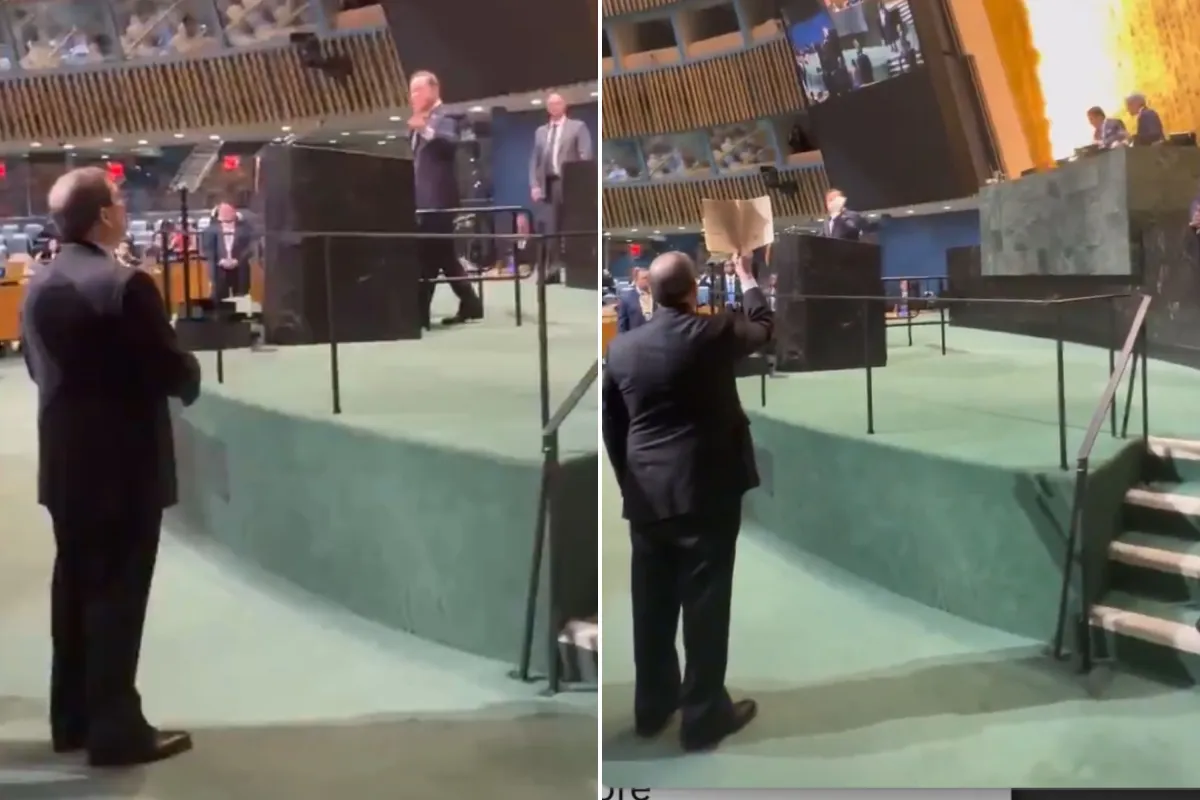
The alleged incident did not happen in a vacuum. In the hours before the expulsion news broke, a dramatic confrontation had unfolded at the United Nations, where Waltz was delivering a speech that evidently enraged Cuban representatives. According to Waltz, officials from the Cuban government rushed the stage in an attempt to disrupt his address. A clip of the moment captures the raw tension: Waltz can be heard barking, “Back away from this podium, he’s not going to intimidate me…” The image is striking, because it feels so far removed from the polished, carefully choreographed world of international diplomacy. Here was an American ambassador, standing at a podium, facing what he later described as “regime thugs” who were trying to physically or verbally shut him down. It was a scene that seemed more suited to a street protest than to the halls of the United Nations. For Waltz, this was not simply an interruption; it was an attempt at intimidation, an effort to prevent him from speaking uncomfortable truths to the international community. His refusal to back down became the defining moment of the confrontation. “They can intimidate their own people in Cuba but think again,” he wrote later on X, turning the incident into a broader accusation about the nature of the Cuban government. In that single sentence, he suggested that the officials who had rushed the stage were accustomed to silencing opponents in Havana but had miscalculated if they thought they could do the same to an American ambassador in New York. The confrontation gave a human face to the larger political conflict. It was no longer just about sanctions, embargoes, or ideological disagreements; it was about a physical clash at a podium, in front of cameras, with the world watching. And it set the stage for the expulsion announcement that followed, making clear that the United States would not allow such behavior to go unanswered.
The details of the alleged incident involving the Cuban diplomat remained somewhat unclear, as is often the case in fast-moving diplomatic stories, but the accusation was serious: shoving and attempting to assault an American diplomat. If true, it would represent a significant breach of diplomatic norms, which rely heavily on the principle that officials should be able to carry out their duties without fear of physical harm, regardless of the political tensions between their countries. The United States and Cuba have a long history of hostility, but even during the darkest days of the Cold War, there were established rules of engagement between their diplomats. To allegedly lay hands on an American diplomat is not just an insult to one individual; it is an affront to the entire U.S. diplomatic establishment. It also raises a host of questions. Was the confrontation a spontaneous moment of anger in the aftermath of Waltz’s speech? Was it a coordinated attempt to physically intimidate the American delegation? Or was it the result of a misunderstanding that escalated beyond control? The severity and speed of the response from Secretary Rubio and Waltz strongly suggested that they viewed it as a deliberate attack rather than an accident. Rubio, who has been a vocal critic of the Cuban government throughout his political career, would hardly be inclined to give Havana the benefit of the doubt. His decision to sign the expulsion paperwork so quickly indicated a determination to send a message: the United States will not tolerate threats against its diplomats, and it will act decisively when those threats occur. At the same time, the incident highlighted the charged atmosphere inside the United Nations, where delegates from adversarial nations increasingly seem to collide not only in debate but also in physical proximity. The cameras capture the speeches, but the confrontations that happen before and after are often just as tense. In this case, that tension spilled into the open, and the Cuban diplomat’s reported behavior turned what might have been no more than sharp words into a serious international incident with real consequences.
In the aftermath of the confrontation, Waltz took to social media to explain why his speech had provoked such a reaction. “The Castro regime has profited at the expense of the Cuban people with luxury cars, expensive watches and a private island resort,” he wrote. “As I shared this with the world, regime thugs rushed the stage to interrupt my speech. They can intimidate their own people in Cuba but think again.” His message was designed to paint a vivid and damning contrast between the governing elite and ordinary Cubans. Luxury cars, expensive watches, a private island resort: these are images of wealth and indulgence, a world away from the daily struggles of millions of Cubans who have endured decades of economic hardship under a communist government, followed more recently by the pressures of sanctions, the pandemic, and a severe economic crisis. By invoking those symbols, Waltz was not simply making a political argument; he was attempting to shame Cuban leaders on a global stage. The alleged reaction of Cuban officials, he implied, was proof that the regime was more comfortable silencing uncomfortable truths than answering them. This is a powerful narrative, one that has been reinforced for generations by Cuban Americans and anti-Castro voices in the United States who see the Cuban government as a corrupt dictatorship hiding behind revolutionary rhetoric. For those listeners, Waltz’s defiance at the podium was a moment of righteous anger, a rare instance of a U.S. official refusing to be cowed by a government that has long been accused of repressing dissent. But the confrontation also carries risks. It sharpens the already deep animosity between Washington and Havana, making any future dialogue or cooperation more difficult. It also raises the emotional stakes on both sides. In Cuba, the government is likely to frame the incident as an example of American aggression and disrespect. In Washington, the expulsion of the Cuban diplomat is likely to be celebrated as a firm response to bullying. The truth, as always, is more complicated, but Waltz’s words helped define the terms of the debate: this was not just a diplomatic spat; it was a clash between a repressive regime and those brave enough to call it out. Whether that framing will lead to constructive change or simply more hostility remains to be seen.
The expulsion arrives at a moment of heightened tensions between Washington and Havana, with relations at one of their lowest points in recent memory. The two countries share a long and painful history: the Cuban Revolution, the rise of Fidel Castro, the failed Bay of Pigs invasion, the Cuban Missile Crisis, and decades of a U.S. embargo that remains a central point of contention. There were moments when the relationship seemed to be moving in a different direction, with cautious efforts at normalization and the reopening of embassies, but those efforts ultimately faltered, and the political climate in both countries has hardened considerably. For many Cuban Americans, especially those in Florida, hostility toward Havana is not just political; it is deeply personal, rooted in memories of families who fled persecution, poverty, and the loss of their homeland. For the Cuban government, U.S. sanctions and rhetoric are seen as ongoing attempts to undermine Cuban sovereignty and impose regime change. In this context, the alleged shoving incident is not an isolated event but another symptom of a relationship that has become deeply adversarial. The decision to expel the Cuban diplomat may feel satisfying to those who want a tough response, but it is also a measure that can escalate rather than defuse conflict. It signals that the United States is unwilling to let such incidents slide and that it expects Cuban officials to treat American diplomats with respect. Yet it also risks giving Cuba an excuse to retaliate by expelling U.S. diplomats from Havana, creating a cycle of reciprocal punishments that could further reduce the already limited diplomatic presence in both countries. That would be especially damaging because, despite their hostility, the United States and Cuba rely on diplomatic channels for matters as varied as immigration, environmental protection, disaster response, and intelligence sharing. Cutting off or weakening those channels does not make the underlying problems disappear; it only makes them harder to manage. Still, the decision has been made, and according to Waltz, the Cuban diplomat is on his way out of the country. The broader question now is whether this confrontation will lead to a further breakdown in relations or serve, perhaps paradoxically, as a wake-up call that both sides need to find a more careful way of managing their differences.
As the story continues to develop, many details remain unresolved. Newsweek has reached out to Mike Waltz via email outside of normal working hours, and more information is likely to emerge in the coming days about the exact circumstances of the alleged assault, the identity of the Cuban diplomat, and any formal response from the Cuban government. Cuba has not yet publicly responded in the available reporting, but it would be surprising if it remained silent for long. In disputes like this, both sides usually try to shape the narrative, offering their own version of events and accusing the other of distortion and provocation. Waltz has already made his perspective clear: Cuban officials tried to intimidate him, rushed the stage to disrupt his speech, and one of their diplomats went too far by allegedly assaulting an American official. Cuba, for its part, may argue that Waltz’s speech was inflammatory and disrespectful, and that the reaction of its officials was understandable, if not justified. The incident also raises broader questions about the nature of diplomacy in an age of public confrontation. For decades, diplomats have operated under the assumption that even enemies can maintain a degree of civility and mutual respect. But the scene at the United Nations, with officials rushing a podium and an ambassador shouting at them to back away, looks more like a street fight than a diplomatic meeting. It is a reminder that the institutions and norms of international relations are only as strong as the willingness of nations to uphold them. When those norms are broken, the consequences are often unpredictable. In the short term, the expulsion of the Cuban diplomat will be seen by many as a clear victory, a demonstration that the United States will defend its people and stand up to intimidation. In the long term, it may contribute to an atmosphere in which dialogue becomes even harder, and each new incident generates more anger and mistrust. For ordinary Americans and Cubans, the diplomatic maneuvering can feel distant, but the consequences are real. They are the ones who live with the results of these disputes, whether through the continuation of sanctions, the absence of full diplomatic relations, or the lingering resentment that keeps old adversaries apart. The expulsion of one Cuban official will not resolve any of that. But it is a reminder that even small incidents can have outsized effects when they unfold in the spotlight of international politics. For now, the world waits to see whether this confrontation fades into history or becomes another turning point in a relationship that has already been marked by too many difficult decades. More to follow.