


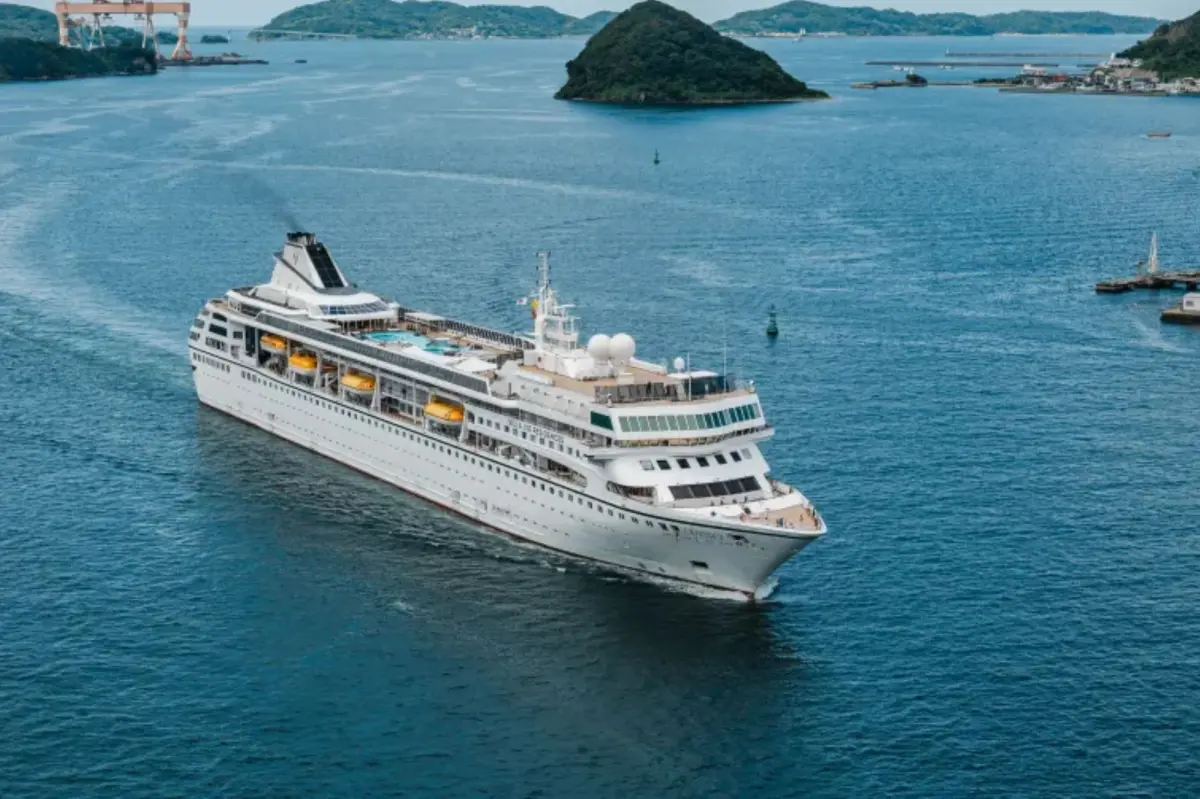
The Odyssey was never meant to be just another cruise ship. For the people who boarded her two years ago, she was a home, a promise, and a way of life—a floating neighborhood that would carry them from continent to continent while they slept, worked, and built friendships on the open sea. But on a recent morning in Sihanoukville, Cambodia, that dream came to a sudden, quiet halt. The ship had docked on October 23 for what was supposed to be a five-day visit, a brief stopover before continuing to Vietnam. Instead, she stayed. The engines fell silent. The passengers, 203 men and women from fifteen different countries, mostly Americans, were told to pack their things and leave. The company that operated the ship, Villa Vie Residences, announced that it could no longer afford to keep sailing. The cause was not a storm, a pandemic, or a mechanical failure. It was fuel. The cost of powering a residential cruise ship had become so enormous, so crushing, that the entire enterprise simply ran out of money. And so the residents of this unlikely community found themselves standing on a pier in Cambodia, staring at the ship that had been their home, wondering what would happen next.
For the residents, the news was not merely an inconvenience; it was the collapse of a carefully constructed future. The Odyssey had set sail two years earlier on a grand, three-year voyage designed to visit all seven continents. It was marketed as a unique blend of long-term living at sea and global travel, a chance to see the world without ever unpacking a suitcase. People sold their houses, gave away their furniture, and said goodbye to their families. They bought into the idea that life could be an endless journey, with new ports and new faces appearing on the horizon week after week. The ship itself was equipped for a community of up to 650 residents, although on this final leg it carried just over two hundred. The crew numbered 156, many of whom had formed close bonds with the passengers over the months and years. There were teachers, retirees, remote workers, and adventurers. There were birthday celebrations, dinner parties, and quiet mornings on deck. The Odyssey was not simply a vessel; it was a social experiment, a shared adventure, a place where people believed they had found a permanent home. To be told that this home was no longer viable, that it would be docked indefinitely in a Cambodian port, was a shock that went far beyond a canceled vacation.
The financial crisis that sank the Odyssey had been building for some time. Villa Vie Residences, based in Florida, explained that the cost of fuel had risen at an astonishing rate. Historically, the company said, monthly fuel expenses per cabin had averaged around $1,800. That was already a significant sum, but it was manageable, baked into the long-term financial model. Recently, however, in parts of Asia during the war in Iran, that number had climbed to an estimated $6,000 to $8,000 per cabin per month. For a ship with more than two hundred occupied cabins, the numbers became staggering. The company tried to adapt. It slowed the itinerary, spending longer stretches in port and reducing the amount of time the engines were burning fuel. It rearranged schedules, hoping that a more leisurely pace would ease the pain at the pump. But none of it was enough. The gap between what residents paid and what it actually cost to operate the ship widened every single day. The company described the situation in stark terms, saying it had been unable to continue carrying the resulting operating losses. It also acknowledged that passing the full increase on to residents was not a realistic solution. People who had already committed their life savings to this voyage could not simply be asked to double their payments. And so the only option, the company said, was to stop.
The official statements were careful and corporate, but they could not hide the human reality unfolding in Sihanoukville. The Sihanoukville Autonomous Port issued its own statement, confirming that the Odyssey had docked on October 23 for a five-day visit and was scheduled to head to Vietnam. Instead, the ship remained in port the following Wednesday, a clear sign that something had gone very wrong. Passengers were told to leave the ship, but the status of the crew remained unclear. What would happen to the 156 crew members who had served the residents, cooked their meals, cleaned their cabins, and guided them through rough seas? Would they be flown home? Would they be paid? No one seemed to know. The passengers, meanwhile, had to figure out where to go. Many had no homes to return to. They had sold everything before boarding. Their mail was forwarded to ports, their plants were given away, their apartments were vacated. Now they were being asked to disembark in a city they had never planned to visit, with no clear timeline for when, or if, the ship would sail again. Some may have had travel insurance, but no policy covers the loss of a way of life. They were more than stranded tourists; they were displaced residents of a tiny nation that had suddenly ceased to exist.
Beyond the immediate chaos, the suspension of the Odyssey’s voyage raises serious questions about the future of Villa Vie Residences and the broader residential cruising industry. The company had planned to launch a second residential cruise ship in early 2029, a sign that it believed the concept was viable and growing. The statement about the Odyssey’s suspension, however, did not mention the second ship at all. That silence was telling. If a company cannot afford to fuel one ship, how can it possibly build and operate another? The Odyssey itself had a confirmed itinerary into November 2027, a schedule of ports and adventures that was now meaningless. Reservations had been made, visas had been arranged, and residents had looked forward to months of future travel. Now that itinerary is in limbo, and the people who trusted the company are left waiting for answers. Industry observers may also wonder whether residential cruising is fundamentally flawed, a luxury concept that only works when fuel prices are low and the global economy is stable. The war in Iran, with its ripple effects on oil prices, exposed how vulnerable this lifestyle truly is. A ship is not a house; it cannot be insulated from the world’s crises. When geopolitics shift, the cost of heating and lighting a home at sea can explode overnight, and no amount of careful planning can protect against that.
In the end, the story of the Odyssey is a story about the fragility of human dreams. It is easy to romanticize life at sea, to imagine endless sunsets and exotic ports, but the reality is that even the most beautiful dream must be paid for. The residents of the Odyssey were not naïve; they were hopeful. They believed in a future that was different from the ordinary, a life that was not bound by mortgages and commutes and predictable routines. For two years, they lived that life. They saw the world, made friends, and created memories that will last a lifetime. But now they are onshore, with their bags packed and their futures uncertain. The company says its focus is on supporting residents, crew, and employees while it tries to restructure, but words can only do so much. There will be difficult conversations, legal battles, and painful goodbyes. Some residents may find another ship, another company, another chance to live at sea. Others may return to the lives they left behind, forever changed by their time aboard the Odyssey. The ship itself remains in Cambodia, a silent monument to an audacious idea that could not survive the realities of the modern world. It was a home for a time, and now it is a question mark, floating in the waters of a country where nobody expected to end up. And the people who lived there, who loved there, who believed in the journey, must now find a new way home.