



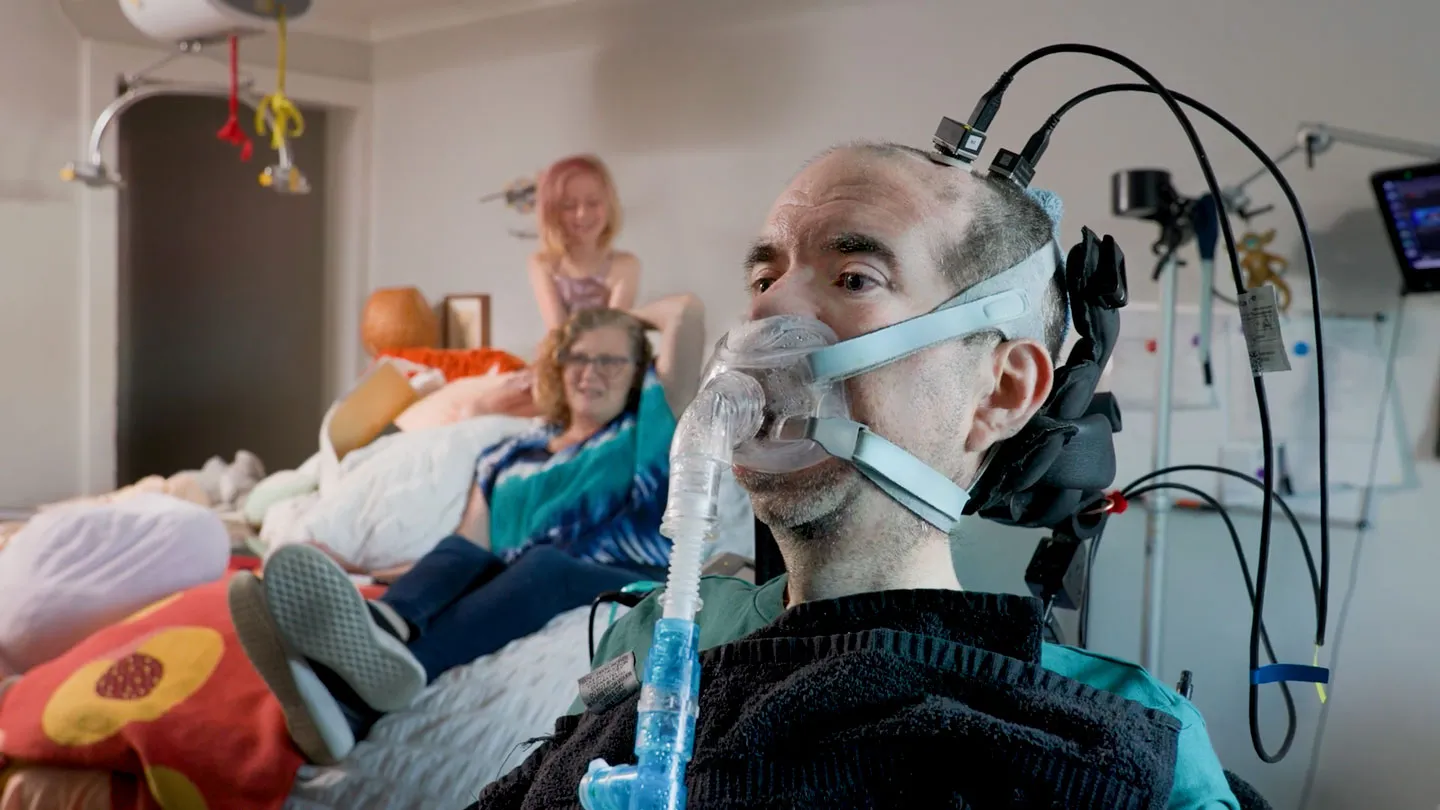
Casey Harrell’s voice was taken from him slowly, in what he calls a “slow motion car crash.” After his ALS diagnosis in 2020, the disease gradually stole his ability to move and speak, until only his wife, Levana, and his assistant could fully understand him. By the time he volunteered for a clinical trial in July 2023, he could no longer rely on speech to connect with the people he loved. A neurosurgeon at UC Davis implanted four tiny electrode arrays into the left side of Casey’s brain, each about as wide as a peppercorn, with 256 electrodes listening to the electrical activity that arose when he tried to talk. Every morning, Casey wakes up and “plugs into the Matrix,” attaching two wires to pedestals on top of his head and connecting to nearby computers. Those computers receive the signals from his speech motor cortex, and machine learning algorithms translate them into phonemes—the building blocks of language—then into words, sentences, and paragraphs. At first, researchers asked him to say pre-scripted sentences to test the system. When he successfully said, “What good is that?” everyone in the room and on the video call burst into tears. Casey remembers the moment as “pure joy” and “profound.” He realized that the possibilities for himself and for humanity were overwhelming. He had been warned not to expect the technology to work, but he had quietly believed it could. And it did.
The technology behind Casey’s restored voice is called a brain-computer interface, or BCI, and it has been decades in the making. The BrainGate consortium, led by neuroscientist Leigh Hochberg, has been running clinical trials for more than twenty years. Early participants used implanted electrodes to move a computer cursor, click around the internet, play video games, and even drink from a thermos using a robotic arm. But decoding speech is far harder. Hochberg describes the science as being at “the very beginning.” Casey is one of only a handful of people in the world to have an implantable BCI that decodes speech. The system uses artificial intelligence to match Casey’s brain patterns to 39 English phonemes, then uses language models to predict what he wants to say. When Casey tries to speak naturally, he can produce about six understandable words per minute. With the BCI, he can say about fifty words per minute—roughly a third of the speed of ordinary conversation, but enough for real, meaningful exchanges. Over nearly two years, Casey used the system for more than 3,800 hours at home, with no researchers present. He communicated 183,060 sentences and nearly two million words, with an average accuracy of about 92 percent. He typed messages on Slack, sent emails with the tagline “Sent from my brain” and a pink brain emoji, played Wordle with his wife and daughter, and kept working full time as a climate campaigner, all while paralyzed. The bare statistics sound dry, but each sentence represents a tether connecting Casey to his life: a message to a friend, a joke with a colleague, a goodnight to his child.
The most memorable moment came on the second day of using the full dictionary. The researchers had expanded Casey’s vocabulary from 50 words to more than 125,000 English words. The first thing he said was a funny quip: “Is this thing on?” Then he said something that seemed impossibly random: “I’m looking for a cheetah.” Leigh Hochberg, watching remotely from his office, assumed the decoder had made an error. But the researchers in the room with Casey knew differently. Casey’s four-year-old daughter had just walked into the living room dressed as a cheetah—one of her favorite animals. Casey was talking to her, playing with her, being her father. Hochberg later said he realized that this technology would restore not only daily activities, but communication between parent and child. For Casey, that moment mattered more than any technical milestone. His daughter had been born around the time he was diagnosed with ALS, and he had never been able to respond to her in the way he wanted. With the BCI, he could finally talk to her in real time, using a version of his own voice coming out of a computer. The voice was an integral part of his identity, and getting it back, even in a limited form, changed everything. As Casey said, the ability to respond to his daughter had been completely lacking from his life until that point. It was “the most important thing” he had lost to the disease. Restoring it, even imperfectly, was revolutionary.
The episode also reveals how difficult slow communication can be for everyone involved. Laura Sanders, the host, interviewed Casey over Zoom and quickly realized she was not used to the rhythm. She fumbled, interrupted, asked too many questions, and filled silences with nervous chatter. Casey gently reminded her that people in her position often struggle to stay focused because they are unaccustomed to a conversation moving so slowly. Humans, as speech pathologist Jessica Pietrowski explains, are deeply uncomfortable with silence. We fill gaps, finish sentences, and rush to help, often making things worse. Another person in the episode, Jules, uses an eye-tracking device and a cloned voice to communicate, typing letter by letter on a screen. Jules hates when people read his screen before he is ready, comparing it to “having to constantly deal with an over-competitive charades partner.” These communication bottlenecks are exhausting and dehumanizing. Doctors and nurses sometimes treat people who cannot speak as if they cannot understand. David Brandman, the neurosurgeon who implanted Casey’s device, says he constantly reminds health care professionals: “They’re inside. They’re there. They can understand everything that’s happening.” Karina Nagin, from an organization supporting people with ALS, says that when someone loses movement, facial expression, and speech, others assume they are not present. But their minds are completely working. This bias, this conflation of inability to communicate with lack of understanding, is one of the most painful consequences of losing a voice. For Casey, being treated as if he weren’t there was “incredibly undignified,” and a terrible consequence of a health care system that moves too quickly to listen.
Casey’s restored voice has given him more than the ability to be understood; it has given him his roles back. He is a father, a husband, a friend, a climate campaigner with a wry sense of humor. He uses the BCI to make jokes, add sound effects, and even curse—when asked if he could swear with the device, he answered, “I most certainly [beep] can.” He has a sad trombone sound effect for funny moments and can play the Seinfeld theme when he wants to say “LOL.” These small flourishes are a reminder that communication is not just about exchanging information; it is about personality, intimacy, and joy. Casey has spent most of his professional life fighting companies that destroy the Earth, traveling the globe as a climate campaigner. He has deep friendships and deep roots. He loves his Southern upbringing and wants to show his daughter where he grew up, even though travel is incredibly difficult when you cannot move. The BCI is not perfect. It requires an internet connection, power, and a piece of hardware protruding from his head. It occasionally makes errors, and Casey sometimes finds himself stubbornly trying to correct it rather than rephrasing. But as he puts it, the technology is “good enough for now.” He hopes that devices like this will become widely available soon, because everyone who wants this should have the opportunity to have it, especially people with his disease. Hochberg says this generosity of spirit is common among trial participants; they join not only for themselves, but to help others with brainstem strokes, spinal cord injuries, and ALS.
Casey’s story is ultimately about the meaning of the human voice. We take it for granted, he says, until it is gone. “The ability to scream when you are running and want to get out some stress. The ability to say sweet nothings into your partner’s ear. These are the things that life is all about. And when you are robbed of those times, you want them back at all costs.” The BCI has given Casey back a version of those stolen moments. It allows him to parent his daughter, connect with his wife, and share a wry joke with friends. It has given him nearly two million words over two years, each one a small act of resistance against the silence that ALS tried to impose on him. He is an “N of 1,” the only person using a brain-computer interface for communication this heavily, but he hopes that will change soon. The science is moving fast, and many companies are working on similar systems. As this new world arrives, we will have to reckon with what it means to separate a voice from a body, to clone voices, and to decode thoughts. But for now, Casey’s words, slow and sometimes flawed, are an absolute marvel. They are proof that even when the body fails, the mind and the heart remain. And they are a reminder that voice is not just sound—it is identity, connection, and love. For Casey, having even a limited voice has changed his life, and the hope is that one day, no one will have to lose theirs.