

Paragraph 1:
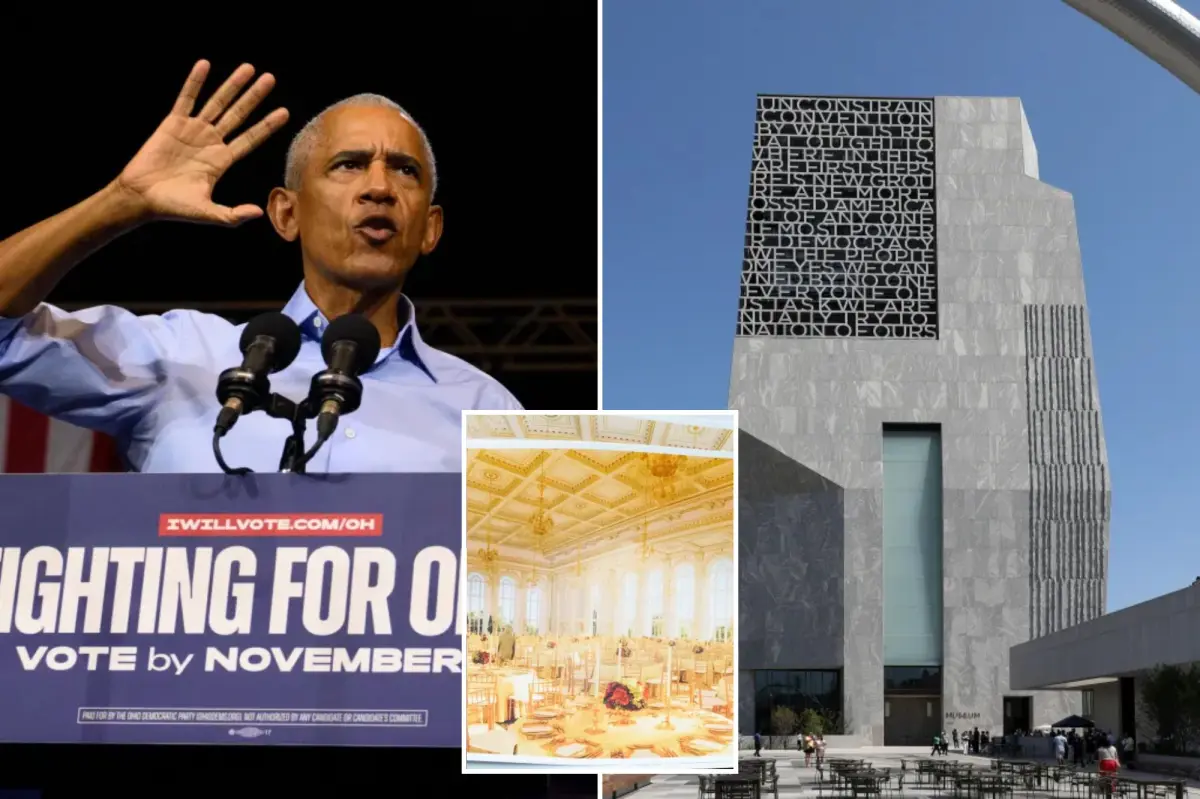
Politics has always had its fair share of sharp elbows, but every now and then a comment lands with such theatrical flair that it seems to hang in the air long after the applause dies down. That was exactly the scene in Ohio on a recent Saturday when former President Barack Obama stepped behind a microphone to rally Democratic voters and decided to take a very personal swing at his successor’s taste in interior design. With the easy, conversational tone of a man who has spent years on the speaking circuit, Obama observed that President Trump appeared far more invested in the look of the White House than in the lives of everyday Americans. “I mean, I don’t know if you’ve noticed, but he seems very focused on home renovations,” Obama mused, before delivering the punchline that would soon ricochet across social media: “He should be on HGTV.” The crowd may have chuckled, but Obama wasn’t finished. He then reached for the kind of vivid, absurdist comparison that has become his signature—the White House, he said, was starting to look like “Saddam Hussein opened a Cheesecake Factory.” The image was deliberately garish, a mixture of authoritarian excess and suburban chain restaurant kitsch, and it was clearly designed to portray Trump as someone who cares more about gold-plated aesthetics than the struggles of ordinary families. For Democrats, it was a moment of cathartic humor. For Republicans, it was an opening they had been waiting for, because if there is one thing that conservative media loves more than a clever insult, it is the discovery that the person delivering it is standing in a very fancy glass house of his own.
Paragraph 2:
Almost before the echoes of Obama’s joke had faded, the counterattack came streaming out of the right-leaning corners of the internet, and it was merciless. The core argument was simple: Barack Obama, of all people, should not be lecturing anyone about architectural restraint or tasteful decoration. The proof, as his critics saw it, was sitting in Chicago in the form of the Obama Presidential Center, a sprawling, towering structure that has drawn comparisons to everything from a medieval fortress to a supervillain’s lair. The building, with its massive stone-like walls and monumental scale, has been affectionately and not-so-affectionately nicknamed the “Obamalisk” and the “Death Star,” and on the day of Obama’s speech, those nicknames came roaring back into circulation. Republican communications strategist Matt Whitlock captured the sentiment with a single, withering line: “The guy who designed this wizard prison for himself has thoughts on aesthetics?” Another commenter, riffing on the building’s heavy, industrial look, called it an “intergalactic porta potty.” The message was unmistakable: before you mock someone else’s palace, take a long look at your own monument. It was a classic case of political irony, and it demonstrated that in the age of instant reaction, no rhetorical stone goes unturned. The fact that Obama was campaigning on a message of economic empathy only made the contrast starker to his detractors. Here was a man who had greenlit an enormous, costly personal legacy project, they argued, mocking a sitting president for wanting a nicer ballroom. The debate shifted almost instantly from the content of Obama’s speech to the aesthetics of his own legacy—a sharp reminder that in American politics, the fastest way to attack someone is not to debate their ideas, but to hold up a mirror.
Paragraph 3:
For those unfamiliar with the Obama Presidential Center, the criticism carries some weight thanks to the project’s troubled, expensive history. The center, which officially opened its doors in Chicago on June 19, has been in the works for years, and its price tag has expanded dramatically from initial projections. The Obama Foundation now estimates the total cost at a staggering $850 million, which is hundreds of millions above early figures that were already considered ambitious. Along the way, the project has faced its share of legal challenges, community opposition, and construction disputes. Some subcontractors have publicly alleged that they are owed millions of dollars for work already completed, and while the foundation’s construction manager is technically responsible for resolving those contractual disagreements, the cloud of controversy has lingered. For critics on the right, this is not just a side note—it is the entire point. When Obama jokes about Trump’s expensive renovations, they argue, he is conveniently ignoring the fact that his own presidential library is a massive public and private undertaking that has consumed enormous resources. The building’s design, often described as rugged and monumental rather than warm and inviting, has become an easy target for mockery. To some, it resembles a modern-day fortress, a place that seems more built to withstand a siege than to welcome curious schoolchildren. To others, it looks like something out of a science-fiction epic, a dark, angular structure that would feel right at home in a galaxy far, far away. Whether or not these comparisons are fair, they have become part of the public conversation, and they make Obama’s quip about Trump’s Cheesecake Factory decor feel, to many, like a case of selective memory. The irony is thick, and every time a Republican says “Death Star” online, the point is driven home a little further.
Paragraph 4:
But there was another layer to this story, one that had less to do with architectural criticism and more to do with class, taste, and the way Americans view their own pleasures. By using the Cheesecake Factory as a punchline, Obama touched a nerve that had nothing to do with politics. For millions of families across the country, the Cheesecake Factory is not a symbol of tacky overindulgence—it is a treat, a special occasion destination, a place where you can celebrate a birthday, an anniversary, or a promotion with an enormous menu and a slice of cheesecake the size of your head. The chain has become a beloved institution, the kind of restaurant that makes people feel both comfortable and a little bit pampered. So when Obama casually name-dropped it as the finishing touch on an insult about authoritarian décor, many ordinary Americans felt that he was not just attacking Trump, but sneering at them. The response on X was immediate and personal. “Does Obama not understand that to most Americans the Cheesecake Factory is a very nice and fancy restaurant?” one user asked, perfectly capturing the disconnect. Another wrote, with even sharper sarcasm, “Classic Obama snobbery. Cheesecake Factory is a great option for people who can’t afford a private chef at their Martha’s Vineyard estate.” It was a classic accusation of elitism, and it managed to make the former president look out of touch in the same breath that he was trying to connect with working-class voters. The internet loves nothing more than a good class warfare debate, and this one had all the ingredients: a wealthy former president, a beloved chain restaurant, and a sitting president who lives in a building full of gold fixtures. The entire episode served as a reminder that taste is deeply personal, and that when public figures mock the preferences of ordinary people, the backlash can be swift and furious.
Paragraph 5:
Of course, none of this happened in a vacuum, and the Trump administration has done very little to discourage the idea that the president loves a good renovation project. Trump has long been associated with grand, flashy aesthetics—gold-tinged penthouses, marble floors, and sweeping ballrooms—and the White House under his watch has been no different. Among the proposed projects that have made headlines is a new White House ballroom, announced in July 2025, which would provide a permanent venue for major events and accommodate up to 650 seated guests, more than triple the current capacity of the East Room, which maxes out at around 200 people. There have also been plans for a revamped Rose Garden and a helipad on the South Lawn, all in the name of modernization and functionality. But the ballroom, in particular, has become a point of contention. The White House initially estimated the price tag at $200 million, but a contractor’s estimate obtained by The Washington Post suggested that the broader project could cost as much as $600 million, a serious jump even by Washington standards. What made the situation even more awkward was the question of who would pay for it. Trump had previously indicated that private donors would cover the cost, but reports suggested that a substantial portion could ultimately come from taxpayer dollars, an issue that has drawn criticism from watchdog groups and Democrats alike. For the administration, the ballroom is a necessary upgrade, a way to hold events in a space worthy of the modern presidency. For critics, it is a symbol of excess, a monument to the very kind of self-indulgence that Obama was trying to highlight in his Ohio speech. The irony is that both presidents now find themselves in the same boat, defending expensive, high-profile building projects while trying to position themselves as champions of the common people.
Paragraph 6:
In the end, the entire exchange was less about architecture and more about the enduring nature of political rivalry. Obama and Trump represent two very different visions of America, not just in policy but in style, temperament, and even the way they choose to leave their mark on the physical world. Obama’s Presidential Center is grand in a solemn, civic-minded way, a statement about legacy and permanence. Trump’s White House renovations are grand in a luxurious, entertaining way, a statement about power and presence. Both men, it seems, love big spaces and bigger statements, and both are more than happy to spend other people’s money—or their own—to achieve them. The real tragedy is that a political debate that should be about pressing issues like the economy, health care, and the future of democracy can quickly devolve into a shouting match about cheesecake and stone towers. But that is the world we live in, a world where every joke is dissected, every building is photographed, and every contradiction is amplified for maximum damage. If there is a human lesson to be taken from this strange episode, it is that no one—not a former president, not a sitting president, not any of the rest of us—is entirely consistent. We all laugh at the excesses of others while quietly enjoying our own indulgences. The Cheesecake Factory will survive the insult, the Death Star will keep its nickname, and the White House will probably get its ballroom. And within a few news cycles, something else will come along to stir the pot. But for a moment, politics felt a little more personal, a little more petty, and a lot more human—because nothing reveals more about us than the things we choose to build, mock, and defend.