



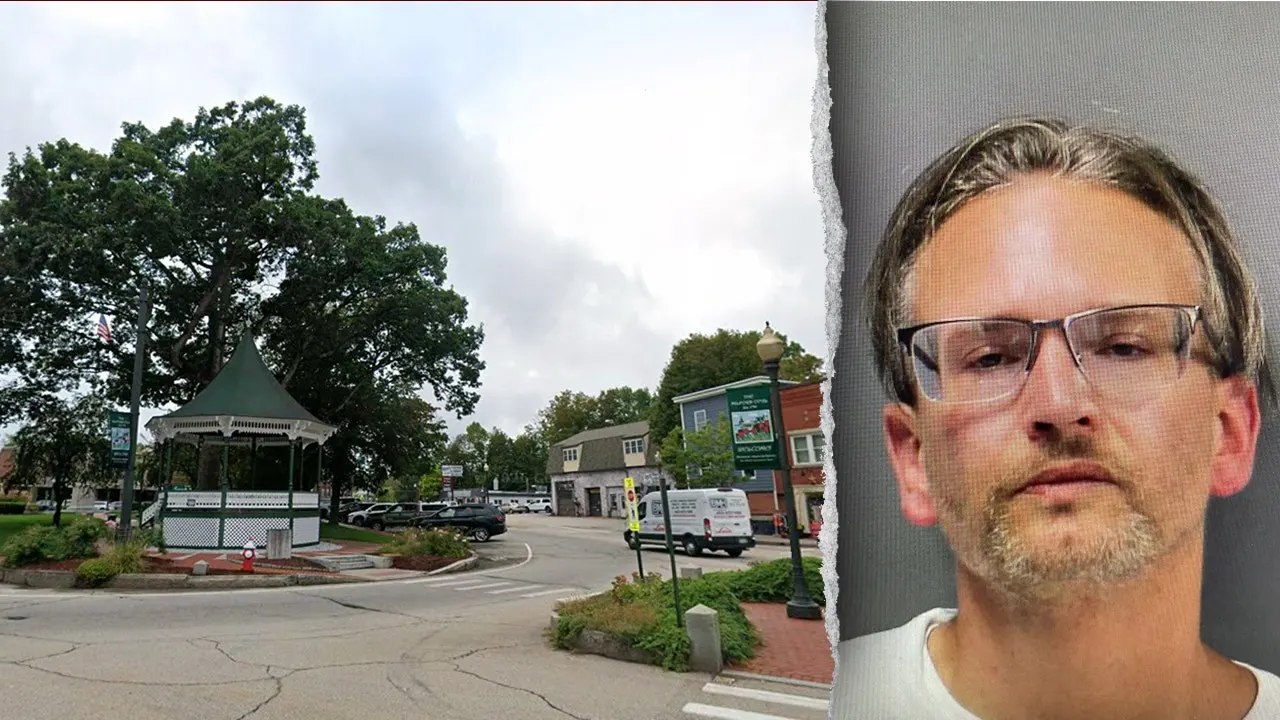
In the late summer of 2003, the town of Milford, New Hampshire, was about to discover something horrible behind the door of an ordinary home. A relative had asked police to check on Paul Herlihy, a fifty-year-old man living alone, and when officers arrived, they found the house quiet and unreachable from the front. They entered through an open window, and the first thing that struck them was not a person but a smell—thick, putrid, unmistakable. Hundreds of flies were buzzing through the rooms, and the air felt heavy with death. On the kitchen floor lay Paul Herlihy’s body, wrapped in carpet and covered with a blue tarp, as if someone had tried to hide both the man and the crime. The room around him told the rest of the story: blood spatters marked the cabinets, the refrigerator, the walls, and the ceiling. What had happened there was not an accident or an exit from a life quietly ended. It was violence, sudden and savage, powerful enough to leave a human being broken in his own home. The autopsy would later show blunt-force trauma so severe that Paul’s skull was fractured, his nose and jaw damaged, his voice box injured. The person who took his life had not stopped after one blow. They had struck again and again, until the man was gone. And somewhere in that violent act, a seventeen-year-old boy—Paul’s own son, Douglas Herlihy—became the only one who truly knew what had happened on the kitchen floor, though it would take more than twenty years for the rest of the world to catch up to him.
The crime scene was a puzzle that law enforcement tried desperately to solve in the days and weeks that followed. Outside, in the backyard, directly below the bedroom of the teenager Douglas Herlihy, investigators found carpet and padding stained with blood. The bedroom window was open, and they came to believe that the blood-soaked materials had been pushed out from that very room. DNA testing suggested that the blood likely belonged to Paul Herlihy, but in 2003 that evidence alone was not enough to indict anyone. Inside Douglas’s bedroom, there was another clue, more disturbing than any forensic finding. A closet door was covered with a towel, and when investigators pulled the towel away, they found large handwriting scrawled across the door: “I WILL SEE YOU IN HELL.” The words were a teenage threat, or perhaps a confession, or possibly just the product of a troubled mind. But in the context of a murdered father, those words felt like a haunting message from beyond the grave. Yet no arrest was made. The killer remained unidentified, and the case grew cold. Paul’s body was taken, the house was eventually cleaned, but the question of who had killed him and why remained a wound in the community. The father and son had a turbulent relationship, one that had already involved violence and law enforcement before Paul’s death. Still, in the absence of a confession or a witness, the case stalled. For years, it sat in the cold case files, waiting for new science, new attention, or a moment when someone would finally speak the truth.
In the months and years after his father’s murder, Douglas Herlihy did not fade into the background of life. Instead, he collected arrests and encounters with police. There were drug charges, a stolen vehicle, and a pattern of behavior that suggested he had no respect for a system that could not catch him. In 2020, after another arrest, he told an officer that he expected the charges to be thrown out. “That’s what I do. I beat cases. I beat my first body when I was 17!” The officer later noted that he assumed Douglas was implying that he had killed people in the past. It was a chilling moment, a glimpse into the mind of a man who seemed almost proud of the violence that had shaped his life. But even those words were not enough to connect him legally to his father’s killing, especially since Douglas had consistently denied any involvement over the years. When investigators approached him in 2010 about the murder, he simply referred them to his attorney, and the conversation went no further. The cold case unit, however, never truly stopped working. The New Hampshire Department of Justice and its partners kept looking at old evidence, using new technology, and waiting for the pieces to finally fit together. It was patient, unglamorous work, but it eventually paid off. In June 2025, more than two decades after Paul Herlihy was found dead on his kitchen floor, an arrest warrant was issued for Douglas Herlihy. He was taken into custody in Saugus, Massachusetts, and later extradited to New Hampshire. The boy who had once been suspected of killing his father was now a forty-year-old man entering a courtroom, finally forced to face the past.
The justice that followed was not swift, but it was real. Douglas Herlihy pleaded guilty to manslaughter in the death of his father. He had originally been charged with two counts of second-degree murder and falsifying physical evidence, but the plea agreement reduced the charges to a single manslaughter count that carried a sentence of twelve to twenty-four years in the New Hampshire State Prison. A separate potential sentence of three and a half to seven years for attempting to falsify evidence was suspended for twenty years, meaning that Douglas would have the chance to avoid serving that additional time if he complied with the terms of his release. For the family of Paul Herlihy, there was no jubilant victory. They had asked for privacy, choosing not to speak with the media, according to the New Hampshire Department of Justice Cold Case Unit. The forty-year-old man who had admitted his role in the killing was going to prison, but no sentence could undo the loss of the father, the funerals, the years of wondering, and the terrible burden of knowing that the person responsible was someone the family had raised and loved. Douglas Herlihy’s attorney could not be reached for comment, leaving the case to speak through the facts and the legal documents. A sentencing hearing was scheduled for early 2027, adding another layer of waiting to a story that already contained far too much of it.
There is a reason that cold cases resonate so deeply with us. They sit in the dark, unresolved, and they remind us that the work of justice is not always immediate. It is often refused, delayed, dismissed, and then restored. New Hampshire Attorney General John M. Formella made this point clearly when he said, “This case is a reminder that the pursuit of justice does not end with the passage of time.” He praised the New Hampshire Cold Case Unit and its law enforcement partners for continuing to pursue answers even decades after the crime. He talked about persistence, patience, and determination—qualities that are rarely visible in the moment but become obvious when the final arrest is made. But behind that official statement lies a human truth: a man was murdered, and his son was the one accused of raising a hand against him. The father and son relationship, already turbulent and marked by prior violence, had been a battlefield long before the final fatal attack. There is no way to know all the pain that flowed through those darkened rooms in Milford, but the evidence suggests a family that had been struggling with anger and fear for years. The “I WILL SEE YOU IN HELL” message on the closet door is not just a forensic curiosity. It is a cry, full of rage and despair, from a young man who had somehow convinced himself that his father was his enemy. In that sense, the murder of Paul Herlihy was not just a crime. It was a breaking point, an explosion that had been smoldering for years.
When we step back from the details, the story of the Herlihys is a meditation on how time changes everything and yet changes nothing at all. The body is long gone, the blood has been cleaned, the carpet has been thrown away. The flies are no longer buzzing in the kitchen, and the town of Milford has likely moved on to other concerns. But the murder remains, etched into the lives of everyone who loved Paul Herlihy, and now into the legal record of his son. Douglas Herlihy will spend years in prison, but the deepest punishments are not always counted in years. He will live with the memory of what he did, the images of his father’s face, the sound of the blows, the smell of the tarpaulin. That is something that no plea deal can suspend or dismiss. The family, too, will live with an incomplete grief, because the person who caused their loss is also a person they once knew as a child. There are no clean endings in stories like this, only legal conclusions that provide some measure of accountability. Still, there is something powerful in the fact that a case from 2003 could still produce an arrest in 2025. It tells us that the world is not always forgetful, that science and vigilance can reach across decades. It tells us that those who commit terrible acts may escape for a time, but the truth has a way of waiting, breathing quietly in the dark until enough light finally arrives. And perhaps in that waiting, there is a small comfort for the rest of us—a reminder that justice can move slowly, but it can still move, even when the clock has been running for twenty years and the files have grown old.