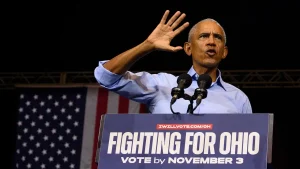


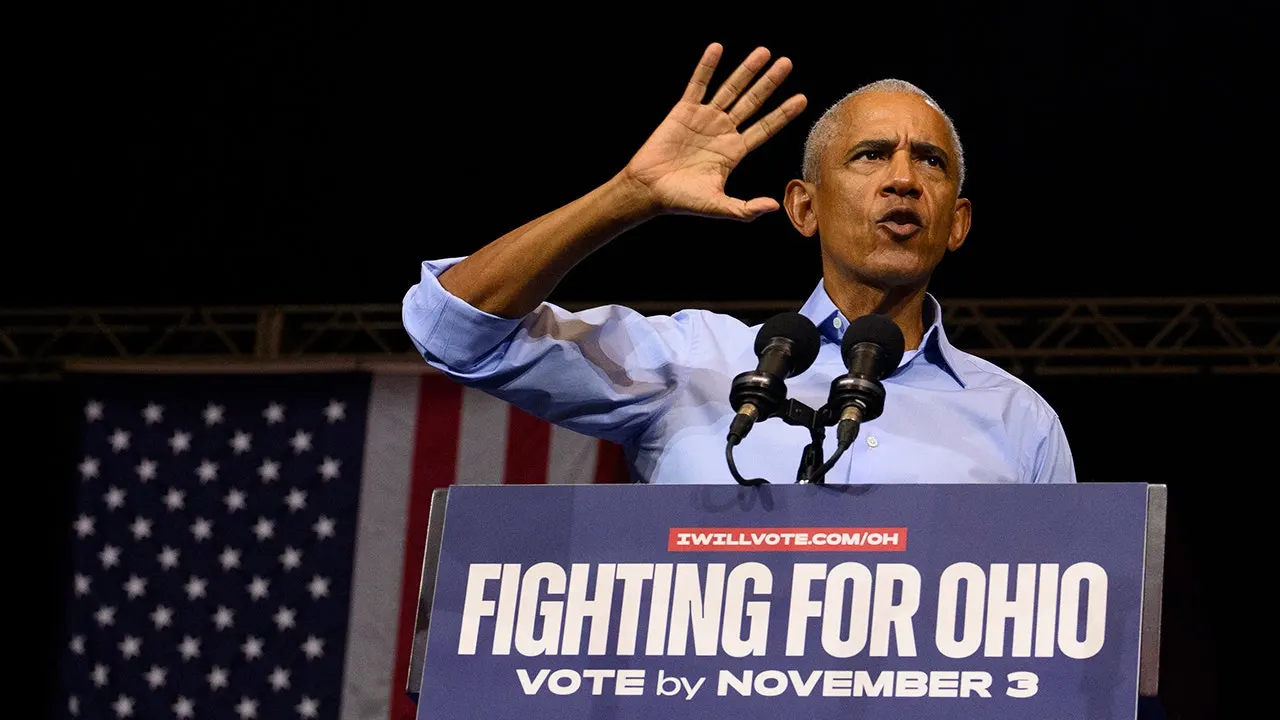
Barack Obama knows how to deliver a line. On a chilly Cleveland evening, with the midterm elections just ten days away, the former president stepped onto a rally stage not to talk policy tables or poll numbers, but to take a very personal swing at the man who now occupies the White House. Standing alongside Democratic gubernatorial candidate Amy Acton and Senate hopeful Sherrod Brown, Obama looked out at the crowd and zeroed in on something he clearly finds both baffling and ripe for mockery: Donald Trump’s taste in home décor. “I mean, I don’t know if you’ve noticed, but he seems very focused on home renovations,” Obama said with a smirk. “He should be on HGTV.” The crowd laughed, but the punchline was still to come. Obama rattled off a string of White House projects—a ballroom, a Rose Garden makeover, a South Lawn helipad—then loaded his biggest verbal cannon. “He’s got the White House looking like Saddam Hussein opened a Cheesecake Factory,” he quipped. It was the kind of image that sticks: gold everything, marble everywhere, a bizarre collision of authoritarian kitsch and chain-restaurant comfort. In one sentence, Obama managed to mock the president’s aesthetics, his priorities, and the sheer spectacle of it all. And in doing so, he framed the midterm choice as a referendum on maturity and focus. It was classic Obama—wry, polished, and devastatingly quotable—delivered in the voice of the cool dad who’s about to give you a lecture you didn’t ask for but secretly know you need to hear.
But beneath the one-liners, there was a serious argument being made about presidential priorities. Obama’s core point was that Trump is spending his time picking out drapes and paving stones while American families are worrying about gas prices, groceries, and the uncertainty of a volatile world. The former president’s mockery tapped into a broader frustration among Democrats that the White House has traded statecraft for stagecraft. And yet, if you actually look at the projects Obama mentioned, the story is a little more complicated than “Trump just wanted a nicer lawn.” The Rose Garden renovation, completed in 2025, replaced the central grass with limestone paving, a move that created a permanent patio for outdoor events and speeches. Traditional roses were kept around the perimeter, so the iconic look wasn’t entirely ditched. It was, the administration argued, a functional improvement—no more soggy shoes during East Room events dragged outside or muddy rows of folding chairs for dignitaries. The helipad, unveiled in September 2025, is a granite upgrade featuring a massive presidential seal, designed to handle Marine One with more grace and safety. The ballroom project, meanwhile, is supposedly aimed at giving the White House a permanent, secure space for large official functions, replacing the tents that have been thrown up on the lawn for decades. The National Park Service even produced an environmental assessment noting that the need for expanded event space had been identified as far back as 2000. So while Obama’s “Cheesecake Factory” jab made for great television, the reality is a mix of cosmetics and genuine logistics. Whether those upgrades justify the image of a president playing interior designer while the world burns is another question entirely—and that was precisely Obama’s point. He wasn’t just critiquing the gold trim. He was suggesting that a president so consumed with how the house looks is missing the people living in it.
There’s an irony in Obama’s critique that didn’t go unnoticed by his critics. The former president’s own legacy project, the Obama Presidential Center in Chicago, has become a monument to something far more expensive and controversial than a limestone patio. The center’s projected price tag has now blown past $1 billion—nearly triple the original $350 million estimate. It’s a granite-clad tower that critics have gleefully nicknamed the “Obamalisk,” a not-so-subtle nod to both its towering height and the pharaonic scale of the project. Subcontractors have alleged they’re owed millions for work already completed, and taxpayers have been left holding the bag for hundreds of millions in public infrastructure spending tied to the center, costs that exist entirely separate from the center’s own construction budget. The delays have stretched on for years, and what was once promoted as a beacon of community uplift has become, in the eyes of many locals and political opponents, a cautionary tale in grandiosity. Obama would no doubt argue that a presidential library is fundamentally different from a working residence—that his center is meant to inspire and educate, while Trump’s renovations are simply vanity. But to a cynic watching from Ohio, the contrast between Obama mocking a little gold paint while overseeing a billion-dollar granite monument named after himself might feel a bit, well, rich. The best comedy often contains a grain of truth, but it lands a lot harder when the person delivering it isn’t standing on a marble threshold of his own making. That kind of double-edged politics is nothing new, but it does complicate the moral high ground.
Obama, never one to stop at a single jab, moved from décor to diplomacy. He turned his attention to Iran, blaming Trump for starting a conflict that, in his view, nobody asked for and nobody voted for. The former president’s comments on energy costs and foreign policy were pointed: “Most importantly, he decided to start an unnecessary war that nobody asked for and nobody voted for.” Obama also reprised his defense of the 2015 nuclear deal, the Joint Comprehensive Plan of Action, which he described as the thing that kept Iran from getting a bomb. “Iran didn’t have nuclear weapons because I had put a deal in place that everybody knows kept them from getting nukes,” he claimed. Trump, of course, pulled the United States out of that agreement in 2018, arguing that its restrictions were temporary, that it gave Iran too much money too quickly, and that it ignored Tehran’s missile program and its backing of proxy militias across the Middle East. There is some truth on both sides. International inspectors did report Iranian compliance during the years the deal was in effect, and Iran did accelerate its uranium enrichment after the U.S. walked away. But the deal was never a permanent solution; it was a stopgap, and critics argued it simply delayed the inevitable while releasing billions in frozen assets that Iran used to fund mischief abroad. Obama’s framing of it as a flawless achievement glosses over those imperfections. And yet his broader point—that military confrontation carries unpredictable costs, and that a president should be careful about stumbling into a regional war—resonated with a weary public that has watched fuel prices climb and overseas entanglements drag on. By using Ohio as his stage, Obama was speaking to the kinds of workers and families who feel those economic shocks at the pump and the checkout line, and his message was simple: this didn’t have to be the way things are.
The setting of the speech mattered as much as the words. Ohio was a state Obama won decisively in both 2008 and 2012, but it has since drifted hard into Trump’s column, backing him in all three of his presidential runs. Rallying there for Acton and Brown was, on its face, an uphill climb. Amy Acton, a former physician and public health leader who became well-known during the COVID-19 pandemic, is challenging Vivek Ramaswamy for the governor’s mansion. Ramaswamy, a biotech entrepreneur turned national political firebrand, has positioned himself as the heir to Trump’s America First movement. Sherrod Brown, a longtime Democratic senator with a scrappy, working-class persona, is fighting to keep his seat against Republican Jon Husted, another Trump-aligned conservative. Obama’s presence was a reminder of a time when Ohio was truly a bellwether, a place where a Democrat with the right message could connect with labor unions and middle-class voters. But that era has faded. The state’s politics have become more polarized and more nationalized, and Obama’s appeal—once forged in “hope and change”—now sounds like an echo from a different political age. Still, he came, because that’s what party figures do in the homestretch, especially when the map looks challenging. He brought his signature charisma and a set of jokes that made the crowd feel good, even if the math is steep. Whether those comments move actual voters is another matter, but on that November weekend, the former president was doing what he does best: reminding Democrats what it feels like to have someone speak with confidence and a little wit.
When you strip away the gags and the glitter, Obama’s speech was a last-minute plea to a state that left him behind. He wasn’t just making fun of Trump’s love for chandeliers; he was trying to convince everyday Ohioans that their own kitchens and living rooms matter more than the White House’s. The choice he laid out was stark: a president focused on his own residence versus a government focused on the people’s residence—which is to say, the country itself. But human beings are complicated, and so is politics. People can disagree about whether a stone patio is a waste of money or a wise investment in the presidency’s long-term operations. They can debate whether the nuclear deal was a diplomatic triumph or a dangerous illusion. They can even laugh at a joke about Saddam Hussein and cheesecake while simultaneously thinking, “well, that White House does look pretty nice.” Obama’s critique was powerful because it made Trump the butt of a joke, but it was also a gamble—because jokes don’t win elections in places where the other guy’s message has become part of the community’s identity. As the rally ended and the crowd spilled out into the Cleveland evening, the cheers faded into the quiet reality of the next ten days of campaigning. At the end of the day, Obama did what he came to do: he humanized the stakes, attached a punchline to a policy argument, and reminded everyone that politics is as much about feeling as it is about facts. Whether Ohio listens is an open question, but one thing is certain—old speeches, like old houses, always have a way of being renovated.