


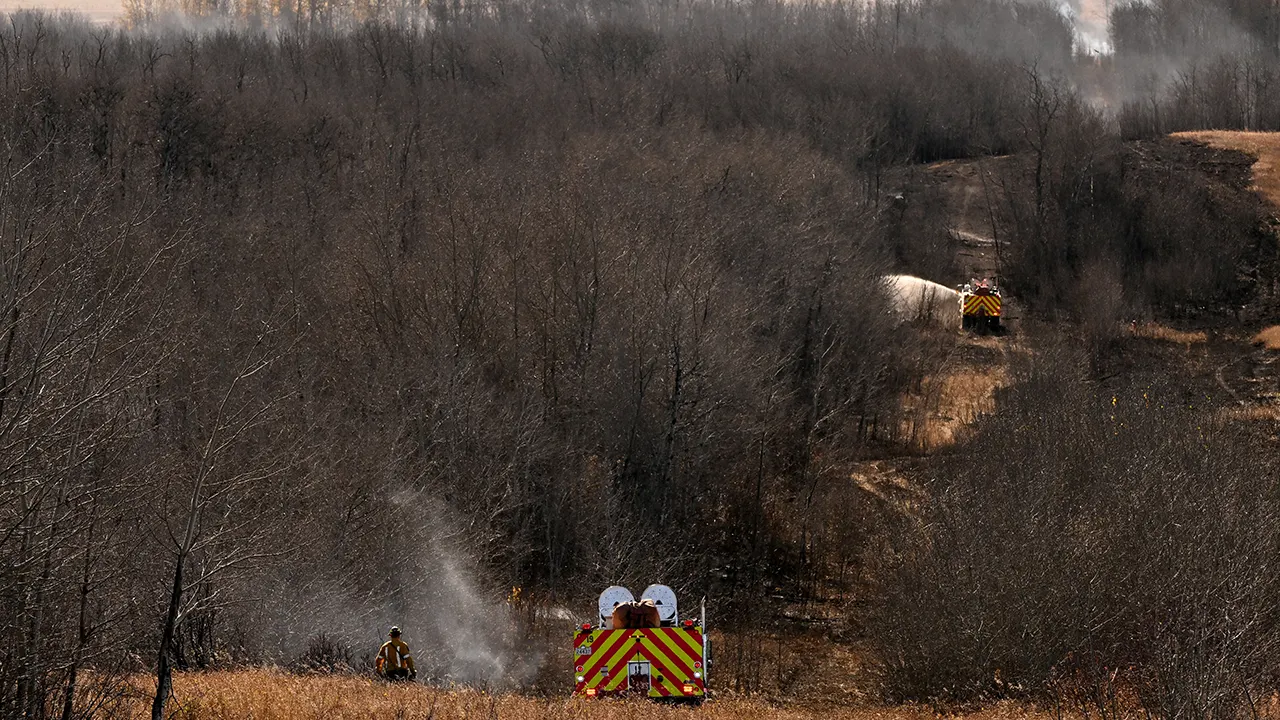
Nothing about the immense, windswept landscape of Canadian Forces Base Wainwright, Alberta, hinted at the tragedy that was about to mark itself into the history of Canada’s armed forces. Soldiers were deep into a live-fire training exercise on Saturday—the kind of realistic, high-stakes preparation that military units have relied on for generations to hone their skills and sharpen their readiness. The land around them was dry and open, and a fire had been burning in the area for hours. Commanders watched it closely and believed it was contained enough for the training to continue. Then, in a heartbeat, the wind betrayed them. A sudden, violent shift in wind direction transformed what seemed like a manageable blaze into a fast-moving wall of flames that raced toward the soldiers with terrifying speed. Maj. Gen. Wade Rutland, commander of the Edmonton-based 1st Canadian Division, would later describe the horrifying suddenness of the disaster in simple, devastating terms: the fire had been about a kilometer away when the wind shifted. That distance meant nothing. The blaze covered it in roughly 36 seconds—a speed that Rutland called completely abnormal. There was no time to sound a clear warning, no time to run. The fire swept through the training area, leaving behind death, chaos, and wounds that would be counted in both bodies and spirits.
When the smoke began to clear and the first casualty reports reached command, the scale of the tragedy became achingly clear. Four soldiers had lost their lives—young men who had put on their uniforms that morning expecting another day of demanding but routine training. They were identified by the military as Sgt. Morgan Wong and Privates Shaun Farrell, Aidan Goulding, and Hayden Lykkemark. Sgt. Wong served with the Loyal Edmonton Regiment, an infantry unit with deep roots in the city of Edmonton. The three privates—Farrell, Goulding, and Lykkemark—were members of the 3rd Battalion, Princess Patricia’s Canadian Light Infantry, one of the most storied regiments in the Canadian Army. All four were attached to the Edmonton-based battalion, meaning they trained together, lived together, and shared the particular bond that comes from serving in the same unit. They were more than names on a casualty list. They were sons, brothers, partners, and friends. They were soldiers who loved their country and believed in what they were doing. Their lives were cut short not on a distant battlefield, but on home soil, in a place where Canada’s military has trained for decades to prepare for exactly the kind of dangerous work they knew they might one day face. The loss of these four service members sent a shockwave through their unit, their families, and the wider Canadian military community, leaving a grief that will not fade quickly.
The toll of the burning grass and raging flames did not stop at those four deaths. Thirty-nine soldiers were rushed to medical care, their bodies burned, broken, or struggling against smoke inhalation. Of those, nineteen were listed in critical condition—young men and women clinging to life in hospitals far from the base. Eight were reported as stable, while twelve were being treated for less serious injuries. As the injured arrived at medical facilities, Alberta’s health system snapped into emergency mode. Several hospitals across the province activated what is known as a “Code Orange,” an emergency designation reserved for mass-casualty incidents, mobilizing additional staff and resources to handle the sudden influx of patients. The wounded were taken to hospitals in Wainwright, Edmonton, Red Deer, and Calgary—cities spread across the province, reflecting the scale of the emergency and the need to distribute patients across multiple trauma centers. Air ambulances from Edmonton and Saskatoon were dispatched to the base on Saturday to help transport the most critically hurt, flying through skies still thick with smoke to bring soldiers to the care they desperately needed. Doctors, nurses, paramedics, and support staff dropped everything to prepare for the wounded. They worked through the night alongside military medics, fighting not against flames but against time and trauma. The scene in those emergency rooms was both heartbreaking and heroic, as medical professionals confronted the human consequences of a disaster that had unfolded in a matter of seconds. Their work was a reminder that in the darkest moments, ordinary people rise to extraordinary challenges—and that the soldiers who were injured, like those who died, were surrounded by people determined to save them.
As the dust and smoke began to settle, military leaders and investigators started piecing together how such a catastrophe could happen on a training base in peaceful Alberta. Maj. Gen. Wade Rutland addressed the public with a mixture of sorrow and bewilderment, acknowledging that commanders had been aware of the fire for hours but had judged it contained enough to allow training to proceed. His words painted a picture of a natural force moving beyond human control. A kilometer is not a great distance, but for a fire to cross it in 36 seconds defies the normal behavior of a grassfire—and yet that is exactly what happened. The wind shifted, the fire exploded, and soldiers who had every reason to believe they were safe suddenly found themselves fighting for survival. Investigators have not yet determined what sparked the fire in the first place, and that question will be pursued with urgency in the coming weeks. Defense Minister David McGuinty spoke to the press with a tone of deep unease, saying he could not recall such an incident in his time as minister, nor in recent memory. The lived truth of that statement hung over every word. This was not a training accident involving a vehicle crash or a weapon malfunction; it was a natural force, whipped by weather into a killer, tearing through a place where soldiers were simply doing their duty. Through the night, military and civilian firefighters battled the flames, their own courage tested as intense winds continued to fuel the fire and push it ever closer to anything and anyone in its path.
Across Canada, the news of the tragedy triggered an outpouring of grief, unity, and gratitude for those who serve. Prime Minister Mark Carney called the blaze one of the worst peacetime tragedies to strike Canada’s armed forces on home soil—a phrase that carried enormous weight. In a country that has made significant sacrifices in overseas missions, the idea that four soldiers could lose their lives on Canadian ground, in a training exercise, felt almost impossible to comprehend. Carney announced that flags on federal buildings across the nation would be lowered to half-staff in honor of those killed and those injured, a visible symbol of a country in mourning. He also took a moment to praise the emergency crews and medical personnel who fought through the night, not only extinguishing the flames but also tending to the wounded and grieving. The act of lowering the flag is more than ceremony; it is a recognition of a shared loss, a way for Canadians who will never know these soldiers by name to nonetheless honor their sacrifice. For families and friends, the flag is a small but meaningful gesture. For the soldiers who served alongside the fallen, it is a reminder that their brother- and sisterhood is seen and appreciated. For the nation as a whole, it is a moment to pause and reflect on the real human cost carried by those who volunteer to protect the country, and on the cruel randomness of a disaster that struck without warning and without mercy.
By the time Sunday broke over Alberta, the fire had crossed the base perimeter into the surrounding area, yet local officials said no evacuation orders were necessary—the blaze was not expected to spread beyond its existing boundaries. The immediate crisis had been contained, but the emotional and psychological aftermath was just beginning. Grief counselors would be needed for the soldiers who survived, especially those who watched their friends fall or who fought their way through the flames. The military community would need time to heal, to honor the dead, and to answer the difficult questions that every tragedy leaves behind. There will be investigations, reviews, and changes to training protocols, all intended to ensure that such a disaster never happens again. But no procedural change can bring back Sgt. Morgan Wong or Privates Shaun Farrell, Aidan Goulding, and Hayden Lykkemark. No report can erase the images burned into the memories of those who were there. What can be done, and what is being done, is to remember them. To hold their families close. To thank them for their service. To recognize that they made the ultimate sacrifice not far from home, but still in service to their country. In the days ahead, the silence of the parade grounds will be heavy with their absence. But the stories of their courage and their commitment will endure, carried by comrades, memorialized in regimental history, and honored by a nation that stopped, lowered its flags, and wept for the soldiers who never came home from training on a windblown evening in Alberta.