


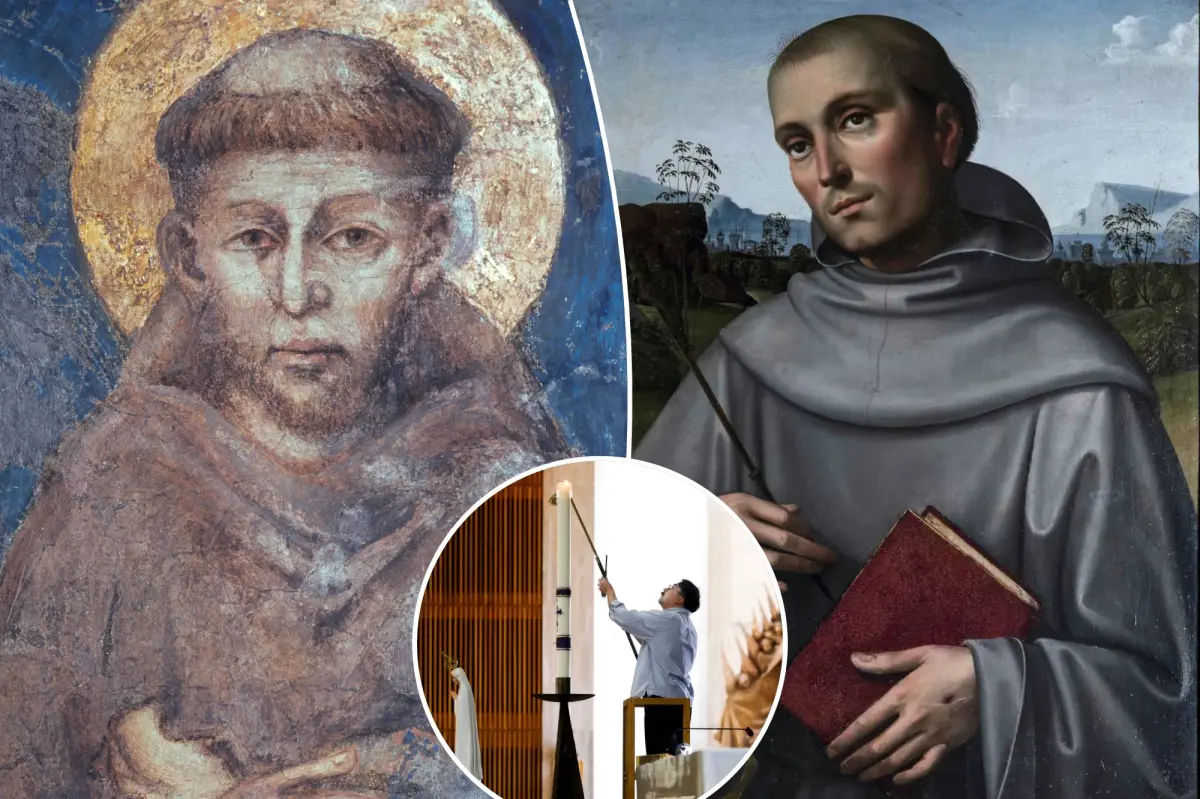
Something extraordinary is happening inside St. Mary’s Cathedral of the Assumption in San Francisco, and it has nothing to do with the usual Sunday crowd. Ancient relics from Italy — including an 800-year-old cloth stained with the blood of St. Francis of Assisi and an Italo-Byzantine painted panel that once covered his tomb — have arrived for an ultra-rare public display. These are not reproductions or artistic interpretations. They are actual objects that touched the body and life of one of the most beloved saints in history. And for the first time in eight centuries, they have left Italy. That alone is almost impossible to wrap your mind around. The cloth, encased in a silver reliquary, is small and fragile, a simple piece of linen that has somehow survived wars, earthquakes, centuries of devotion, and the passage of time. The painted panel, traditionally attributed to the Italian master Cenni di Pepo — better known as Cimabue — glows with gold leaf and shows Francis in his humble brown habit, standing with a halo, a book, and the marks of the stigmata on his hands and feet. Together, these relics turn a modern cathedral into a doorway to the Middle Ages. You don’t have to be Catholic to feel the weight of that. You just have to stand still and let the centuries wash over you.
To understand why a bloodstained bandage can stop people in their tracks, you have to know the story behind it. Francis Bernardone was born in Assisi in the late 12th century, the son of a wealthy cloth merchant. He spent his early years chasing adventure, dreaming of knighthood, and living the kind of privileged life that many would envy. But after illness, war, and a series of unsettling visions, Francis underwent a radical transformation. He renounced his inheritance, embraced a life of poverty, and began to see God in the most overlooked people and places. He kissed lepers, preached to birds, and spoke of Brother Sun and Sister Moon as if creation itself were his family. In 1224, just two years before his death, Francis retreated to the rugged mountain of La Verna for a 40-day fast. He was seeking God, but he found something far more mysterious. According to Catholic tradition, while deep in prayer, Francis saw a seraph with six wings, and when the vision faded, he felt both piercing pain and overwhelming love. He had received the stigmata — the spontaneous appearance of wounds on his hands, feet, and side, mirroring the crucifixion wounds of Jesus Christ. It was a mystical encounter that has fascinated believers and historians for centuries. And the bloodstained cloth now on display in San Francisco is linked directly to that moment. It was used to stanch the bleeding from his side. Think about that. This is not a painting of a miracle. This is the physical leftover of a miracle, a piece of cloth soaked in the blood of a man who lived, suffered, and loved so deeply that his body bore the marks of his faith.
The exhibition includes far more than just the bandage. The other major relic is the full-length image of St. Francis traditionally attributed to Cimabue, a masterpiece of Italo-Byzantine style that once covered the saint’s tomb in the Basilica of Saint Francis in Assisi. In the painting, Francis stands in the simple brown habit of the Friars Minor, a golden halo encircling his head, a book in his hand, and the stigmata wounds visible on his body. It is both a portrait and a sermon, a visual statement that humility and glory are not opposites but two sides of the same sacred mystery. The panel has been near the bones of Francis for centuries, absorbing the prayers of countless pilgrims who came to honor him. Alongside this treasure, visitors will find the Veil of St. Clare of Assisi, a poignant reminder of Francis’s closest spiritual companion. There are Renaissance paintings by Dono Dori, including “The Stigmata of St. Francis” and “Crucifixion of St. Francis of Assisi.” There is an anonymous 17th-century painting titled “St. Francis Watched Over by the Angels,” and a striking work by Adamo di Cladaro. Taken together, these pieces form a small but deeply moving museum of Franciscan art and devotion. The Church classifies the bandage as a “second-class” relic, meaning it was an item belonging to a saint, as opposed to direct remains like the fragmented kneecaps and ribs of St. Bernadette Soubirous that are also touring the United States this year. But second-class does not mean second-rate. A personal object, especially one stained with the blood of a saint, carries an intimacy that bones alone cannot convey. It whispers: this person was real. This person suffered. This person believed.
The Catholic tradition of venerating relics dates back to ancient times, long before cathedrals and golden reliquaries. Historians trace it to at least 156 A.D., when the early Christian community honored the remains of martyrs like Polycarp of Smyrna. From the beginning, believers understood that holiness takes flesh. It is not a vague idea floating in the sky; it is something you can touch, kiss, carry, and treasure. Relics became bridges between heaven and earth, tangible signs that ordinary human beings could be transformed by grace. For centuries, pilgrims have traveled thousands of miles to stand before the bones, clothing, and personal objects of saints. They come not out of superstition, but out of longing. They come to feel connected to something greater than themselves. In a world that often feels fragmented and disconnected, relics offer a rare kind of intimacy. They remind us that the past is not dead. The same God who sustained Francis in his doubt and pain is present now. The same grace that marked his body can mark our hearts. Standing before the bloodstained bandage, you may feel skepticism, curiosity, awe, or even tears. The relic does not demand belief. It invites you to wonder. It invites you to ask yourself: what does it mean to love so completely that your body becomes a witness?
How did these treasures end up in San Francisco? Through the tireless work of the Knights of Saint Francis of Assisi, a Catholic lay organization founded by attorney and former politician Angela Alioto. To mark the 800-year anniversary of the saint’s death, and the special jubilee year declared by Pope Leo XIV, the Knights worked to bring these relics to the city that bears Francis’s name. It was no small task. The relics were publicly displayed this year at the Basilica of Saint Francis in Assisi, but they have never before crossed the Atlantic. “Again, these relics have not left Italy in 800 years, and they won’t be back anytime soon. So please do the best you can and getting over to see this incredible little museo,” Alioto wrote on social media. Her words carry the urgency of someone who understands just how fleeting this opportunity is. The display runs through Nov. 28, and after that, the relics will return to Italy, possibly for another century or more. There will be no encore tour, no digital replica that can replace the presence of the real thing. The cathedral itself, with its sweeping modern architecture and quiet corners for prayer, becomes a pilgrimage site. Visitors can move slowly, breathe deeply, and let the centuries of faith settle around them. It is a once-in-eight-centuries moment, and it is happening right now, not in a distant basilica but in the heart of San Francisco.
In the end, this exhibition is not only for Catholics. It is for anyone who has ever felt broken, lost, or in need of hope. Francis of Assisi is the patron saint of San Francisco, but his message belongs to all of humanity. He gave away everything he owned, not because poverty was good, but because love was better. He embraced the outcast, cared for the sick, and found the face of God in animals, trees, and the simplest moments of daily life. In a city that is too often divided by inequality, technology, and loneliness, his relics arrive like a quiet challenge. What are we holding onto? What wounds are we trying to stanch? The bloodstained bandage is a reminder that our own wounds, too, can become sacred. They can teach us compassion. They can open our hearts to others. They can be the places where God meets us. Maybe you will come to the cathedral as a curious tourist and leave as a pilgrim. Maybe you will stand before the golden panel and think of your own longing for peace. Maybe you will simply feel a strange and beautiful connection to a man who lived 800 years ago and still has the power to move us. The doors are open. The relics are waiting. Eight centuries have brought them here, across oceans and generations, to a city named after a saint who had almost nothing and yet gave everything. Do not miss it.