



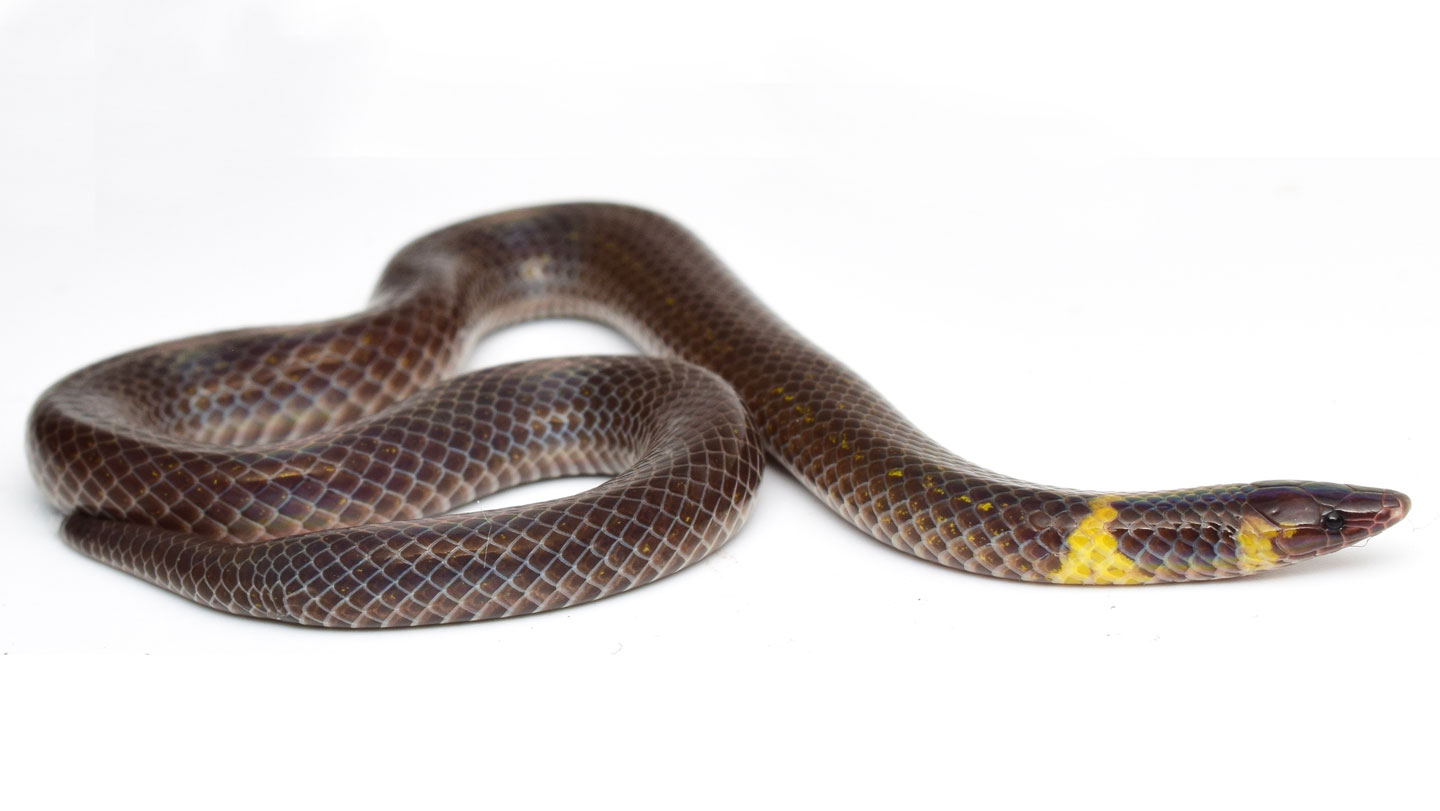
It sounds like something out of a cartoon: a tiny snake, no arms or legs, suddenly throwing itself into a series of backflips to escape danger. For most of us, the idea of a snake cartwheeling seems absurd—cartwheels require limbs, right? Apparently not. Deep in the rainforests of Southeast Asia, a group of dwarf reed snakes has turned this seemingly impossible feat into a survival strategy. These itty-bitty serpents, barely longer than a pencil, have developed a bizarre acrobatic escape that leaves even seasoned biologists scratching their heads. The first hints of this behavior surfaced in 2023, when scientists shared snapshots of a dwarf reed snake (Pseudorabdion longiceps) apparently cartwheeling away from a threat. But those were just still images. Now, thanks to a new study published in Current Biology, we have video evidence of these snakes tumbling down a racetrack in a laboratory, and the footage is both astonishing and delightfully strange.
The story begins with Yosuke Kojima, an ecologist at Toho University in Japan, who first heard about the behavior in 2019 from a colleague in Sarawak, Malaysia. The colleague described witnessing something “very weird”—a snake rolling away like a wheel. Intrigued, Kojima and his team traveled to Malaysia’s Kubah National Park to see for themselves. But finding these diminutive snakes was no walk in the park. The creatures measure only 11 to 28 centimeters long, and they are masters of camouflage. “They always hide under the leaves,” Kojima explains. Despite the challenge, the team managed to scoop up 11 Pseudorabdion saravacense, one P. collaris, and one P. longiceps, along with six Calamaria reed snakes for comparison. Then came the big question: would any of them actually cartwheel away from the researchers? “No,” Kojima laughs. “We are quicker than them.” The snakes apparently reserve their acrobatics for more credible threats. Undeterred, the team brought their reptilian performers back to the lab and set up a 2.2-meter-long racetrack, complete with cameras positioned above and to the side to capture every twist and turn.
What unfolded on that miniature track was nothing short of mesmerizing. With a gentle tap to encourage movement, each snake would begin its escape routine. The cartwheel starts with the snake coiling its body into a C-shape, lifting its head off the ground and orienting itself in the direction of travel. Then, in a flash, it whips its tail out behind it, launching itself into a brief airborne somersault. The tail flips forward and down past the head, and the moment it hits the ground, the snake is already primed for another roll. The effect is a continuous, tumbling wheel of serpentine motion, moving at speeds of 1.7 to 3.7 meters per second—roughly 6 to 13 kilometers per hour. For a creature that normally inches along the forest floor, this is practically supersonic. All of the Pseudorabdion snakes performed the maneuver, while none of the Calamaria snakes did, suggesting this is a unique talent of the dwarf reed snake lineage. Perhaps most impressive, the snakes kept their heads remarkably steady throughout the spinning, a feat reminiscent of flying snakes that stabilize their heads while gliding through the air. It’s as if they’re saying, “I’m making a quick getaway, but I’ll keep my eyes on the prize.”
The discovery raises a host of tantalizing evolutionary questions. How did such a strange and physically demanding movement evolve? What special adaptations—in anatomy, physiology, or neural control—allow these snakes to perform a feat that their close relatives apparently cannot? Jessica Tingle, a biologist at Brown University who was not involved in the study, finds the behavior absolutely captivating. “What a cool snake behavior,” she says. “I find it especially amazing that an elongate animal like a snake can manage to roll, especially given that they do it in such an explosive way, which probably asks a lot of their muscles and bones.” But the questions go beyond mechanics. Are the brains of dwarf reed snakes wired differently to coordinate such a rapid and unusual series of movements? Or do all snakes possess the basic equipment for cartwheeling, and it’s simply a matter of whether they’ve ever needed to use it? For now, these remain open mysteries. The study offers a rare glimpse into a behavior that seems almost too fantastical to be real, and it challenges our assumptions about what animals are capable of, even limbless ones.
There’s also a delightful historical footnote to this discovery. In the 1800s, some nature writers regaled readers with tales of “hoop snakes”—snakes that supposedly grasped their tails in their mouths and rolled downhill like hoops to chase prey or escape danger. For years, scientists dismissed these stories as tall tales or overly vivid imaginations. Jessica Tingle admits she was among the skeptics. “Some writers in the 1800s talked about ‘hoop snakes’ and described their motion as rolling, but that seemed pretty fantastical to me, and I chalked it up to overly inventive imaginations,” she says. The new video evidence doesn’t exactly match the old myth—the snakes don’t grasp their tails and form a perfect circle, and they roll horizontally rather than downhill—but it’s close enough to give those old stories a new lease on life. “Either way,” Tingle adds, “it’s neat to find out a real animal does something reminiscent of a fantastical old story.”
The study also underscores how much we still have to learn about the natural world, especially in biodiversity hotspots like Southeast Asia’s rainforests. These tiny snakes have likely been cartwheeling for millennia, yet it’s only now that we’re beginning to understand the mechanics and significance of their behavior. The next steps for researchers will be to explore the detailed biomechanics of the roll—how energy is transferred through the body, what muscles are involved, and how the snakes manage to keep their heads stable. Comparative studies with other snake species could reveal whether this is a derived adaptation or an ancestral talent that most snakes have lost. And then there’s the question of the snakes’ perspective: do they choose to cartwheel only in certain situations, or is it a default panic response? Observing them in the wild, where predators like birds, mammals, and even other reptiles might trigger the escape, would provide even deeper insights.
For now, the image of a six-inch snake breaking into a furious series of somersaults to dart away is a wonderful reminder of nature’s ingenuity. It’s a behavior that seems to defy physics and biology, yet it works perfectly for these little survivors. As scientists continue to unravel the secrets of the cartwheeling snake, one thing is certain: the more we look, the more we realize that the animal kingdom is full of surprises. So the next time you’re trudging through a forest and catch a glimpse of a tiny snake disappearing under a leaf, remember—it might just be preparing to show you a move you never thought possible. And if you ever wondered whether hoop snakes exist, the answer is: maybe not in the way the old stories claimed, but something even more wonderful is real. Sometimes, reality truly is stranger than fiction—and far more delightful.