




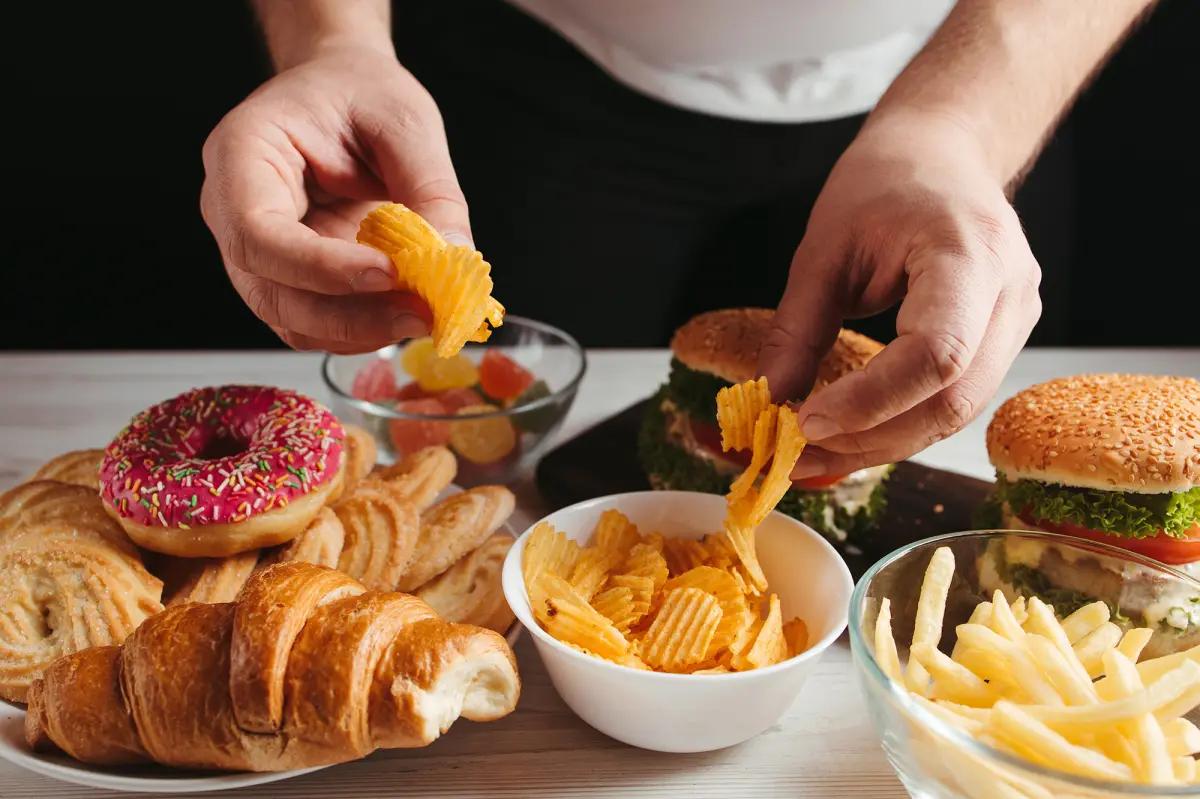
Think for a moment about the foods that fill your day. Maybe breakfast is a bowl of sugary cereal, a pastry from a wrapper, or a flavored coffee drink. Lunch might be a deli sandwich and a bag of chips; dinner often comes from a box or a drive-through. These foods are familiar, convenient, and easy to love. But a new Canadian study asks us to look at them more carefully. Researchers at McMaster University and Hamilton Health Sciences, with colleagues across Canada, used MRI scans to look inside the brains of about 9,000 adults. They found that people whose diets were heavy in ultra-processed foods—soft drinks, packaged snacks, sugary breakfast cereals, and similar products—were more likely to show small areas of brain damage, even though they considered themselves healthy and had no diagnosed heart problems. The findings, published in JAMA Network Open, suggest that these food choices may be linked to a higher risk of stroke and memory problems later in life. The difference was striking: those in the highest consumption group were about 40% more likely to have these brain changes than those in the lowest group. And because these changes do not cause obvious symptoms, they could go unnoticed for years, quietly accumulating in the background while life goes on as usual.
The brain changes the researchers saw are not the kind that suddenly incapacitate someone. They are small marks of damage that can be detected on scans but not felt in daily life. That makes them especially important. These silent changes can be early warning signs, showing up years before a stroke or cognitive decline becomes obvious. For the Canadian team, these findings came as a surprise. Russel J. de Souza, the first author of the study and an associate scientist at the Population Health Research Institute of McMaster University and Hamilton Health Sciences, said that this kind of damage is usually seen in older adults or in people with conditions like heart disease, diabetes, or high blood pressure. But the people in this study were middle-aged Canadians who had no heart problems and reported no other health concerns. They were, in many ways, ordinary people going about their lives, eating what most of us eat, and feeling fine. The fact that such changes could already be visible in their brains is a quiet wake-up call. It suggests that the connection between diet and brain health is not something that only matters in retirement. It matters now, in the middle of busy working lives, while we are raising families, building careers, and trying to get through each day. We may not feel the effects today, but the choices we make with our forks could be writing a story that our future brains will have to live with.
The study included participants between the ages of 35 and 69, all of them middle-aged and generally healthy, though some had risk factors like extra weight. Participants who consumed the most ultra-processed foods also tended to carry more body fat, particularly visceral fat—the deep abdominal fat that wraps around organs and has been linked to heart disease and metabolic problems. This aligns with other research linking ultra-processed diets to weight gain and inflammation. But the brain connection was seen even in people who did not have obvious health problems, and it was especially pronounced in women. While the overall 40% increase was striking, women in the highest consumption group had nearly twice the likelihood of showing signs of brain damage compared to women in the lowest group. The exact reason for this sex difference is not clear; hormones, body composition, and differences in how men and women process certain foods might all play a role, but the researchers did not explore that in depth. Sonia Anand, the senior author of the study and a senior scientist at the Population Health Research Institute, said that the findings suggest the link between diet and brain health may be detectable before people experience noticeable problems with memory or thinking. That is both concerning and hopeful: concerning because damage may begin early, but hopeful because diet is something we can change. We cannot rewind time, but we can make different choices from this point forward, and those choices might help protect the brain we are going to need for decades to come.
What makes a food ultra-processed? It is not simply about being made in a factory. Foods like canned vegetables, frozen fruit, or plain yogurt are processed but still recognizable. Ultra-processed foods go much further: they are formulated with industrial ingredients, preservatives, artificial colors, sweeteners, and other additives to be cheap, shelf-stable, and almost irresistibly tasty. The U.S. Centers for Disease Control and Prevention points out that these foods are often low in fiber, vitamins, and minerals, and high in sodium, saturated fats, and added sugars. The American diet, as a result, is full of them: federal data published by the CDC in August 2025 showed that between August 2021 and August 2023, ultra-processed foods contributed about 55% of total daily calories for Americans ages one year and older. The participants in the Canadian study were not quite that high—ultra-processed foods averaged about 25% of their daily food intake—but the range was broad. People who ate the most ultra-processed foods also ate fewer nutrient-dense foods. As ultra-processed intake climbed, intake of fruits, vegetables, whole grains, legumes, and other real foods fell. Sonia Anand acknowledged that these foods are convenient and widely available, which helps explain why they dominate so many pantries and refrigerator shelves. But she also noted that diets high in these foods may be linked to brain changes that could eventually lead to memory loss and stroke. It is not about demonizing a single snack; it is about recognizing that the overall pattern of eating matters.
Looking at the two ends of the spectrum makes the pattern clear. Among participants who ate the largest amount of ultra-processed foods, whole foods such as fruits, vegetables, and grains accounted for only about 41% of their daily intake. Among those who ate the least ultra-processed foods, whole foods made up 68% of daily intake. That is a large difference, and it suggests that ultra-processed foods are not merely replacing calories; they are displacing the very foods that nourish the brain and body. Still, the researchers are careful not to say that ultra-processed foods directly caused the damage. This was an observational study, not a controlled experiment. Participants were evaluated one time, and no one followed them forward to see what happened later. It is possible that other unmeasured factors—income, stress, sleep, physical activity, access to health care—contributed to both dietary habits and brain changes. That does not make the finding useless; it means the next step is deeper. As de Souza explained, “We need longer-term studies that track people over time with repeated MRI scans to find out whether reducing ultra-processed food intake can slow or prevent these brain changes.” He also said that follow-up research is already in the works. Until those results come in, the current study stands as a strong signal, even if it is not the final word. It gives us a reason to pause and look at our plates with fresh eyes.
So what can we do with this information? We do not need to panic, and we do not need to promise ourselves a perfectly clean diet overnight. The study does not say that one bag of chips or one fast-food meal will damage your brain. It points to a pattern, a way of eating that stretches over months and years. And because it is a pattern, we can change it piece by piece. Maybe it means swapping a sugary breakfast cereal for oatmeal with fruit and nuts. Maybe it means carrying an apple or a handful of unsalted almonds instead of stopping at the vending machine. Maybe it means choosing water or unsweetened tea instead of soda, and adding an extra serving of vegetables to dinner, even if the rest of the meal is not perfect. Small shifts like these, repeated day after day, can move the balance toward more whole foods and fewer ultra-processed ones. The researchers are not saying that every ultra-processed food is poison; they are saying that the overall pattern matters and that the brain may show the effects earlier than we expect. Our brains are with us every moment, quietly managing our thoughts, memories, movements, and dreams. They deserve foods that support them, not ones that may slowly damage them. This study is a reminder that eating well is not just about fitting into a certain size or avoiding heart disease. It is about protecting the mind that makes us who we are. Today’s meals are tomorrow’s memories, and we have more control than we often realize.