


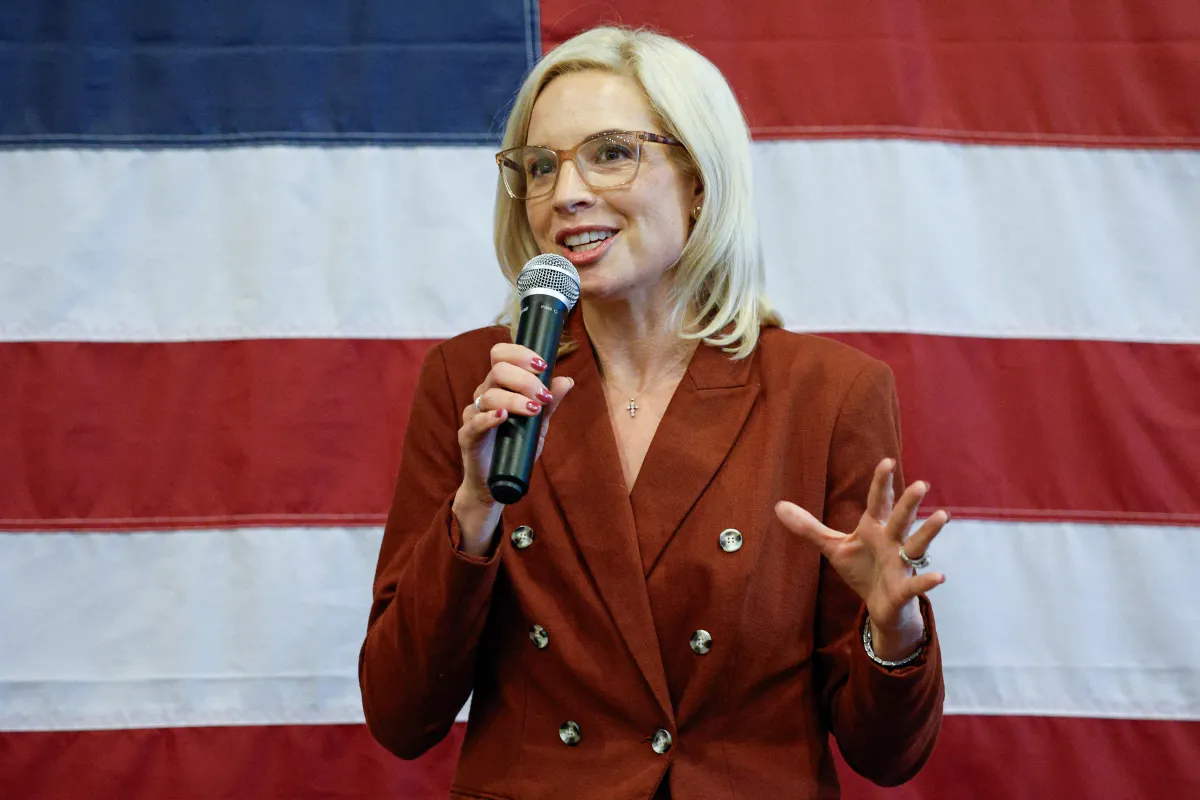
It started with a simple, off-the-cuff request on a campaign stop in Fort Dodge, Iowa. Republican Senate candidate Ashley Hinson was in the middle of her statewide bus tour, trying to fire up supporters and push them toward the polls, when she asked for a little help with the road ahead. “Use that anger about these lies that they’re telling about us on TV, cause if they’re willing to lie about me, they’re willing to lie about you,” she said, her voice carrying the urgency of a candidate in a tight race. “So I want you to channel that into action in getting your friends out to vote, help give us a little gas money for our bus, make sure we’re showing up at the polls, because there is more to do.” It was the kind of loose, folksy appeal that politicians make all the time, the sort of thing that usually gets a laugh and a few small donations. But in this particular moment, in this particular state, with gas prices hovering near record highs and farmers watching their diesel costs soar, the phrase landed like a lightning bolt. It didn’t take long for the opposition to turn that casual ask into a political weapon.
Democratic challenger Josh Turek seized on the remark with obvious relish, and his response cut straight to the heart of what many Iowans were already feeling. “Now she’s begging for gas money while Iowans are struggling to fill up their tanks and Iowa farmers are struggling to afford the diesel to harvest their fields,” he wrote on X. “That’s shameful.” The timing made it especially potent. AAA data at the time showed Iowa’s average price for regular gasoline was about $4.14 a gallon, a staggering jump from roughly $2.72 just a year earlier. Diesel was even worse, averaging about $6.07 a gallon compared to around $3.43 the previous year. Those aren’t just numbers on a sign outside a convenience store; they are the difference between a family taking a weekend trip and staying home, the difference between a farmer making a profit and barely breaking even. Nationally, AAA noted that gasoline prices were unusually high for that time of year, with crude oil costs staying stubbornly elevated. For rural Iowans, for truckers, for anyone who depends on a full tank to get through a day’s work, the phrase “gas money” from a politician’s lips was not just ironic. It felt dismissive. And Turek made sure nobody missed the point, tying her request to her record on the Iran war and casting her as out of touch with the economic pain behind the pump.
The “gas money” moment didn’t happen in a vacuum, and it quickly became tangled up in the candidates’ broader clash over foreign policy and the cost of living. Fuel prices had already been a major theme in the Iowa Senate race, largely because of the ongoing conflict with Iran. During their final debate, Turek argued that the war was directly driving up gasoline, diesel, and agricultural input costs across Iowa, and he accused Hinson of having voted seven times to continue the conflict. Those votes, he said, were proof that her policies were hurting the very people she now wanted to fuel her campaign bus. Hinson defended herself, insisting that she wanted the war to end but that the United States needed guarantees that Iran would not develop a nuclear weapon. She said she trusted the American military to achieve that objective, and she pushed back against the idea that ending the conflict was as simple as a single vote. But both candidates found common ground in rejecting the Trump administration’s move to ease sanctions on Russian diesel imports. “We need to lower diesel prices, but I don’t think we need to be making a deal with Russia to do it,” Hinson said during the debate. Turek agreed, saying lower prices shouldn’t come at the expense of benefiting Russian President Vladimir Putin. From there, each candidate offered a different path forward. Hinson suggested temporarily lowering the gas tax, creating a diesel rebate program for agricultural producers, and expanding American biofuels. Turek proposed temporarily suspending federal and state gas taxes, suspending diesel exports, and tapping into strategic oil reserves. But the underlying question was the same: what can Washington actually do to make life more affordable for ordinary Iowans?
What made Hinson’s “gas money” comment so politically dangerous was not just the timing, but the broader context of an election where every dollar feels like a decision. Iowa is a major agricultural state, and diesel isn’t just a transportation cost for farmers; it’s the lifeblood of harvest season. When fuel prices spike, the effects ripple through the entire economy, from the cost of fertilizer to the price of groceries. Political science professor Karen Kedrowski of Iowa State University noted after the debate that Hinson’s decision to break with Trump over Russian diesel imports was significant in an agriculture-heavy state, where rural voters feel fuel costs directly at the pump and in their field equipment. Steffen W. Schmidt, another political science professor at Iowa State, suggested that Turek could gain ground by making fuel prices a central part of his attack on Hinson. “In a contest that’s this tight and close, I would not be surprised to see Turek catch up with and pass Hinson, especially since he effectively connected her to wealthy Americans and Trump-related gas and diesel price hikes,” Schmidt said. The gas-money remark gave Turek another opportunity to make that case, turning a moment that might have been a harmless campaign trail aside into a powerful symbol of everything his campaign was trying to say. It was, in a strange way, the perfect political gift: Hinson asking for help paying for a bus, while her constituents were just trying to figure out how to afford the trip to town.
That gift may matter more than usual because the Iowa Senate race is remarkably tight. Hinson and Turek are competing for the open seat being vacated by retiring Republican Senator Joni Ernst, and the contest has become one of the most closely watched Senate battles of the midterms. A Marist Poll conducted in mid-October found Turek leading with 48 percent of likely voters compared to Hinson’s 45 percent, though the margin of error of plus or minus 6.6 percentage points made it essentially a dead heat. A YouGov survey around the same time showed Turek at 47 percent and Hinson at 46 percent, again within the margin of error. There were also polls showing Hinson narrowly ahead, including an Emerson College survey that put her at 47 percent and Turek at 45 percent. The split results reflected a genuinely competitive race, one that is all the more remarkable because Iowa is a state Trump won by more than 13 percentage points in 2024. That a Democratic challenger could be running so close in a deeply red state speaks to the mood of the electorate, where economic anxiety, inflation, and fuel prices are weighing heavily on voters’ minds. It also explains why every moment, every debate line, and every offhand remark feels so consequential. In a race this close, a single stumble can shift the narrative, and a seemingly small comment about gas money can become the defining image of the final weeks of the campaign.
In the end, the “gas money” episode is more than just a political gaffe or a clever attack line. It’s a window into what this election is really about. Iowans are not just choosing between two candidates; they are choosing between two visions of how to address the economic pressures that touch their daily lives. Hinson’s request, made in the heat of a campaign stop, revealed a certain tone-deafness, a reminder that politicians often see fuel costs as a line item on a spreadsheet or a talking point in a debate, while regular people see them as the difference between getting to work and staying home, between harvesting a crop and watching it rot in the field. Turek’s response, sharp and accusatory, tapped into a genuine resentment that has been building in rural communities for years. But beyond the insult-slinging and the polling numbers, there is a deeper story: a state struggling with the cost of living, a pair of candidates fighting for every vote, and a moment in American politics where the price of a gallon of gas can feel a lot more important than any policy paper or campaign promise. The bus will keep rolling, the ads will keep airing, and the candidates will keep repeating their talking points. But for many Iowans, the real question isn’t who can raise the most gas money for their campaign. It’s who can actually make it just a little bit easier to fill up the tank and get through the month. And in that simple, human concern, the election will likely be decided.