

On a crisp autumn afternoon in Alexandria, Virginia, South Washington Street hummed with the restless energy of a crowd that refused to be ignored. Among the throng, 26-year-old environmental engineer Nayely Cruz Hernandez stood shoulder-to-shoulder with her boyfriend, Noah Schwarzott, and their thirteen-year-old Maltese-poodle, Maybellene, who seemed more amused than alarmed by the honking cars and waving placards. To Hernandez, the purpose of this gathering was crystal clear, and she was not about to let anyone muddy it. “We got to take the power away from Trump, from the Republicans,” she declared, her voice rising above the din. “So we got to win the House, we got to win the Senate, not only in Virginia, but across the country.” It was a blunt, passionate call to action, one that flew directly in the face of the carefully crafted “nonpartisan” label that the national organizers of the “No Kings” protests had attached to this very event. When reminded that the movement’s official guidance urged participants to avoid partisan endorsements, Hernandez waved her hand dismissively. “The No King organizers can say whatever they want,” she said, tightening her grip on Maybellene’s leash. “But I’m here to say vote blue, because look at who holds the House, the Senate, and the White House. It’s all red, it’s all Republicans, and it’s Trump.” She then introduced her dog to the reporter, deadpanning, “Maybellene is telling you to vote for Don Beyer,” the Democratic congressman representing the area. For Hernandez, the protest was not some abstract civic exercise; it was an urgent, visceral plea to change the course of the country.
That scene in Alexandria was a microcosm of a much larger movement that had erupted across the nation on October 17th, known as “No Kings” – a direct jab at what demonstrators called the authoritarian overreach of the Trump administration. But beneath the colorful signs and chants, a fascinating and somewhat awkward contradiction was playing out. The official organizers, led by the influential progressive nonprofit Indivisible, had gone to extraordinary lengths to frame these events as nonpartisan, issuing detailed election-law guidance that prohibited partisan slogans, campaign materials, candidate endorsements, and any coordination with political parties. This careful language was no accident; it was designed to keep the vast network of tax-exempt charities and advocacy groups that funded the protests safely within the bounds of federal law, which restricts political activity for certain types of nonprofits. Yet a Fox News Digital investigation uncovered a web of more than 300 organizations, with a combined annual revenue of $2.5 billion, standing behind the “No Kings” network – including major labor unions, the American Civil Liberties Union, MoveOn, and the American Federation of Teachers. While the official line was “nonpartisan,” the very existence of this coalition, and its alignment with Democratic causes, made the claim feel like a carefully maintained legal fiction, a shield against potential regulatory backlash.
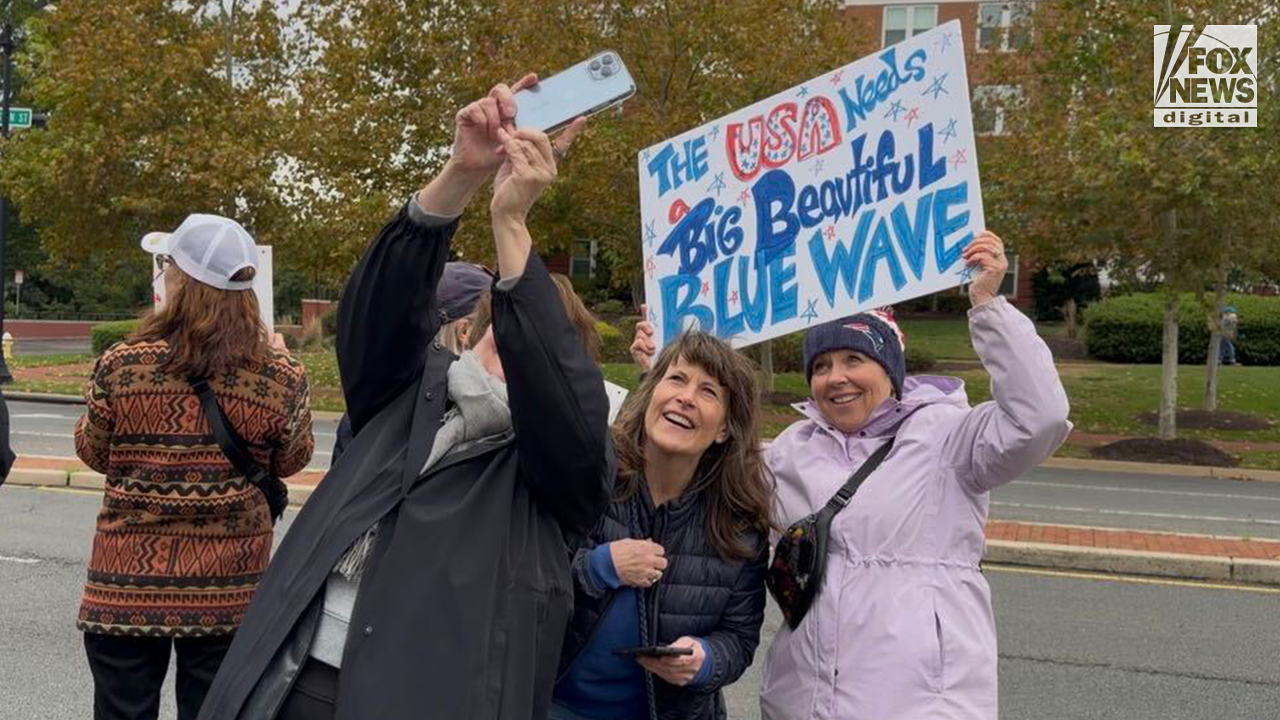
The crowd in Alexandria, and at dozens of other official “No Kings” events from Maine to Oregon, seemed to delight in puncturing that fiction. One demonstrator beamed while holding a sign that read “The USA Needs a Big Beautiful BLUE WAVE,” a message so overtly partisan it could have been lifted from a Democratic campaign rally. Nearby, a man from the far-left group “Refuse Fascism” held a placard demanding, “TRUMP MUST GO NOW!” Another pumped an inflatable balloon depicting Trump as a diaper-clad baby, while a different sign showed the cryptic numbers “86 47” – a reference to former FBI Director James Comey’s social media post that federal prosecutors had deemed an overt threat against the president. The atmosphere was less like a detached, nonpartisan call for democratic norms and more like a full-throated opposition rally, a gathering of the resistance. The laughter and cheers that erupted as passing cars honked in support were not those of concerned citizens above the fray; they were the sounds of a political army gearing up for battle, united less by abstract principles than by a shared hatred of the current occupant of the White House. For every person who tried to explain the nuance of “defending democracy,” there were three more who simply shouted, “Vote them out!”
The disconnect between the organizers’ official stance and the ground-level reality became even more jarring when the national spokesperson for No Kings, Eunic Epstein-Ortiz, fielded questions from Fox News Digital. Insisting that “No Kings” was a “nonpartisan, peaceful movement that has brought millions of Americans together to stand up for democracy,” she acknowledged that some partisan events may have been “circulating online” that were “not affiliated with or officially organized by No Kings.” But the protest on South Washington Street was, in fact, an official event, listed on the organizers’ own website. When confronted with the evidence of blatant partisan messaging, Epstein-Ortiz offered a somewhat evasive response, suggesting that people were “utilizing the No Kings name as a rallying cry.” That explanation, however, did little to reconcile the obvious contradiction: the very people on the ground, the lifeblood of the movement, were openly rejecting the nonpartisan label, and they were doing so at the exact events the organizers had sanctioned. The carefully worded legal guidance had clearly failed to contain the passions of a base that saw the 2024 election as an existential struggle.
Among those who embodied this defiance was Nadine Seiler, a self-described “professional protester” who had recently been name-dropped by Trump himself. Decked out in an inflatable costume that made her hard to miss, Seiler marched in an official No Kings event near the White House on H Street NW. When asked whether she agreed with the organizers’ insistence on nonpartisanship, she let out a laugh. “No, no, the people who agree with Trump are not out here,” she said, her voice muffled but unmistakably determined. “So it’s never gonna be non-partisan if it’s a resistance to the fascist regime.” She didn’t stop there. “They can pretend, but it’s not,” she added, pulling the costume closer around her. Asked point-blank if the event was partisan, she answered with no hesitation: “Yes, this is a partisan protest. Yeah, so this is as partisan as you can get.” Seiler’s blunt assessment was echoed in the words of the movement’s own leaders. During an October 15 livestream, Indivisible co-founder Ezra Levin accidentally let the mask slip when comparing the two parties’ candidates: “Our candidates are quite good all around the country. Their candidates are quite trash all over the country.” In an earlier webinar, he explained to activists how to criticize Trump without explicitly endorsing Democrats, advising, “You’ve got to let people connect the dots on that one.” It was a wink-wink approach, a transparent effort to have it both ways – to mobilize Democratic voters while maintaining the legal cover of nonpartisanship.
In the end, the “No Kings” protests revealed a fundamental tension at the heart of modern political organizing: how far can a movement go to influence an election before it admits what it truly is? The legal distinction matters, as tax-exempt charities face very different restrictions than political advocacy groups. But on the ground, in the chants and the signs, in the passionate pleas of a young environmental engineer and the defiant costume of a professional protester, the truth was impossible to hide. “Every day I hate him more than I did the day before,” read one sign. “No crown for the clown,” read another. The organizers could issue all the guidance they wanted, but they could not control the hearts of the people they had summoned. For all the careful legal language, the “No Kings” movement was, in the eyes of its most visible participants, nothing less than a partisan crusade to defeat Donald Trump and elect Democrats up and down the ballot. As Nadine Seiler put it, walking away in her inflatable getup, “This is as partisan as you can get.” And in a country as divided as this one, perhaps that was the only honest thing about the whole event. The protests may have been framed as a defense of democracy, but for the thousands who showed up, they were simply the opening salvo of the next election – a battle cry to vote blue, to take back the House, the Senate, and ultimately, the presidency itself.