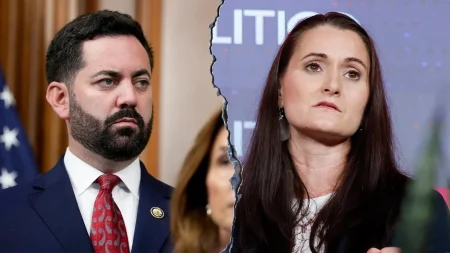



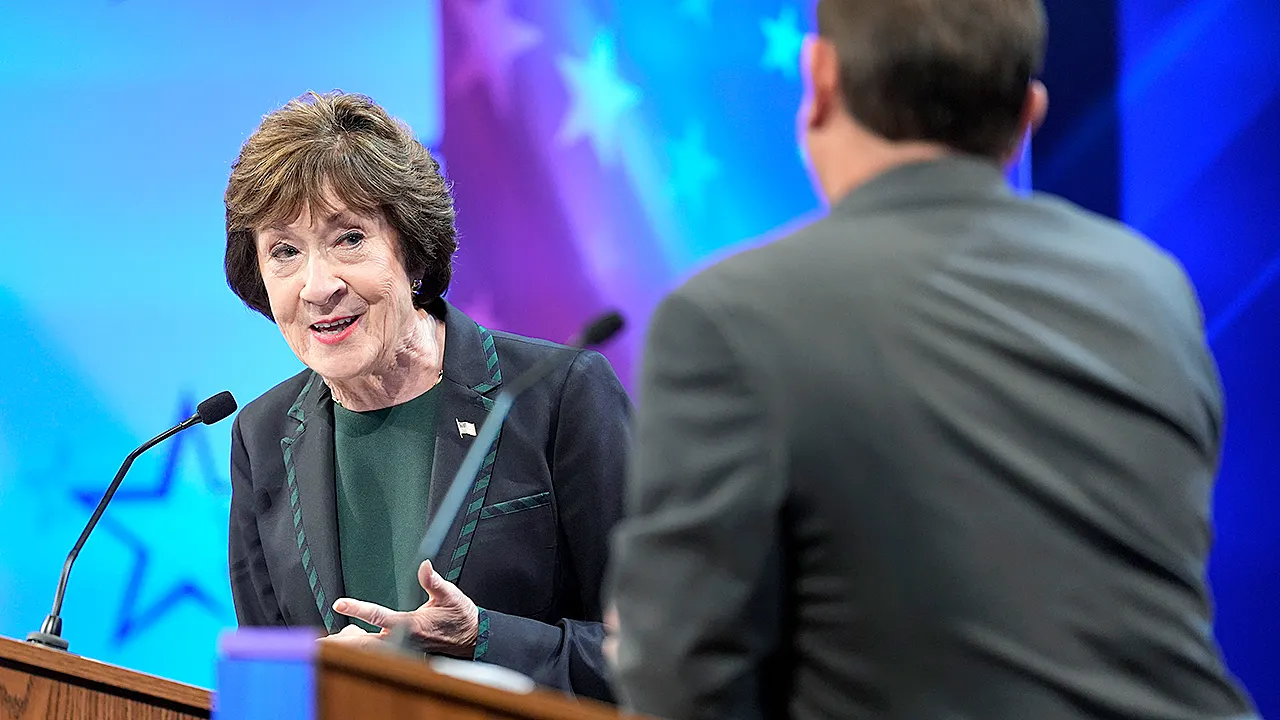
The heavy wooden doors of the auditorium in Bangor, Maine, had barely closed behind the last audience members when the evening’s carefully scripted political ritual was shattered. The stage lights were hot, the cameras were rolling, and Republican Senator Susan Collins and her Democratic challenger Troy Jackson had just begun their final debate of a bruising campaign. Then, from the middle of the packed room, a voice cut through the measured cadence of senatorial debate. “I’m terrified,” the protester shouted, his voice trembling with frustration. “AI data centers are destroying our climate. They are poisoning our water.” For a moment, the audience sat frozen, unsure whether this was part of the spectacle or a genuine rupture. Then came the second cry, aimed directly at the senator’s long career: “30 years for what?” Security moved quickly, their footsteps echoing as they converged on the young man, escorting him toward the exit. But the damage was done—the polite facade of the debate had been cracked open, revealing the raw anger and anxiety that lay just beneath the surface of Maine’s politics. And before the room could settle, Collins herself added a twist, gesturing toward the departing figure and musing aloud, “So, this is obviously one of Troy’s supporters.” The accusation hung in the air, a match dropped onto dry grass.
Jackson, a former logger from the northern reaches of the state, did not let the remark slide. His face tightened, and he fired back without a moment’s hesitation. “Oh, shut up,” he said, his voice carrying both disbelief and genuine offense. “I did not—I didn’t, I don’t even know who that kid.” The exchange was more than just a clumsy debate moment; it was a window into the central tension of the race. Collins, the consummate institutionalist, seemed to assume that any disruption came from her opponent’s camp—a sign of how much she viewed Jackson as a creature of political theater. Jackson, meanwhile, wore his outsider status like armor, and the suggestion that he would plant a heckler struck him as an insult to his authenticity. The two candidates embody different Mains: Collins, the moderate Republican from Caribou who has made a career of bipartisan dealmaking and careful positioning, and Jackson, the rough-hewn legislator who talks about the struggles of mill towns and logging camps. In that brief, awkward quarrel, all the unspoken class resentment and political suspicion between them bubbled to the surface, and the audience felt it. It was the kind of moment that no amount of debate prep can produce—raw, personal, and deeply revealing.
Outside the auditorium, the broader context of this race was impossible to ignore. Maine, a state that has leaned Democratic in presidential elections, has emerged as a top target for Democrats hoping to reclaim the Senate majority in the midterms. Collins, who is seeking her sixth term, is the only Republican senator running for reelection in a state that Donald Trump lost in the 2024 election, and that makes her an anomaly in an increasingly polarized national landscape. Public opinion polls showed the race within the margin of error, and independent political handicappers—from the Cook Political Report to Inside Elections to Sabato’s Crystal Ball—had all labeled it a toss-up. For Democrats, this was the kind of opportunity that comes along only once in a generation: a chance to unseat a familiar, moderate Republican whom they long viewed as too cozy with her party’s rightward drift. For Republicans, it was a test of whether Collins’s personal brand of Maine independence could survive the gravitational pull of national politics. The debate in Bangor was therefore not just an argument between two candidates; it was a proxy for a larger national struggle over the soul of the Senate, the future of bipartisanship, and the meaning of political representation in a divided country.
The issues debated over that hour were as varied as they were contentious. Iran, immigration, rising fuel prices, electricity rates, budget deficits, Supreme Court reform, dark money in politics, assault weapons bans, and climate change—all were thrown onto the table like a messy pile of unresolved grievances. Collins used her time to remind voters of the tangible benefits of her seniority, pointing to federal funding she had secured for Maine’s transportation infrastructure, broadband expansion, and hospitals. She spoke of her role as the most bipartisan member of the Senate, a claim she has made repeatedly and one that resonates with moderate voters exhausted by partisan gridlock. “I vote very independently,” she insisted, and she warned that Maine did not need “more people who are going to vote a straight party line.” Her voice, calm and practiced, was the voice of a politician who has survived tough fights before by positioning herself as a bridge-builder. Jackson, by contrast, leaned into his biography. He spoke of growing up in rural northern Maine, in the same county as Collins, but the similarities seemed to end there. He talked about the hollowing out of timber communities, the anxiety of families struggling with high heating bills, and the feeling that Washington had forgotten people like him. At one point, during the question-and-answer segment, he turned to Collins with a question that carried the weight of a lifetime: “Is it just me that you look down on, or is it working-class people overall?”
The question was pointed, almost cruel, but it spoke to a deep political fault line. Collins responded with a defense of her own origins. “Troy, I do not look down on you or on anyone,” she said. “I grew up in Caribou. My first job was picking potatoes.” It was a classic New England rejoinder—earnest, almost sentimental, but also calculated to remind voters that she, too, had humble roots. Yet Jackson’s campaign has repeatedly tried to tie Collins to President Donald Trump, arguing that despite her occasional public disagreements with the former president, she ultimately votes with him whenever it matters. “The reality is 100% of the time when Donald Trump needs her, Susan Collins is going to be there,” Jackson claimed. It was a devastating sound bite, and it spoke to the core of the Democratic strategy: make Collins run against Trump’s record even if she tries to run away from it. The senator, for her part, seemed almost weary of the attack, dismissing it as partisan caricature. She insisted that her record of bucking her own party on issues like abortion and impeachment proved her independence. But in an election cycle defined by toxic tribalism, the question was whether a reputation for moderation could still matter—or whether voters had already made up their minds based on national allegiances.
The path that led Jackson to this debate stage was itself a strange chapter in Maine political history. He had claimed the Democratic Senate nomination at a special convention in late July, after the original primary winner, Graham Platner, abruptly ended his campaign following allegations that he had raped a woman he previously dated. Platner denied the allegations but dropped out, leaving the party scrambling for a replacement. Jackson, who had earlier that year run unsuccessfully for the Democratic gubernatorial nomination, quickly stepped into the void, bringing with him a history of progressive advocacy and a working-class persona that played well in the northern counties. He had campaigned alongside Platner during the primary, which made the transition less awkward than it might have been, but it also meant that his candidacy was born in a swirl of controversy and uncertainty. For Jackson, this debate was an opportunity to move beyond that messy backstory and focus on the issues that defined his campaign—economic justice, labor rights, and the defense of rural communities. For Collins, it was another chance to portray herself as the steady, experienced leader Maine has always chosen in times of turbulence. As the hour drew to a close, both candidates seemed to know that the race could be decided by a handful of votes, by the smallest of impressions, by the way a moment like that protester’s shout echoed in the memory of voters watching at home.
Maine has seen this movie before. Six years ago, Collins trailed her Democratic challenger, Sara Gideon, in the polls, yet she won reelection by nearly nine points while Joe Biden carried the state by a similar margin. That history is both a comfort and a warning for the senator’s supporters: she has proven she can survive Democratic waves, but each race grows harder, and the national environment has grown more volatile. The protester who shouted about AI data centers and poisoned water was not on any campaign’s payroll; he was a symptom of a broader unease, a reminder that the issues driving American politics today are not always the ones in the debate scripts. Climate change, technological disruption, the hollowing out of local economies, the feeling that powerful people are making decisions that harm ordinary families—these anxieties are real, and they do not fit neatly into partisan categories. Collins’s response, attributing the disruption to her opponent, may have been instinctive, but it also revealed a politician who has grown accustomed to being the target of anger. Jackson, by contrast, seemed to thrive in the chaos, ready to channel that anger into his own narrative of betrayal. In the end, the debate in Bangor was not just about policy positions or resumes; it was about who truly understands the fears and hopes of the people watching. And with polls showing a dead heat, the answer remained uncertain. For Maine voters, the choice was not simply between a Republican and a Democrat, but between two very different ideas of what it means to fight for them—one rooted in institutional memory, the other in lived struggle. The final votes would be cast in the near-silence of voting booths, but the echoes of that interrupted debate would linger far beyond the auditorium doors.