


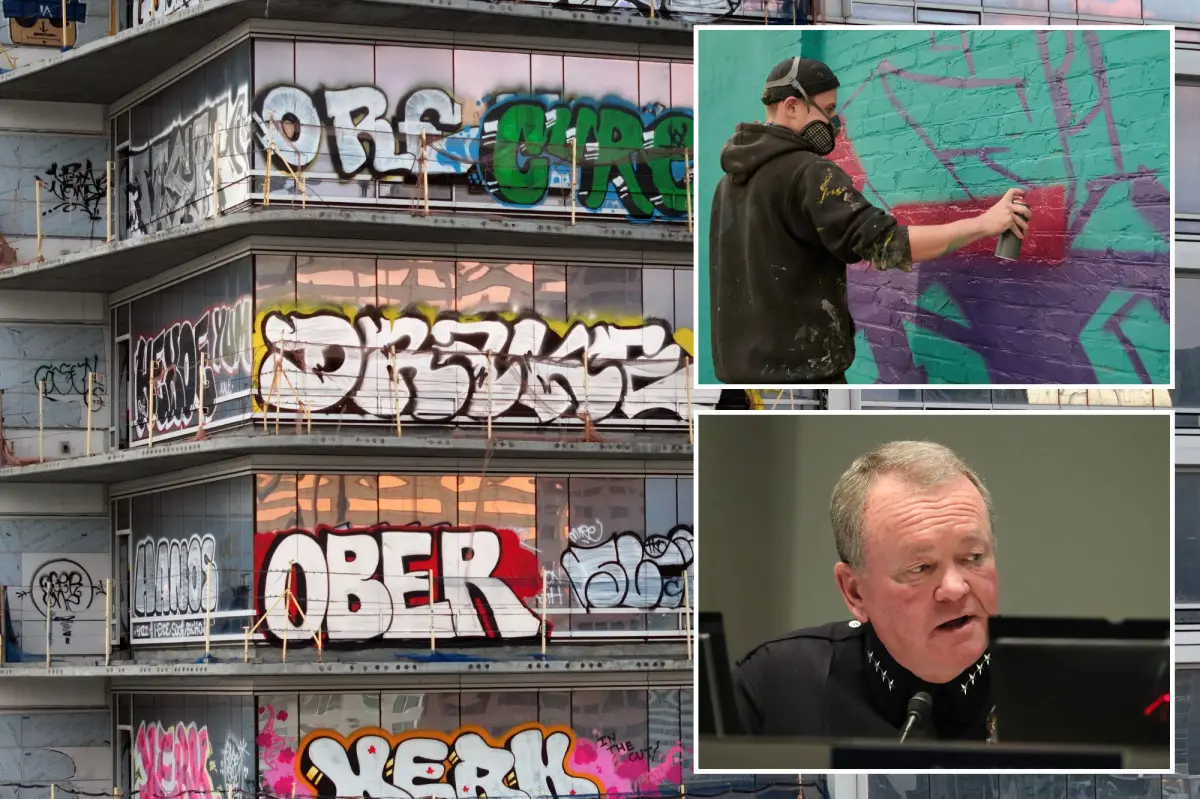
There is a particular kind of dread that settles over a neighborhood when you round a corner and see a beloved building defaced. In Los Angeles, that feeling multiplied across the city for more than a year as a crew of alleged vandals treated some of the region’s most visible structures as their personal spray-painted billboards. Between August 2025 and August 2026, prosecutors say, the group climbed tall buildings, left enormous tags on their exteriors, sent drones buzzing overhead to film the results, and then tried to profit from the mayhem by selling merchandise tied to their graffiti. The total repair bill reached an estimated $172,930, and some of the damaged buildings were historically significant, meaning the cost was not just financial but cultural. For the people who live and work in those buildings, the discovery was a gut punch: a smear of paint across a facade that had stood for decades, a signature where no signature was invited, a mess that would take weeks and thousands of dollars to undo. Then came a detail that made the case feel especially unsettling: one of the accused was a city utility worker, a man whose job was to help keep Los Angeles running. Javier Rezendez Rocha, an electrical craft helper at the Los Angeles Department of Water and Power since 2018, now faces 12 felony counts of vandalism. Prosecutors say he used his specialized utility gear and climbing ropes to help the crew scale buildings that would have been impossible to reach with a simple ladder. His base salary ranged from $75,335 to $102,249, which made him, at least on paper, a working professional, not a disaffected outsider. The case, filed Oct. 8, has rattled property owners and city officials alike, forcing Angelenos to confront the uncomfortable reality that the people allegedly behind the spray-paint attacks were not just anonymous figures slipping through the night, but in at least one instance, someone trusted to serve the city. It also raised questions about how a man with a steady paycheck and access to municipal equipment could have allegedly joined a scheme that caused so much damage.
The alleged operation was not the work of someone with a single can of spray paint and an impulse. It was, according to the Los Angeles County District Attorney’s Office, a coordinated campaign that required planning, physical risk, and a troubling level of access. The crew did not limit themselves to ground-level walls. They carried ladders and specialized climbing equipment, scaled tall buildings, and hung over ledges to spray-paint large exterior surfaces that were never meant to be touched. Drones were deployed to document the work from above, giving the group a portfolio of their alleged crimes. That documentation was then leveraged for profit: investigators say the defendants sold merchandise associated with their graffiti, turning the defacement of public and private property into a business model. For the owners of the targeted buildings, the aftermath was not a quick cleanup. Paint had to be stripped from brick, glass, metal, and historical masonry. In some cases, specialized restoration experts were needed, and the bills piled up to more than $172,000. Small business owners faced the added burden of lost revenue while scaffolds and tarps covered their storefronts. Landlords had to explain to tenants why the building looked like a crime scene. Neighborhood residents had to look at the damage every day, a constant reminder that someone had treated their community as a playground. Los Angeles County District Attorney Nathan J. Hochman did not mince words when announcing the charges. “These defendants turned buildings across Los Angeles into their personal billboards, leaving property owners with over $170,000 in repair costs,” he said. He went further, describing the scheme as a money-making operation and promising that prosecutors would push for offenders to clean up graffiti themselves as part of their punishment. “This was not harmless graffiti, and these are not victimless crimes as they destroy the quality of life in our community,” Hochman said. “To anyone thinking about vandalizing property, Los Angeles County is not yours to deface.” That warning was aimed not just at the four defendants but at anyone who might see graffiti as a youthful rebellion rather than a crime with real consequences. The legal system, Hochman made clear, would treat it as the latter.
The four men charged in the case come from different corners of Southern California, but they are now linked by a series of accusations that could reshape their lives. Javier Rezendez Rocha, the LADWP employee, faces the most serious exposure: 12 felony counts of vandalism, with a potential sentence of up to 10 years and four months in county jail if convicted as charged. The irony of his alleged role was not lost on those who followed the case. Rocha was an electrical craft helper, someone who had worked for the Department of Water and Power since 2018 and earned a base salary between $75,335 and $102,249. He was, by all appearances, part of the civic infrastructure, a man with a steady job and access to equipment that most civilians would never possess. Prosecutors say he allegedly used that equipment, including utility gear and climbing ropes, to help the crew scale buildings that would otherwise have been out of reach. His co-defendants include Michael Ray Gonzales of Pico Rivera, who faces seven felony counts, and Francisco Rodriguez Aguilar of West Covina and Richard Evan Ward II of Oceanside, who each face two counts. The case was formally filed Oct. 8, and the legal process has already begun to move. Ward pleaded not guilty Oct. 12 and is scheduled for a preliminary hearing setting Nov. 19. Rodriguez Aguilar is due for arraignment Oct. 19. Rocha is scheduled to appear Oct. 23. Gonzales will be arraigned later. Those who have already appeared in court were released on their own recognizance, a sign that they are not considered flight risks but also a reminder that the consequences they face are still substantial. Gonzales could face up to seven years in county jail, while Rodriguez Aguilar and Ward each face up to three years and eight months. For all four men, the coming months will be a blur of hearings, legal negotiations, and hard questions about how they ended up on the wrong side of a spray-paint can. They will have to sit across from prosecutors who see them as opportunists, and from judges who will decide whether the damage they allegedly caused was a crime of ego, greed, or both. Their families, too, will have to wrestle with the public shame of seeing their names in the news, connected to a scheme that turned city landmarks into targets.
Los Angeles Police Chief Jim McDonnell framed the alleged rampage as an attack on the entire city, not just on the property owners who had to pay for repairs. The vandalism, he said, struck at businesses, property owners, taxpayers, and the wider community, with some of the city’s most iconic buildings and public spaces allegedly in the crosshairs. For Angelenos, the news was another reminder of the fragile balance between the city’s celebrated street-art culture and the vandalism that crosses a legal line. Los Angeles is a place where murals are beloved, where graffiti artists have become global names, and where walls have long told stories of identity, resistance, and creativity. But the alleged acts in this case were not murals commissioned by building owners or community groups. They were large, unauthorized tags and pieces sprayed onto structures that were not blank canvases but workplaces, homes, and historical landmarks. When paint goes up without permission, the people who own those buildings are left with a choice: pay thousands to remove it, or let it stand and risk encouraging more. That burden falls especially hard on small business owners, who may already be struggling with rent, insurance, and the cost of doing business in a city that is not cheap. For residents, the sight of a defaced landmark can feel like a violation of the shared space they call home. It can make a neighborhood feel less safe, even if no one was physically harmed. It can send a message that no one is watching, that the rules do not apply, that a building’s facade is fair game for anyone with a can of paint and a willingness to take risks. McDonnell’s warning was blunt: “Let this serve as a clear message: If you deface our city, we will investigate you, identify you and hold you accountable.” That message was meant to deter, but it also acknowledged a deeper truth: the damage done by graffiti is not only measured in dollars. It is measured in the loss of a sense of safety and ownership that communities feel over their streets, their buildings, and their public spaces. The cleanup process can take weeks, and even after the paint is gone, the memory of the defacement lingers. Property owners may install cameras, add lighting, or apply anti-graffiti coatings, but the psychological scar remains, a reminder that their space was invaded.
It would be easy to imagine the defendants as romantic outlaws, the kind of figures who populate films about underground street artists. They scaled buildings, braved heights, left their names in huge letters, and filmed their exploits with drones. They even sold merchandise, creating a brand around their alleged vandalism. But the reality of the case is far less glamorous. The buildings they used as canvases belonged to real people, and the damage they left behind created real financial and emotional burdens. A property owner who wakes up to find a six-story tag across the front of their building is not thinking about artistic intent. They are thinking about the cost of the scaffold, the paint remover, the labor, the lost business while the building is covered in tarps, and the uneasy feeling that their property has been violated. The district attorney’s office has signaled that it wants the defendants, if convicted, to do more than serve time. Hochman said prosecutors would push for offenders to clean up graffiti themselves as part of their punishment. That proposed remedy has a kind of poetic justice: the people who spent months turning the city into their personal gallery would be forced to spend hours scrubbing away the work of others, or perhaps their own. There is something humbling about being handed a pressure washer and a bucket of solvent and told to make things right. It strips away the false bravado of the spray-paint can and replaces it with the mundane, unglamorous labor of repair. For the community, seeing the vandals clean up their mess could be more satisfying than a jail sentence, because it requires them to look at the faces of the people they harmed and to understand that the city is not a blank canvas but a shared home. The case also raises questions about how a person with a steady city job and a salary that topped six figures could end up involved in a scheme that caused nearly $173,000 in damage. Money may have been a motive, but so too might have been the thrill of the climb, the satisfaction of seeing a tag spread across a skyline, or the desire for recognition in a subculture that rewards audacity. None of those motivations, however, erase the harm done to the people who have to live with the aftermath. The victims are not faceless corporations. They are the barista whose coffee shop lost customers during cleanup, the family whose apartment building was defaced, the elderly couple who have owned the same commercial property for forty years and cannot understand why someone would do this to them.
As the legal proceedings unfold, the case stands as a cautionary tale about the difference between expression and destruction. Los Angeles has always been a city of walls that speak, a place where murals and street art are woven into the cultural fabric. But the alleged vandalism in this case crossed a line that most Angelenos understand instinctively: art is made with permission, or at least with respect for the people who own and live in the spaces it adorns. Vandalism is made with neither. The defendants will now have their day in court, and the legal system will determine their guilt or innocence. But whatever happens in the courtroom, the case has already had an effect. It has reminded property owners to install better security cameras and lighting. It has prompted conversations among city officials about how to prevent similar crews from scaling buildings and spray-painting historic facades. It has given the district attorney’s office a platform to promise tougher enforcement, including the demand that vandals clean up their own messes. And it has forced the public to confront the fact that the people who commit these crimes are not always shadowy figures from the margins of society. Sometimes they are neighbors, coworkers, even city employees. Rocha’s alleged involvement is a reminder that access and expertise can be misused, and that the tools of a legitimate trade can become instruments of destruction in the wrong hands. For the victims, the story is not over when the paint is removed. There are insurance claims to file, repairs to complete, and a lingering sense of vulnerability that does not fade quickly. For the defendants, the future is uncertain, with the possibility of years behind bars and a criminal record that will follow them long after they have paid their debt to society. The most hopeful outcome would be one in which the city repairs its buildings, the law holds the accused accountable, and the energy that went into destruction is redirected toward creation. But that kind of redemption cannot be forced. What can be forced, through the courts and through community pressure, is accountability. Los Angeles is not a place to be defaced. It is a place to be cared for, painted with permission, and passed on to the next generation a little better than it was found. The story of this case is not just about four men and a series of crimes. It is about a city choosing whether to let a few people with spray-paint cans define what its walls mean, or whether to take those walls back, clean them, and fill them with something the community actually wants to see.