

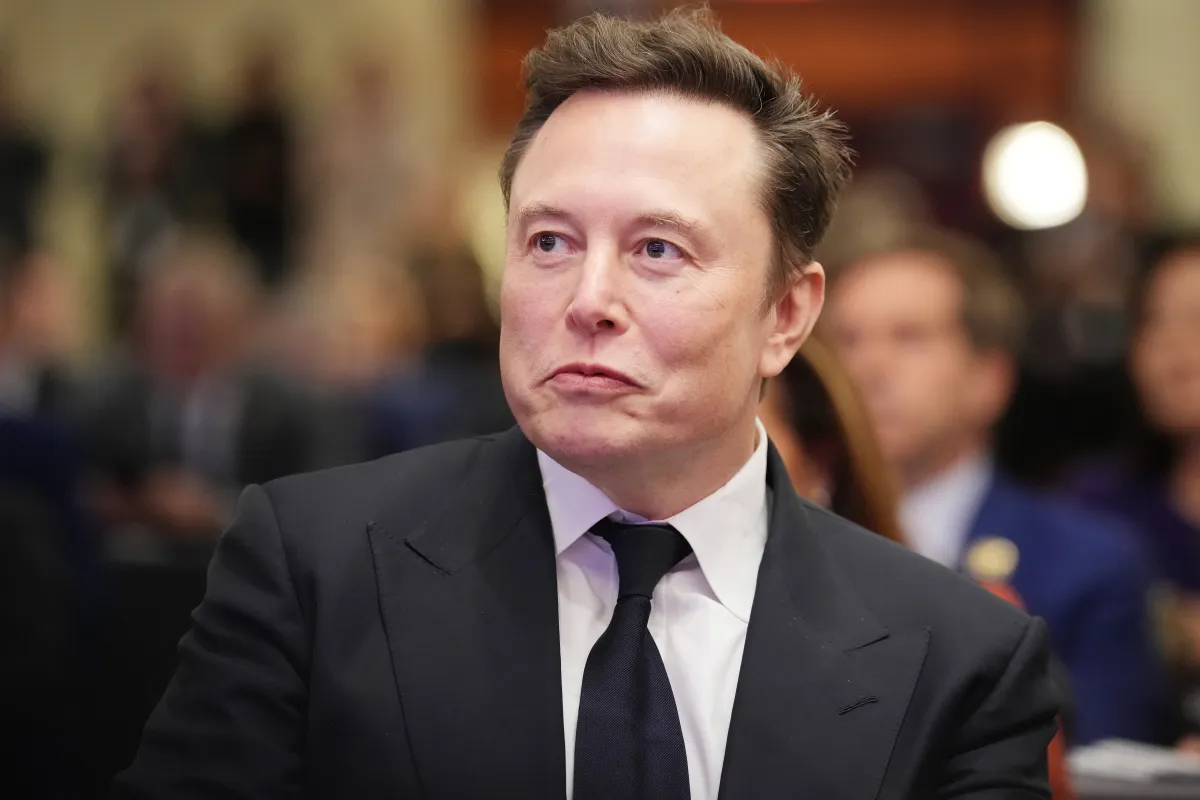
On Thursday evening, at a sunbaked SpaceX test facility in McGregor, Texas, Elon Musk did something that made even hardened tech watchers blink twice: he unveiled a Tesla Roadster that could hover above the ground. The vehicle didn’t exactly soar through the sky like an airplane; instead, it lifted off and maneuvered a few feet over the concrete, looking like a science-fiction prop that had somehow rolled out of a rocket factory. The clip spread quickly across X, racking up 1.7 million views within hours, and the reactions poured in from every corner of American public life. Florida Governor Ron DeSantis called it impressive, Congresswoman Elise Stefanik marveled at the spectacle, Kari Lake and reality television personality Spencer Pratt also weighed in, and Tesla fans compared the demonstration to something out of Blade Runner or The Jetsons. For a few minutes, the usual political and cultural divisions seemed to dissolve into collective amazement. Musk, standing beside Tesla’s design chief Franz von Holzhausen and vice president of vehicle engineering Lars Moravy, let the machine speak for itself. This was not a render or a teaser; it was a physical vehicle lifting off in front of cameras. Yet even as the applause built online, there were lingering questions about what exactly the Roadster is, what it will cost, and whether anyone will ever be allowed to drive one out of a showroom and into the sky. The spectacle was deliberately cinematic, and Musk seemed to know exactly what he was doing: giving the world a glimpse of a future that felt both thrilling and improbable at the same time.
The event itself was staged as a livestreamed presentation from SpaceX’s test facility, and Musk made clear from the opening moments that the audience should expect something unusual. “You’ll see some crazy stuff,” he said, describing the project as a collaboration between Tesla and SpaceX, which he called the best car company and the best rocket company in the world. He declared that the Roadster would be “better than any James Bond car,” a phrase that seemed to sum up the entire mood of the evening. But Musk also made a point of lowering expectations, at least slightly. “Success is not guaranteed,” he admitted. “It’ll probably work, but if it doesn’t work, we’re at a safe distance. Excitement is 100 percent guaranteed.” That mix of bravado and self-aware humor has become Musk’s signature, and it was on full display as he described a vehicle that would “defy physics” and was not necessarily “safety optimized.” Those words may worry regulators and safety advocates, but they electrified the crowd, many of whom had waited years to see the long-delayed next-generation Roadster in action. Tesla also announced that the Roadster can accelerate from zero to sixty miles per hour in less than one second, a figure that would make it one of the fastest production cars ever conceived, if it ever reaches customers. Musk said production is expected to begin in 2028, which is nearly a decade after Tesla first unveiled the redesigned Roadster and began taking reservations. For people who placed deposits years ago, that timeline may feel like yet another delay, but the Thursday demonstration suggested that the project is at least real, not just a collection of slides and promises. The fact that Musk was willing to stand at a safe distance and watch a car hover above the ground was, in itself, a statement: he believes in this thing enough to put it in front of cameras, even if he is not entirely sure it will work every time.
Pricing remains one of the biggest open questions. Tesla has not announced updated pricing following Thursday’s reveal, and the silence has left analysts and reservation holders guessing. When reservations originally opened, Tesla listed a base Roadster at $200,000, while a limited “Founders Series” model carried a $250,000 price tag. That was already steep, but that was also years ago. Given nearly a decade of delays, inflation, and the addition of the SpaceX thruster package, most industry observers expect any production version to command a substantially higher price. Some have speculated that the final price could approach or even exceed half a million dollars, especially if the flying capabilities are included in the standard package rather than offered as an expensive option. The economics of a vehicle like this are difficult to model because there is nothing else quite like it on the market. A traditional supercar competes on speed, handling, and prestige; a flying car, even one that only hovers for short periods, competes on sheer novelty. But novelty has a cost, and Tesla has learned over the years that ambitious vehicles often take longer to develop and cost more to produce than initially projected. The original Roadster reservation holders, many of whom wrote checks years ago with dreams of owning a piece of automotive history, are now waiting to see whether their deposits will be enough or whether they will need to dig much deeper. For most ordinary drivers, the Roadster is less a purchase than a fantasy, but the Thursday demonstration made that fantasy feel slightly more tangible. It is one thing to hear about thrusters and acceleration numbers; it is another to watch a car lift off the ground in a cloud of dust and hover like a magician’s trick.
The most obvious practical question, though, is whether drivers could actually use such a vehicle on public roads. The answer, for now, remains unclear. Experts have long noted that a vehicle capable of lifting off the ground would likely face serious scrutiny from federal regulators. According to reporting before the launch, Federal Aviation Administration rules generally classify anything that flies above the ground as an aircraft, while specialized regulations already exist for electric vertical takeoff and landing vehicles, known as eVTOLs. That means a hovering Roadster might not be able to legally operate as both a car and an aircraft in the same trip. Industry observers have suggested that any future Roadster aerial functions would likely be limited to controlled environments, such as private tracks, test facilities, or designated airspace, rather than unrestricted use over public roads and neighborhoods. Interestingly, the FAA flight restrictions established around Tesla’s Texas demonstration site before the launch fueled speculation that regulators were already preparing for an unusual test. That suggests Musk’s team may have been working behind the scenes with authorities to at least stage the event legally. But obtaining permission for a one-time demonstration is very different from obtaining certification for everyday use. The regulatory path for a car that can hover is uncharted territory, and it will likely require new rules or significant amendments to existing ones. Until then, the Roadster may remain a spectacular track-day toy or a collector’s item for the ultra-wealthy, rather than a vehicle that transforms the daily commute. The dream of flying cars has been around for decades, but the legal and safety realities have always grounded it. Thursday’s demonstration did not solve those problems; it only made them more visible, and more urgent.
For Musk, the Roadster demonstration represents the latest payoff in one of his longest-running promises. Since unveiling the second-generation Roadster in 2017, he has repeatedly touted a SpaceX package that would use cold-gas thrusters inspired by rocket technology. Over the years, he suggested that the system could allow the vehicle to hover, make short jumps, and achieve acceleration beyond what conventional performance cars can deliver. Those claims were often met with skepticism, given the enormous engineering and regulatory hurdles involved. Critics pointed out that cold-gas thrusters require storage tanks, valves, and pressurized systems that add weight and complexity to a car. Others wondered why anyone would want a car that could hover for only a few seconds at a time. Yet supporters argued that Musk has built a reputation around delivering ideas that initially sounded implausible. Reusable rockets were once dismissed as a pipe dream, and now SpaceX lands boosters routinely. Commercial spacecraft were once the domain of governments, and now private astronauts fly regularly. Electric vehicles were once seen as glorified golf carts, and now Tesla is one of the most valuable car companies in the world. That track record gives Musk a kind of credibility that few other entrepreneurs possess, even if his timelines are notoriously optimistic. The fact that the Roadster hovered at all, even briefly, was enough to convince many fans that the impossible was simply taking longer than expected. For them, Thursday’s demonstration was not a stunt; it was proof of concept. For skeptics, it was a carefully choreographed illusion designed to generate hype and distract from Tesla’s challenges. The truth probably lies somewhere in between, but the emotional impact was undeniable. Watching a car float above the ground, even for a few seconds, changes the way people think about what is possible.
The Roadster demonstration also adds another headline-grabbing project to Musk’s already crowded portfolio of ambitious technologies. Through SpaceX, he helped pioneer reusable orbital rockets and expanded the Starlink satellite network, which now provides internet access to millions of people around the world. Through Tesla, he pushed electric vehicles into the mainstream and popularized software-driven car updates, turning vehicles into devices that improve over time. His companies have also pursued projects ranging from humanoid robots to brain-computer interfaces, each one aimed at solving a problem that most people did not even know needed solving. Whether the Roadster ultimately becomes a practical flying vehicle remains deeply uncertain. The engineering challenges are formidable, the regulatory barriers are real, and the price will likely put it out of reach for almost everyone. But the reaction from a wide range of public figures on X suggests that Thursday’s demonstration succeeded in its immediate goal: convincing many viewers that they had just watched a glimpse of the future. In a world that often feels divided and cynical, there is still something powerful about a moment of collective wonder. Musk may be overpromising again, and the Roadster may never fly into your neighborhood. But for one evening in Texas, with cameras rolling and a crowd holding its breath, the future felt close enough to touch. And as Musk himself reminded everyone, excitement was 100 percent guaranteed.