


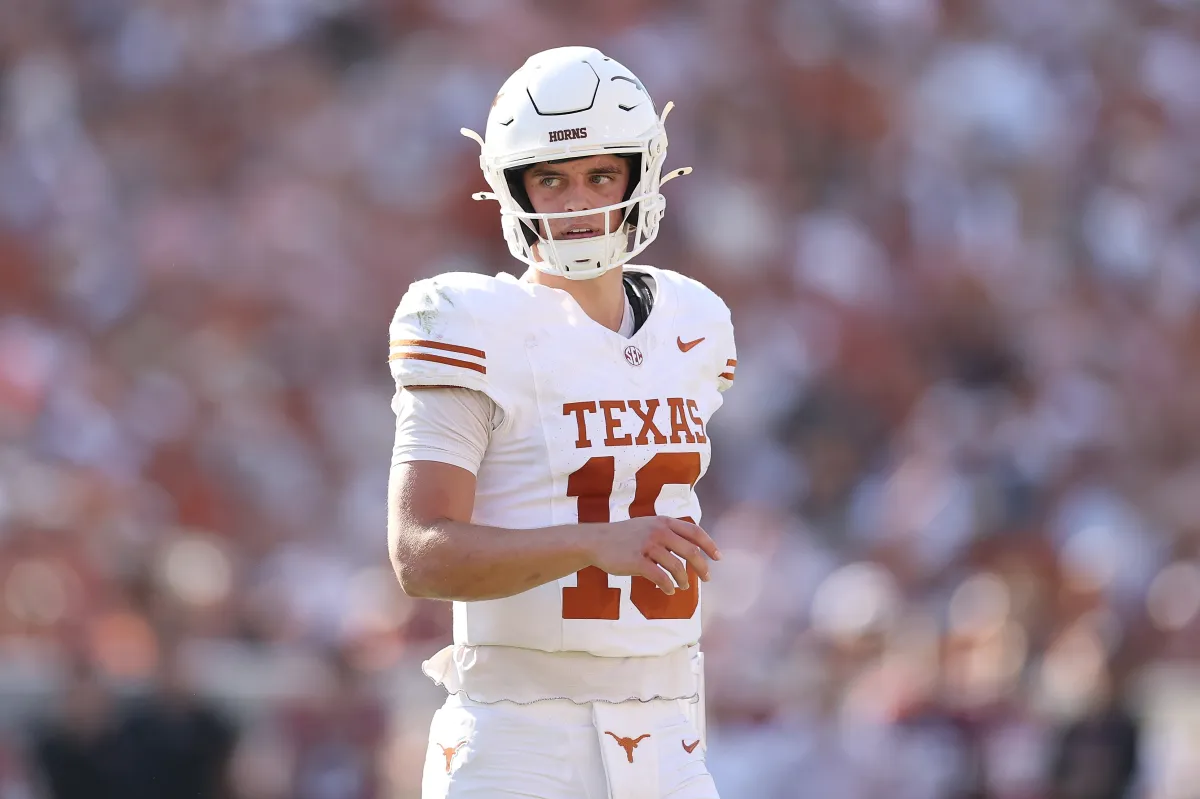
The weight of a surname can feel like a thousand-pound barbell, especially when that surname is Manning. For Arch Manning, the Texas Longhorns quarterback, the world has watched every throw, every scramble, and every grimace since he first stepped onto a college field. The narrative has been written before he even took a snap: he’s the heir to a quarterbacking dynasty, a meticulous product of a football bloodline that includes two Super Bowl-winning uncles and a father who was a college star in his own right. So when his draft stock begins to slip, as recent reports suggest, the murmurs grow louder. Gerald McCoy, the legendary Oklahoma Sooners defensive tackle and a former NFL All-Pro, has a word of advice for the young signal-caller, and it’s one that cuts through the noise with a fatherly warmth. McCoy, now a proud father of three sons, looked into the camera on ESPN’s “First Take” and made a plea not for Manning to declare for the draft, but to stay in Austin for another year. It’s not about the film breakdowns or the metrics; it’s about the intangible, brutal reality of professional football and the unjust weight of expectation that no 20-year-old should have to carry alone.
McCoy’s reasoning is steeped in the very humanity that often gets stripped away in mock drafts and hot takes. “You cannot put expectations on the kid because of how great the father, or the uncles, were,” he said, his voice carrying the weariness of someone who has seen the game’s darker side. “That’s what we did to Arch.” It’s a subtle but devastating critique—not of Manning’s talent, but of our collective tendency to project greatness onto a name, to expect a reincarnation of Peyton and Eli before the young man has even forged his own identity. McCoy also issued a stern warning about the league itself. “The NFL will break you. The NFL is a man’s, man’s game. It will break you and humble you,” he warned. His point isn’t to scare Manning; it’s to ensure that he enters the professional ranks with a fully formed soul, resilient enough to withstand the inevitable failures, the crushing losses, and the relentless scrutiny. “He needs to go to the NFL when he believes ‘I can handle everything that comes with the NFL,’” McCoy added, suggesting that this belief comes not from a stat sheet, but from the quiet confidence earned through battles won and lost at the collegiate level. It’s a mentor’s plea, not a critic’s dismissal.
The timing of this advice stings, as it always does when a loss exposes the cracks in a narrative. Texas fell 27-24 to an unranked Oklahoma in the Red River Rivalry, their first loss of the 2026 season. Manning threw for 260 yards and three touchdowns, but the game will be remembered for the two interceptions in the fourth quarter—one of them coming with the score tied and just 19 seconds left, a moment of pure heartbreak that set up Tate Sandell’s winning field goal for the Sooners. You could see the agony in Manning’s eyes as he walked off the field, the weight of a century-old rivalry pressing down on his shoulder pads. That moment—one of chaos, miscommunication, and a desperate heave into coverage—is the very crucible McCoy is talking about. Through the loss, Manning’s season stats remain solid on the surface: 1,122 passing yards, 10 touchdowns, and five interceptions on 63% completion. But the underlying numbers whisper caution—a 65.6 QBR that ranks eighth in the SEC, and eight sacks over the last two games. These are not the numbers of a bust, but they aren’t the numbers of a demigod either. They are the numbers of a still-developing quarterback, learning to handle the spikes in the road that every great player must navigate.
Cam Newton, ever the voice of the player’s perspective, stepped in to push back on the growing chorus of analysts. On his “4th and 1” podcast, Newton offered a nuanced defense. “I think people are unfairly analyzing Arch or judging Arch, not because of his gameplay. It’s because of the expectations that everybody had for him,” he said. Newton’s point is a sharp reminder that the noise around Manning is less about his actual performance and more about the mythology that precedes him. It’s a classic case of the “phoenix” being judged against the ashes of a legend rather than the fire of his own potential. Texas coach Steve Sarkisian has similarly made the case, pointing to Manning’s wins over four top-10 opponents across 13 starts—including a 24-23 thriller against then-No. 1 Ohio State earlier in 2026. Those victories are not accidents; they are evidence of a young man who can rise to the occasion when the lights are brightest. But the narrative remains stubborn. A single loss, a few shaky throws, and suddenly the doubters emerge from the shadows. Newton’s defense is a plea for patience, a reminder that players grow at different rates, and that the best thing for Manning might be to savor the college experience, to fail, to learn, and to return with a thicker hide.
The road ahead offers no reprieve, only a gauntlet that will define his legacy. After hosting Florida, Texas faces No. 9 Ole Miss, No. 16 Mississippi State, No. 13 Missouri, and No. 22 LSU. This is a murderer’s row of SEC defenses, each one scheming to create the next viral highlight of Manning getting harassed or making a mistake. But this is exactly what McCoy wants—not as a punishment, but as a forge. Every sack, every interception, every game-winning drive in the fourth quarter will be a lesson that no practice can replicate. If Manning can navigate this schedule, if he can rally his team to a conference championship and maybe a playoff berth, he will enter the NFL with the kind of war-tested confidence that cannot be drafted or simulated. And if he stumbles again? Even that is valuable, as long as he learns. The human element here is that Arch Manning is not a finished product. He is a 20-year-old kid with extraordinary talent but also ordinary fears—the fear of failing his father, his uncles, his coach, and the legions of fans who have already anointed him. McCoy’s advice is a reminder that the NFL is not a destination; it’s a battleground. And entering it prematurely, with an ill-prepared mind and spirit, can be a career-ending mistake.
In the end, this debate is not about a quarterback’s stats or a draft projection. It’s about the fundamental question of what it means to grow up in the public eye, to be measured against the ghosts of greatness, and to decide when to leave the safety of college for the unforgiving professional world. Gerald McCoy’s words, Cam Newton’s defense, and Steve Sarkisian’s quiet belief all circle back to the same human truth: Arch Manning needs time. Time to make mistakes when the stakes are slightly lower, time to learn what it feels like to lose a rivalry game and have to rebuild, time to discover his own voice without the echo of his family’s legacy drowning him out. The loss to Oklahoma was painful, but it was a gift—a chance to see how he responds to adversity. The upcoming schedule is brutal, but it’s also an opportunity. And while the hot takes will continue to rage, the most compassionate take is the one McCoy offered: let him be a kid a little longer. Let him find the joy in the game, the belief in his own abilities, and the armor necessary to survive the NFL’s harsh reality. Because when he does eventually declare, we want him to walk in with his head held high, not because of his name, but because of the man he has become. And that man is still being forged, one snap at a time, in the crucible of college football.