


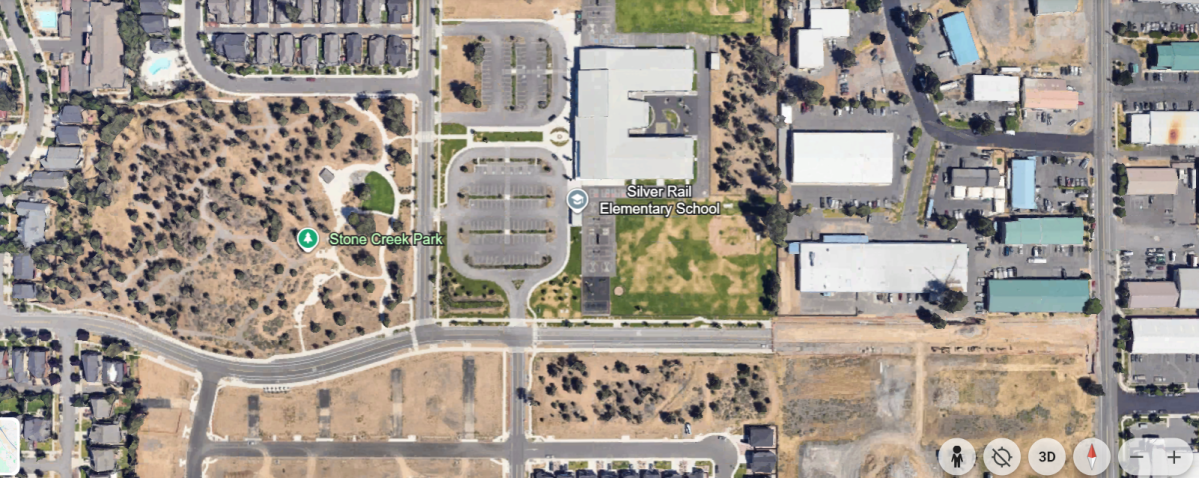
It began as an ordinary Thursday afternoon in Bend, Oregon, where the quiet rhythm of a school day was about to be violently interrupted. At Silver Rail Elementary School, a place designed for crayons, story time, and the simple lessons of childhood, the unthinkable became reality. Police received reports of an active shooter inside the building, and within minutes, a calm suburban community was thrust into the kind of nightmare that has become all too familiar in American life. The initial posts from law enforcement were stark and urgent: a large police presence had descended on the campus, and people were asked to stay away. The school, located at 61530 SE Stone Creek Lane, became the scene of flashing lights, sirens, and the kind of fear no parent should ever have to know. But behind the official language of “active shooter” and “avoid the area” were real people—children in classrooms, teachers making split-second decisions, families who had no idea whether their loved ones were safe. This is not just a news alert; it is a story about a community suddenly forced to confront the possibility that the worst had happened. The hours that followed would bring more questions than answers, and the initial reports—contradictory, fragmented, incomplete—only deepened the anxiety. What exactly happened inside the school? Who was hurt? Who was safe? These were the questions echoing through the minds of parents who rushed toward the scene, only to be kept at a distance by police tape and a blanket of uncertainty. The school’s location, in a growing part of central Oregon, was a symbol of ordinary life: a place where neighbors knew each other, where children walked to school and parents gathered at pick-up time. On this afternoon, that ordinary life shattered, and the phrase “active shooter” became not a headline from somewhere else but a terrifying reality here.
The first details began to emerge shortly after 1 p.m. local time, when the Bend Police Department received multiple 911 calls imploring them to come to Silver Rail Elementary. According to Sheila Miller, the communications manager at Bend Police, the calls were about an active shooter in the school. Officers were dispatched immediately, and the response was overwhelming. A large police presence surrounded the building, tactical teams moved through hallways, and authorities pleaded with the public to stay away so that the emergency response could proceed without further danger. In a world where these incidents are sometimes reported with cold efficiency, it is important to remember the chaos of the moment: radio traffic, panicked voices, teachers locking doors and pulling blinds, children huddled in corners or running for exits. The police updates were brief and measured, but every word carried the weight of a community holding its breath. Then came the first extraordinary and confusing detail: the shooter was dead, killed during the incident. Miller told the press that initial information suggested the shooter may have been taken down by a bystander. This piece of information, still unconfirmed, added a layer of absurdity to an already surreal afternoon. Who takes on a shooter? A teacher, a staff member, a parent, a passerby? At a time when school shootings have become a recurring American tragedy, the idea of a quick response by a civilian seems both heroic and heartbreaking—heroic because lives may have been saved, and heartbreaking because it had to happen at all. The fact that police were still piecing the story together, and that “may have been” was the operative phrase, meant nothing was certain. The shooter was dead, but the nightmare was far from over. Officers continued to secure the school, and the public was warned to avoid the area while an investigation began into a crime that would leave everyone asking the same question: Why? But that question would have to wait. For now, the immediate focus was on the wounded and the missing, on the families waiting for word, and on a community that had just been violently shaken to its core.
Perhaps the most painful details in the initial reports concerned the victims. Sheila Miller confirmed that there were “multiple victims” inside the school, and that two people had been transported to a local hospital. Their statuses were unknown in the immediate aftermath, a phrase that carries agonizing ambiguity. When authorities say “status unknown,” they are not just providing an update—they are acknowledging that families do not yet know if their loved one will live or die, that doctors are fighting behind closed doors, and that the next phone call could either bring relief or irreparable devastation. The word “victims” is dehumanizing in its generality, but each victim is someone’s child, someone’s parent, someone’s friend. They were at school on Thursday, doing the ordinary things that people do: learning, teaching, helping. They may have been a student in a reading group, a teacher at a whiteboard, a staff member in the hallway. Now they were in a hospital, with medical teams working on them while law enforcement began the difficult process of notifying families. The community was left to wait. In the immediate aftermath, there was no official word on the number of victims, their ages, or the severity of their injuries. The uncertainty was a kind of torment. Every parent with a child at Silver Rail Elementary was counting the minutes until they could hear that their child was safe. Every family member of a teacher or staff member was doing the same. The fact that police were quoting “multiple victims” meant that this was not a false alarm, not a training exercise, but a real event with real consequences. As the hours passed and the sun began to sink lower over central Oregon, the pines and the desert landscape offered no comfort. The emergency vehicles had become a permanent fixture on the street. The school, once a place of yellow buses and morning announcements, was now a crime scene.
In the midst of the chaos, authorities established a reunification center at Journey Church, located at 61303 S Highway 97, near landmarks that made it easy for parents to find: Goodwill and Dairy Queen. The choice of a church as the meeting point was more than just a logistical decision. It was also a small, hopeful gesture in a day filled with darkness. A church is a place of refuge, of prayer, of community. It could not undo what happened at the school, but it offered a space where families could gather, wait, and hold on to one another while they waited for news. The Bend Police Department posted on social media, directly addressing families: “Students’ families are asked to respond there.” There was no indication of how long the wait would be, no guarantee that every child would walk out of the school and into the arms of their parents. Reunification is a process that takes time: first, officers must ensure the building is safe; then, students must be located, accounted for, and released one by one. For parents, every minute of that process is an eternity. Some arrived at the church with their cell phones in hand, hoping for a call or text. Others stood in clusters, whispering to each other, trying to make sense of what was happening. There were tears, fear, and the heavy silence that comes from not knowing. The church, with its open doors and its helpers offering water and comfort, became a makeshift sanctuary. It was not the same as being at home, but it was a place where the community could be together. The fact that the city had a plan for reunification, that there were designated safe places and lines of communication, was a small comfort. But nothing could erase the reality that an active shooter had entered a school. For the families outside Journey Church, the wait was excruciating. The landmarks—Goodwill, Dairy Queen—were little more than signposts on a road toward answers, and the answers were slow to come. It was a reminder that even in the midst of a well-prepared response, grief and fear are not orderly.
As the news spread beyond Bend, political leaders began to respond. Senator Jeff Merkley, an Oregon Democrat, took to social media on Thursday to express his concern. “My team and I are closely monitoring reports of an active shooter situation at Silver Rail Elementary School in Bend,” he wrote. “As details continue to come out, my heart is with the Bend community and all of the students and families affected.” He added a sentence that struck at the heart of the tragedy: “No one should have to fear violence at school.” The words were brief, and they offered no political solution or policy proposal, but they expressed a truth that every American parent had felt. There is something uniquely terrible about violence in a school. It violates the promise that children are safe, that teachers are protectors, that a school is a second home. It is a fear that has been repeated in communities across the United States, from Sandy Hook to Parkland to Uvalde, and yet every incident feels no less shocking. Merkley’s statement was also a reminder that this tragedy was not isolated. It was part of a broader pattern, a national crisis that has left no community feeling immune. The senator’s team was monitoring; they were not providing answers, because there were no answers yet. There were only questions, and the terrible weight of waiting. In Bend, a city in the high desert of Oregon, this was not supposed to happen. But it did. The message from elected officials, and from police, was one of solidarity and caution. It was also a reflection of the hollowness of words in moments of trauma. A statement on social media cannot heal a wounded child. It cannot calm a parent’s racing heart. It cannot bring back a life lost or undo the damage done to a community. It can only say what everyone already knows: this is wrong, this is heartbreaking, and our hearts are with you. There is power in that, even if it is not enough. As the investigation continued, officials still had not answered the most fundamental questions. Who was the shooter? Why did they choose Silver Rail Elementary? Were there more threats? To whom did the victims belong? The lack of information left room for rumors, for anger, for the spiral of speculation that follows every tragedy. The people of Bend were left with their grief and their uncertainty.
At the end of the day, what remains is the story of a community in shock. In the hours following the shooting, the photographs that emerged from Bend showed a familiar American scene: police tape, parents clutching children, first responders with exhausted faces, and the steady stream of official updates that would, in time, become the historical record. But the full story was not yet written. It was still unfolding in hospitals, in a school that would be closed for days, in the church where families waited, in the homes where children would hold their parents a little tighter that night. There were likely moments of heroism that the public would only learn about later—the teacher who blocked a door, the staff member who pushed students through a window, the bystander whose actions may have stopped the shooter and saved an unknown number of lives. There were also moments of unbearable grief, of families receiving the news that no one should ever have to receive. Newsweek reached out to police and the Bend-La Pine Administrative School District for additional information, and multiple inquiries had not been immediately returned, leaving many details incomplete. The phrase “developing story” is often used in journalism to describe an event in flux, but it also describes the lives of everyone affected. The grief and trauma will continue to develop for years, in therapy appointments, in school assemblies, in the silences that settle over dinner tables. No amount of news coverage can fully capture what happened inside Silver Rail Elementary on Thursday afternoon, and no update can restore the sense of safety that was taken away. But in the face of the inexplicable, community becomes essential. Journey Church, the police department, the school district, the hospital, and the ordinary citizens who rushed to help—they all responded not with answers, but with presence. They stood together against the darkness. As the sun set on Bend, the officers remained, the investigation continued, and a community began the long, slow, uncertain process of healing. The story on the news will be updated, but the true story is the one being lived by the students, families, and first responders. No one should have to fear violence at school. No one should have to learn that “active shooter” has touched yet another address. And yet, here we are again, holding our children close, hoping for a world where this never has to happen at all.