

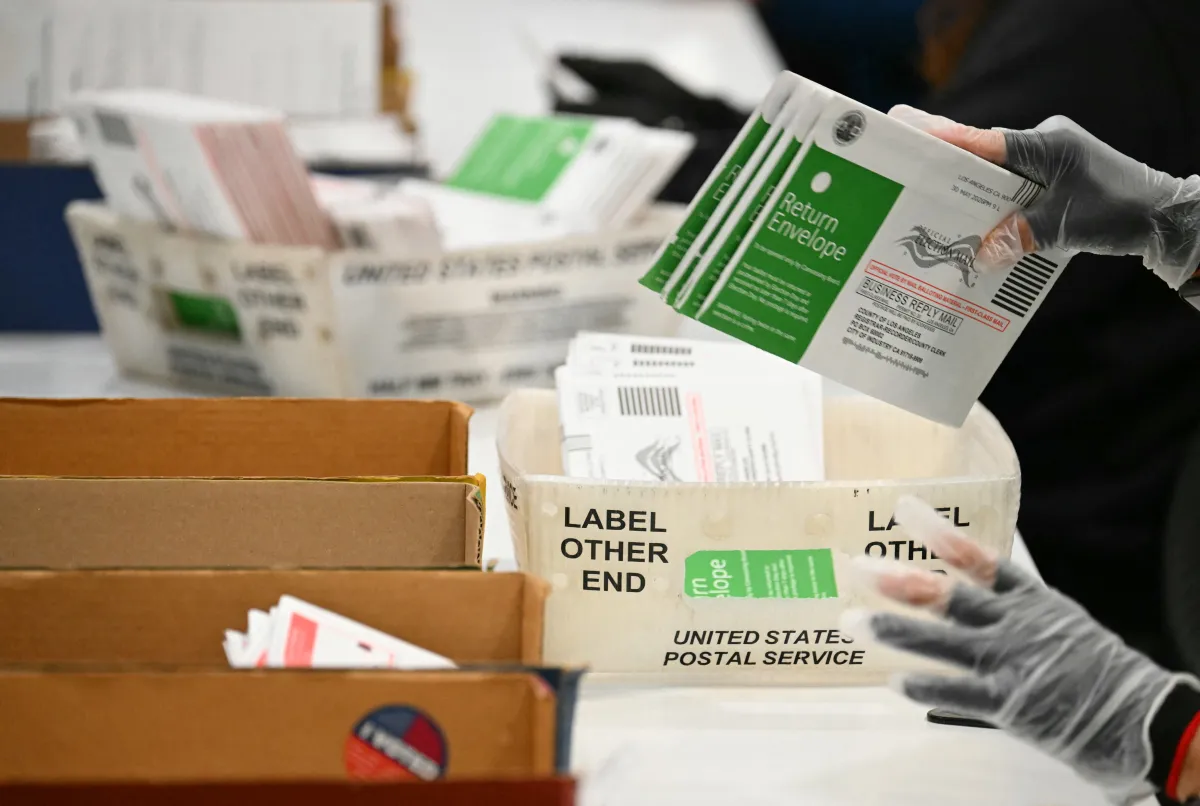
1. A Storm Brews Over California’s Ballots
Less than three weeks before Election Day, a legal storm has descended upon California’s electoral process. The U.S. Department of Justice, acting under the directive of the Trump administration, has revealed the inner workings of a federal investigation that flagged more than 20,000 registered voters in California as “likely noncitizens.” The department has asked a federal court for an emergency order to prevent the mail ballots of these individuals from being tabulated until their citizenship status can be definitively verified. The move has sent shockwaves through the state’s political establishment, triggered a fiery legal battle, and ignited a fierce debate about the delicate balance between election integrity and the fundamental right to vote. At the heart of the conflict is a seemingly simple question: Can the federal government’s data, pulled from vast and imperfect databases, be trusted enough to silence the votes of tens of thousands of people, many of whom may be American citizens? The answer, as California officials see it, is a resounding no, and they have accused the administration of wielding a blunt and error-prone instrument against the state’s diverse electorate. The lawsuit, filed on a Thursday just days before the midterm elections, is not merely a technical dispute over voter rolls; it is a high-stakes confrontation over who gets to participate in American democracy, and under what conditions, with the entire nation watching closely.
2. Inside the Federal Vetting Machine: From Data Points to Allegations
The Department of Justice’s legal complaint lays out a multistage process that reads like a bureaucratic mystery. It all begins with U.S. Citizenship and Immigration Services, which compares California’s voter rolls against its own internal immigration databases. This initial sweep uses a sophisticated matching algorithm that categorizes potential matches into “high,” “medium,” or “low” confidence buckets. A high-confidence match, according to the complaint, means that multiple identifiers—such as full name, date of birth, and other personal details—align so strongly that the system believes it has found a clear link between a registered voter and a noncitizen. Yet the DOJ’s own filing acknowledges a core weakness: voter registration forms are rarely complete, and the information they contain can be stale, misspelled, or simply outdated. To fill in the gaps, USCIS relies on third-party commercial software to guess at potential matches, a process that can generate false positives. For those deemed high-confidence, the agency then attempts to attach the voter’s information to a specific alien number in its systems. Only after that does the real detective work begin. Investigators check whether the person has naturalized, perhaps obtained citizenship through a parent, or otherwise acquired legal status. They also cross-reference State Department records for citizenship indicators and Social Security Administration death records to ensure the person is not deceased. Before a name is sent onward, a second-level review is conducted to filter out any lingering doubts.
From there, the case files are handed to Homeland Security Investigations, the investigative arm of the Department of Homeland Security. HSI runs its own analytical platform on the names to smooth over data inconsistencies and sends the refined list to field investigators for further scrutiny. The end result of this elaborate, multi-layered pipeline is a list of more than 20,000 people that the federal government believes are not just registered to vote in California, but are likely noncitizens doing so illegally. The complaint is careful in its language, referring to these individuals as “likely noncitizens” and asking the court to order verification of citizenship before their votes are counted. However, when pressed on whether the government has definitively proven that all 20,000 are indeed noncitizens, the DOJ points to its own filing, asserting that the agencies conducted a “thorough analysis” of voter rolls and federal data. This disclaimer, buried amid the confident language of the lawsuit, underscores the tenuous foundation upon which the entire case rests—an acknowledged likelihood, not a certainty.
3. California Strikes Back: Doubt, Defiance, and a Question of Numbers
California’s election officials have responded with a mixture of indignation, disbelief, and legal pushback. Secretary of State Shirley Weber, the state’s chief elections officer, fired off a sharply worded letter to the DOJ, accusing the federal government of failing to provide the underlying data or methodology used to generate the list. She noted that the DOJ had initially alleged a far larger problem, claiming earlier that as many as 190,000 registered voters in California “may be” noncitizens. Now, with the list narrowed to roughly 20,000, California officials are questioning what happened to the other 170,000. “What happened to those 170,000? They just got those wrong,” said California Attorney General Rob Bonta, echoing a skeptical sentiment that the federal government’s numbers are unreliable. Weber also pointed to the lack of actionable detail, stating that the list, delivered on a password-protected thumb drive, was practically unusable. To make matters worse, reports surfaced that the password had been written on a sticky note attached to the drive—an almost absurd detail that underscored the slapdash nature of the federal effort.
County officials, particularly in Los Angeles County, refused to even access the drive, citing serious data privacy and information security concerns. Weber’s letter went further, highlighting a similar federal accusation in Nevada, where the DOJ initially claimed nearly 16,000 potential noncitizens were on the rolls but ultimately failed to establish that a single person was actually a noncitizen. She argued that this pattern demonstrates a systemic flaw: the federal government’s matching process is not just imperfect; it is dangerously over-inclusive, casting too wide a net and ensnaring citizens in the process. The DOJ, for its part, declined to explain the discrepancy between the 190,000 and 20,000 figures, adding further fuel to California’s argument that the entire exercise is arbitrary and politically motivated. For Weber, the demand to verify citizenship for 20,000 people before their ballots are counted is not just an administrative inconvenience; it is a direct attack on the voting rights of Californians, many of whom have every legal right to cast a ballot.
4. The Federal Ultimatum and the Legal Escalation
The conflict reached a boiling point when the DOJ issued a demand letter on a Tuesday, giving California officials just 48 hours—until noon on Thursday—to review the list and take action. The instructions were unequivocal: for any person whose citizenship could not be independently confirmed, California was to segregate their returned ballots without canceling them, stop all signature verification and tabulation for those ballots, and refrain from sending ballots to any individuals on the list who had not yet received one. The letter warned that if California failed to comply, the federal government would “seek emergency relief.” Attorney General Todd Blanche framed the demand as a reasonable step, noting that California could simply correct its records or set aside the questionable ballots while the government investigated. But California refused, and the DOJ swiftly escalated the matter by filing a lawsuit in the U.S. District Court for the Central District of California.
The federal government is now seeking both a preliminary injunction and a permanent injunction to block the state from counting vote-by-mail ballots from the flagged individuals until their citizenship can be confirmed. The legal argument rests on the Supremacy Clause of the U.S. Constitution, which establishes that federal law trumps conflicting state law. The DOJ contends that California’s refusal to comply violates the federal prohibition on noncitizens voting in federal elections. By proceeding with tabulation, the lawsuit argues, California is knowingly facilitating unlawful voting and undermining the integrity of the election. The tone of the filing is aggressive, portraying the state as actively obstructing federal efforts to uphold immigration law. Yet the case hinges on a fundamental threshold question: has the federal government provided conclusive evidence of noncitizenship for these individuals, or is it merely acting on a statistical likelihood? The DOJ’s own language, with its repeated use of “likely” and “believed,” suggests a degree of uncertainty that California is eager to expose in court. For the state, the lawsuit represents a trifecta of objections: it is procedurally flawed, legally dubious, and substantively dangerous.
5. Jurisdictional Battles, Expired Deadlines, and Fears of Voter Suppression
California’s legal team has not been idle in crafting its defense. Secretary Weber raised a pointed objection in her Thursday letter, referencing an October 9 federal court order that vacated a DOJ policy involving the comparison of state voter rolls with federal databases. She suggested that the DOJ’s current demand may be rooted in a policy that a court has already deemed unlawful. If that argument takes hold, the entire basis for the federal lawsuit could crumble on procedural grounds. Additionally, state officials have pointed to federal law restricting “systematic voter-roll removals” within 90 days of an election. By attempting to remove or segregate thousands of voters at this late stage, the DOJ may be in direct violation of this statutory wall. Attorney General Bonta emphasized this point, noting that the administration’s demand could run afoul of protections designed to prevent last-minute purges that disenfranchise eligible voters. Governor Gavin Newsom, ever the vocal critic of the administration, called the lawsuit a “sad, desperate attempt” to suppress voter turnout, framing it as a calculated political move rather than a genuine effort to enforce the law.
The timing is undeniably critical: early voting is already underway across the state, and mere days remain before the polls close. Election law experts, including Rick Hasen of UCLA, have expressed skepticism about the federal government’s authority to directly instruct states on which ballots to send or count. Hasen told reporters that he sees no constitutional basis for such federal oversight of state election processes. Meanwhile, the broader context of noncitizen voting looms large. The issue has become a rallying cry for the Trump administration, though documented cases of noncitizen voting remain exceedingly rare. A Reuters investigation published earlier this year identified only 129 people who had been prosecuted for noncitizen voting since the federal statute criminalizing the practice was enacted in 1996. Against that backdrop, the sudden urgency to block 20,000 California ballots appears, to critics, to be less about solving a real problem and more about casting doubt on the integrity of the upcoming election. The lawsuit, in their view, is a political weapon cloaked in legal garb, designed to sow chaos and undermine public confidence in the democratic process.
6. A Contentious Crossroads for American Democracy
As the legal battle unfolds, the nation finds itself at a contentious crossroads. The DOJ’s lawsuit is not just about 20,000 ballots in California; it is a test of how far the federal government can go in challenging state authority over elections, and how much weight can be placed on algorithmic database matching when fundamental rights are at stake. The federal government argues that it has a duty to enforce immigration and election laws, and that a small degree of inconvenience is a necessary price to pay for ensuring that only citizens vote. California counters that the process is riddled with errors, that the government has failed to prove its case, and that the remedy sought—segregating ballots for an undetermined length of time—violates the very principles of enfranchisement upon which the country was built. In the middle are the voters themselves, thousands of ordinary people who may have no idea they are being scrutinized, awaiting a court decision that could determine whether their voices are heard in this election.
The case will likely turn on a series of technical legal arguments: preemption, the 90-day prohibition, the validity of the October court order, and whether the federal government can demonstrate irreparable harm. But underneath those arguments lies a deeper, more human concern. What if a U.S. citizen, naturalized or native-born, finds their ballot cast aside because of a typo or a missing middle name? What if their right to vote is falsely stripped away due to a bureaucratic mismatch? The federal government’s confidence in its data is met with profound distrust from a state that has long prided itself on guarding access to the ballot. In the end, this lawsuit may be remembered not for its legal precedent, but for the questions it raises about the fragility of trust in our institutions. Can Americans rely on the state to protect their vote? Can they rely on the federal government to defend the law without crossing the line into intimidation? As the Election Day approaches, the answer remains as murky as the data at the center of the dispute—a reminder that even the most straightforward-sounding issue can become a battleground when stacked against the promise of democracy itself.