



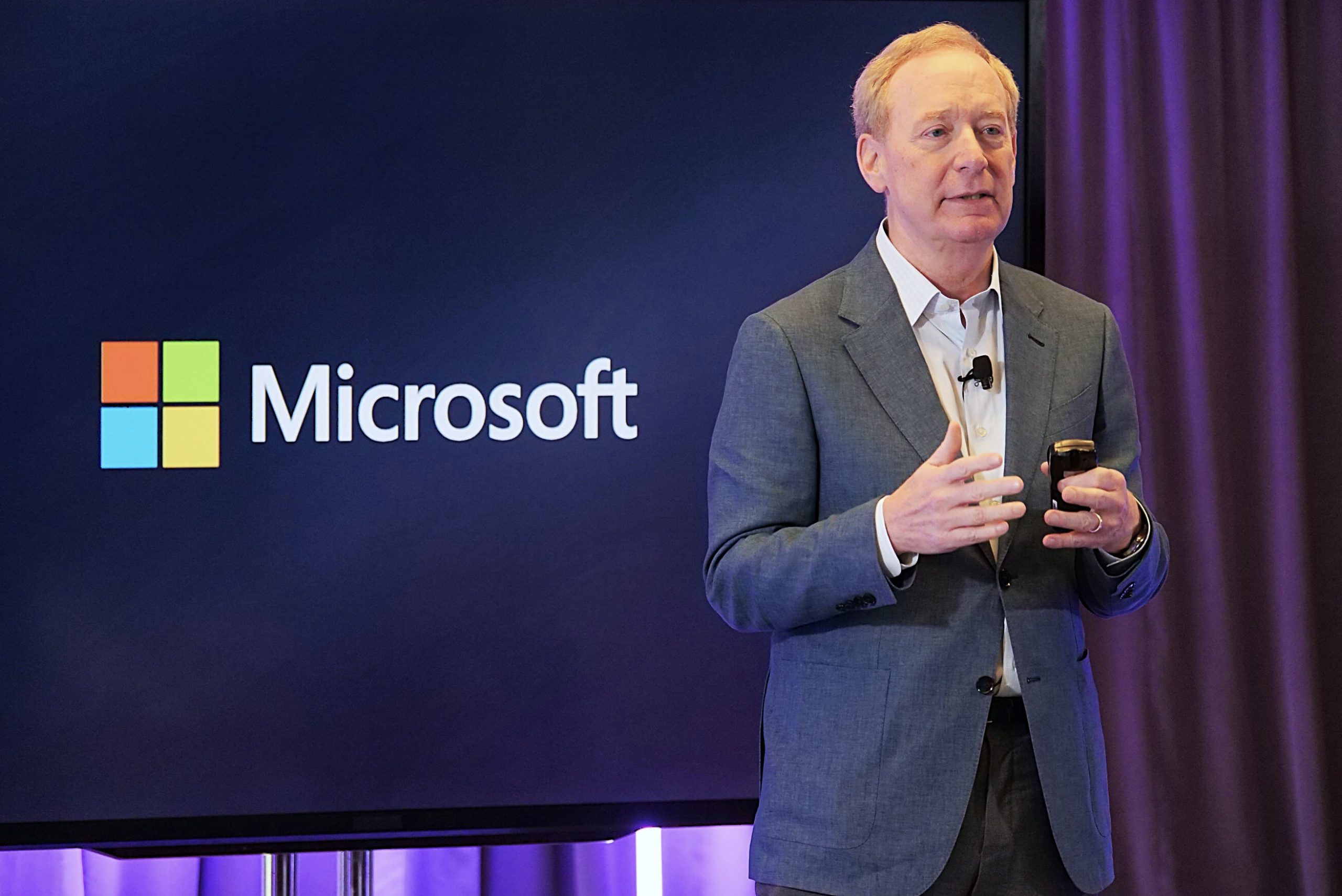
There’s a moment in every high-stakes public dispute when a company can either stay silent or fight back. For Microsoft, that moment arrived this week, and President Brad Smith chose to fight. In an interview published Thursday with Politico, Smith pushed back forcefully against the Trump administration’s decision to block Microsoft from sponsoring foreign workers for permanent residency — and against the accusations that led to that decision. The administration, he said, had gotten the facts wrong. Someone, in his words, “failed to inform the vice president accurately about our numbers.” The result, he argued, is a policy based on a distorted picture of how Microsoft actually hires, who it employs, and what it pays. At the heart of the dispute is a White House claim that Microsoft has abused the U.S. immigration system, replacing laid-off American workers with cheaper foreign labor. Smith rejected that narrative in blunt terms, saying the charges were “completely off base.” He insisted that Microsoft has “always been committed to a high integrity and high compliance” approach to immigration, and he welcomed a closer look at the company’s record. “We will stand by our record,” he said. “And I hope that folks at the White House might look again and look at what we think is a more accurate picture.” The confrontation didn’t happen in a vacuum. It came after Vice President JD Vance, at a White House news conference, singled out Microsoft as the worst offender in the country when it comes to visa programs. That accusation stunned many inside the company, not only because of its severity but because Microsoft executives believe the underlying data tell a very different story. Smith’s response was carefully measured but unmistakably firm. He didn’t just defend Microsoft’s compliance systems; he challenged the administration to re-examine its own numbers. In doing so, he turned a corporate controversy into a broader conversation about how the United States treats the immigrants who help power its technology industry.
The accusations that prompted this clash were stark. Speaking at the White House last week, Vance laid out a simple and damning arithmetic: Microsoft laid off 6,000 American workers last year, he said, while receiving 6,300 H-1B visas and nearly 3,000 green cards. “If you do the math,” Vance declared, “for every worker that Microsoft laid off, they replaced that worker with one and a half foreign indentured servants.” He went further, asserting that “there has been no company in the United States, unfortunately, that has abused the system more than Microsoft.” Those words were calculated to resonate in an election season and on social media, where the H-1B program has become a lightning rod. But for Microsoft, they were also a direct attack on the integrity of thousands of its employees — many of whom came to the United States years ago, earned advanced degrees, and have been working legally, paying taxes, and building products used around the world. To describe such people as “indentured servants” is not just inaccurate, Smith suggested; it is dehumanizing. It ignores the fact that these are not nameless cogs but engineers, researchers, and designers who chose to build their lives in America. Smith’s response was not to deny the existence of layoffs or visa applications, but to put them in context. The company has had layoffs, he acknowledged, as most large technology companies have in recent years. But the idea that those layoffs were a pretext for importing cheaper replacements? That, he said, is where the administration’s math falls apart. The visa numbers cited by Vance, Smith explained, do not represent new hires brought in to replace Americans. They represent a backlog-ridden system in which people already working at Microsoft, often for years, are finally moving through the paperwork needed to stay permanently. The vice president’s speech, in other words, took a complex immigration reality and flattened it into a sound bite. And in doing so, Smith argued, the White House punished a company that was simply trying to follow the rules.
Behind the corporate language, Smith was making a deeply human argument about who these workers actually are. Most of Microsoft’s recent visa and green card applications, he said, were for people already working at the company — many of them for years. They weren’t strangers plucked from abroad to undercut American wages. They were teammates, colleagues, and neighbors who had been waiting in line for a green card for so long that the immigration system itself had become a kind of holding pattern. The long backlogs mean that a worker who arrives on an H-1B visa at age 25 may spend years, sometimes a decade or more, in a state of legal limbo, unable to change jobs freely or plan for the future. When Microsoft finally sponsors that person for a green card, it’s not an act of outsourcing; it’s an attempt to bring stability to someone who has already been part of the company and the country for years. Smith also offered a number he said was missing from the administration’s story: Microsoft hired 9,200 American workers in its last fiscal year. That’s a figure, he noted, that was “left out of the narrative.” The implication was clear: a company that hires nearly ten thousand Americans in a single year is hardly turning its back on the domestic workforce. And on the question of pay, Smith was equally direct. “It doesn’t matter whether you came on a visa or you’re an American worker,” he said. “Everybody has the same compensation system.” In other words, the idea that Microsoft saves money by hiring visa holders is, in his view, a myth. The company’s salary bands are the same for everyone, and foreign workers are not a discount labor pool. That point matters because the “cheap labor” accusation is one of the most persistent and damaging charges leveled at the H-1B program. Smith’s answer was not a legalistic dodge but a simple statement of policy. If anything, he suggested, the system is stacked against the workers, not the other way around. They are the ones who endure the uncertainty, the paperwork, and the indignity of being described as “servants” by a vice president of the United States.
To understand what Microsoft actually lost, it helps to understand the machinery of the U.S. immigration system — a system so arcane that even people who work in it for a living struggle to explain it clearly. The H-1B visa is a temporary work visa, typically granted for three years at a time and generally limited to six years total. It allows a foreign professional to work in the United States, but it is not a path to permanent residence by itself. The green card, by contrast, is the golden ticket: permanent residency, the ability to stay in the country regardless of employment, and eventually a route to citizenship. In fiscal 2025, Amazon led the country in H-1B approvals for new employment, with 4,644, followed by Meta with 1,555 and Microsoft with 1,394, according to the National Foundation for American Policy. To get a green card through employment, companies must go through a program called PERM, run by the Labor Department. PERM is commonly used for employees already working in the U.S. on temporary visas, including H-1Bs. The employer is required to advertise the job and prove to the government that no qualified, available U.S. worker can fill it. That sounds straightforward, but in practice it is a slow, bureaucratic, and often baffling process. The job ads must be placed in outlets where American job seekers might see them — and, in Microsoft’s case, Labor Department records show those required print ads ran mostly in The Seattle Times. Critics of the program argue that such ads are a formality, placed in obscure spots or written in ways that make them hard for real applicants to find. Supporters counter that the process is already so burdensome that it discourages companies from using it at all. What is beyond dispute is that Microsoft has used PERM more than any other employer. According to a GeekWire analysis of Labor Department data, the company had more PERM cases decided than any other employer in fiscal 2025 and the first nine months of fiscal 2026. Other big tech companies, including Amazon and Google, sharply reduced their PERM filings after early 2023 — a sign, perhaps, of how controversial the program had become. Microsoft, by contrast, kept filing, apparently confident that it was playing by the rules. That confidence now looks like a liability. The administration’s action did not stop Microsoft from hiring foreign workers on H-1B visas. Those approvals continue. But by cutting off access to PERM, the government effectively froze Microsoft’s ability to help its existing employees become permanent residents. For the workers themselves, that means more years of uncertainty. For Microsoft, it means a workforce that cannot plan on staying.
Smith’s larger argument, however, was not just about Microsoft. It was about the country. In his Politico interview, he warned that the crackdown could send “the most talented next wave” of engineers to other countries — nations that are eager to welcome the skilled immigrants the United States is now treating as suspects. He pointed to a striking fact: five of the six tech leaders President Trump honored with national medals last week, including Microsoft CEO Satya Nadella, came to the United States as immigrants. Those leaders don’t just run their own companies. Their companies together account for more than 25% of the value of the S&P 500. That is not a small statistic. It is a reminder that the American technology industry, and by extension much of the American economy, has been built on the energy and talent of people who arrived here from somewhere else. Nadella himself is a product of the very system that the administration just cut off for Microsoft workers. He came to the U.S. from India decades ago, earned his degrees, climbed the corporate ladder, and eventually became CEO of one of the most valuable companies on Earth. His story is often held up as an example of the American Dream — a dream that, Smith is suggesting, is being closed to the next generation. “Let’s not put that at risk,” he said. The warning was not just about the fate of a single company. It was about the country’s competitive position in a world where other nations are actively courting the engineers, scientists, and entrepreneurs that the United States has long attracted. Every talented immigrant who is denied a green card is not necessarily lost to America forever — they may simply go somewhere else. And when they go, they take their ideas, their ambition, and their contributions with them. The national medal ceremony, which was meant to celebrate American achievement, became in Smith’s telling a kind of parable. The very people being honored were living proof that immigration and innovation are not opposing forces. They are the same thing.
What happens now is uncertain. The suspension of Microsoft’s PERM access does not mean the company will stop hiring foreign workers. It can still bring people in on H-1B visas, and those workers can still contribute to the company and the country — for a while. But without the ability to sponsor them for permanent residency, Microsoft is effectively telling many of its employees that they cannot count on a future in the United States. They may stay for a few years, work on important projects, and then, when their visas run out or the uncertainty becomes too much, they will leave. That is not a policy designed to protect American workers. It is a policy designed to make a point. The irony is that the people most affected are not faceless “foreign workers” or “indentured servants.” They are human beings with names, families, and stories. They are the colleague who sits in the next cubicle, the researcher who presents at conferences, the engineer who fixes the bug that was crashing the system. They are the people who waited years for a green card, only to be told that the door has been slammed shut. And for what? To score political points in a debate that has always been more about symbolism than substance. Smith’s response was measured, but the emotion underneath it was clear. He believes his company has been unfairly singled out, and he believes the administration’s numbers are wrong. More importantly, he believes the United States is making a mistake. The country has always been a magnet for the world’s best and brightest. That is not an accident. It is the result of a system that, for all its flaws, offered a path — a path that Microsoft, and thousands of other companies, have used to build the most innovative economy in history. Cutting off that path, Smith warned, does not hurt just Microsoft. It hurts the future. And once the most talented people start going elsewhere, they may not come back. In the end, this is not a story about visas or green cards or PERM applications. It is a story about whether the United States still believes in the promise that brought Satya Nadella here, and so many others like him. Smith hopes the White House will take another look at the facts. But he also made clear that Microsoft will not apologize for its record. “We will stand by our record,” he said. For a company that has been accused of abusing the system, that is not just a defense. It is a challenge.