



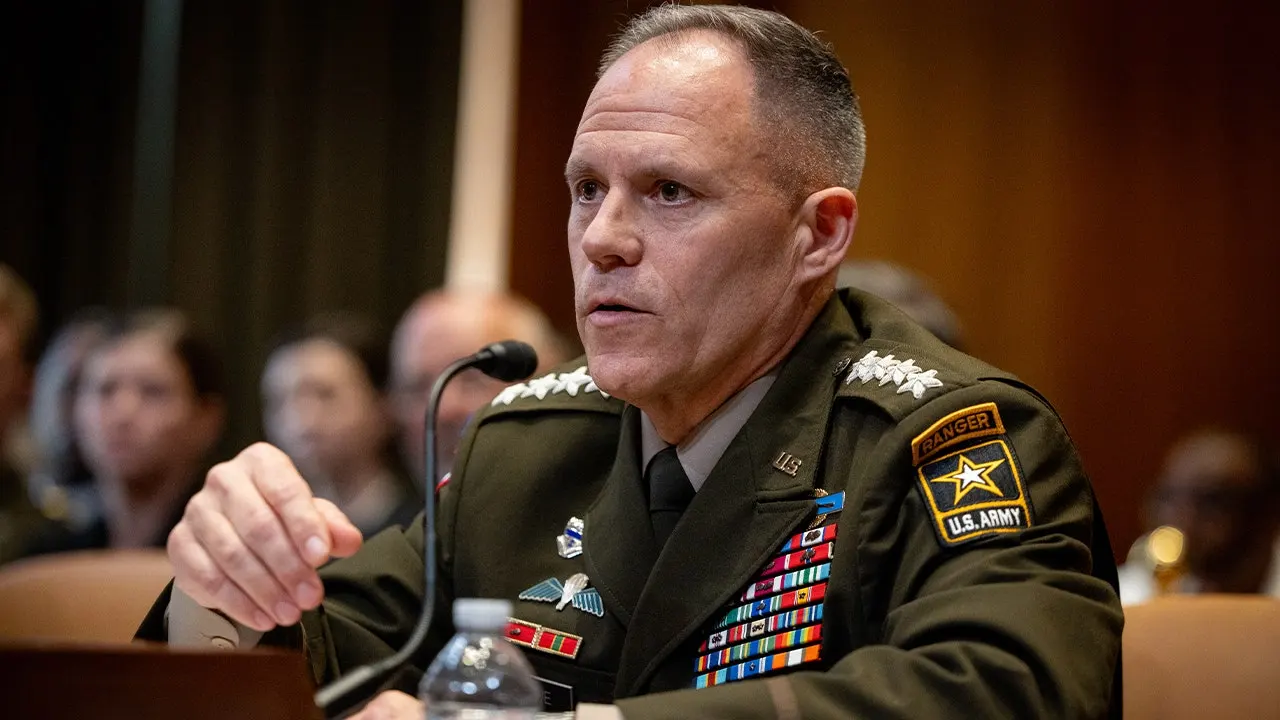
For generations, the United States military has operated on a deeply held and rarely questioned assumption: the best way to protect the American homeland is to fight the enemy somewhere else, far from American shores. From the beaches of Normandy to the mountains of Afghanistan, the logic has been consistent—project power overseas, keep the battle away from home, and maintain secure rear bases where troops can train, equip, and deploy without fear of attack. But that familiar world is rapidly changing, and senior military leaders are now preparing for a future that once seemed almost unthinkable. In a recent interview, General Christopher LaNeve, the Army’s acting chief of staff, said the United States must confront a sobering reality: in any major conflict against a pacing threat like China, the American homeland itself will likely be a battlefield. “If we’re going against a pacing threat, power projection will be contested,” LaNeve said, speaking at the Association of the United States Army’s annual conference in Washington. His words, delivered in a small-group roundtable, signaled a fundamental shift in military thinking—one born from decades of war in Iraq and Afghanistan, where American forces enjoyed secure bases, dependable supply lines, and uncontested communications. “During the Global War on Terror, we took a lot of things for granted, because we could,” he said. Now, that era of uncontested home-base security is over, and the Army is wrestling with what it means to fight a war in which the first shots may be fired at American airfields, ports, and power grids before a single soldier boards a plane.
The threat is not abstract or hypothetical. The Pentagon’s latest report on China’s military capabilities delivers a stark warning: Beijing has reportedly placed cyber capabilities inside U.S. critical infrastructure networks, positioning them to disrupt American military mobilization during a crisis. If a conflict broke out, these hidden intrusions could be used to cripple transportation networks, sever communications, and delay the movement of forces from domestic installations to overseas theaters. The concern is compounded by a wave of unexplained drone incursions over sensitive American military sites. Over the past year, unidentified aerial systems have been spotted over Joint Base Langley-Eustis in Virginia and Picatinny Arsenal in New Jersey, among others. Though these incidents have not been publicly attributed to any particular nation, they have rattled commanders and underscored a growing vulnerability. The drone threat is not limited to overseas battlefields anymore; it is now a domestic reality. Army leaders acknowledge that many installations remain “ill-equipped” to stop swarms of small, cheap drones that can disable aircraft, disrupt operations, or conduct surveillance. This is no longer a theoretical concern about some distant future—it is a present-day vulnerability that military planners are scrambling to address. The shift in mindset is profound. For decades, the U.S. military could assume that its homeland bases were sanctuaries. Now, as LaNeve and other leaders make clear, that assumption is dangerously outdated. The military is being forced to rethink not only how it fights overseas, but how it protects the ground from which that fighting begins—because in the next major war, the opening battle may very well take place on American soil.
In response to these emerging threats, the Army has rolled out a new operational framework called “How the Army Fights.” This document, intended to guide the service’s training, modernization, and strategic priorities, places unprecedented emphasis on the ability to deploy, communicate, and sustain operations even when everything is under attack. The old model of war assumed that once soldiers arrived at a secure staging area, they could prepare and launch their mission with reliable logistics and constant communication. The new framework rejects that comfort. It demands that the Army be ready to fight through disrupted supply lines, degraded communications networks, and damaged military infrastructure. In practical terms, this means units must be trained to operate “disconnected” from higher headquarters for extended periods, making decisions independently and maintaining momentum even when the digital lifeline goes dark. “I think what you would see inside this command and control capability is the ability to operate disconnected and then reconnect when you have that capability, but to continue to be able to maneuver,” LaNeve explained. This is a striking departure from the past, when commanders could always pick up a satellite phone, send an encrypted message, or call in an airstrike. The new reality is one where an adversary like China will not simply allow American forces to assemble unmolested. They will attack the networks, the bases, the ports, and the railroads—everything the United States depends on to move its military power across the globe. The framework also signals a shift in how the Army thinks about technology and training. Instead of treating new tools as luxury add-ons, the service is now integrating them into every facet of warfighting, while simultaneously recognizing that the most advanced systems are not invincible. LaNeve was careful to note that the document provides “direction for our Army, a stake in the ground in where we’re moving,” a way of setting clear priorities amid the chaos of modern threats.
Protecting the homeland has become a mission in its own right, not just a preface to overseas operations. The Army is pouring resources into counter-drone defenses, partnering with federal and local law enforcement through Joint Interagency Task Force 401 to secure military installations and critical infrastructure from aerial threats. This task force represents a broader shift toward integrating the military more deeply with domestic security efforts. The southern border has become something of a living laboratory for these new capabilities. Acting Army Secretary Adam Telle noted that soldiers operating along the border are already confronting drone threats in real-world conditions, using the mission as a proving ground to test new counter-drone technology against actual adversaries. Those soldiers bring both success stories and lessons learned back to their home units, helping the Army refine its approach to a threat that is evolving faster than traditional acquisition cycles can keep up. It is a rare opportunity to experiment under live conditions, and the Army is embracing it. But the threat to the homeland is not only aerial. The military is also expanding its preparation for biological incidents—natural disease outbreaks or deliberate attacks—that could cripple the force just as effectively as bombs. This week, officials announced that biological incidents will be integrated into routine combat training as part of a broader effort to ensure soldiers can continue functioning through outbreaks or deliberate biological attacks. The logic is straightforward: if a contagion sweeps through a military barracks or a deployment hub, it could grind operations to a halt just as quickly as an enemy assault. By exposing soldiers to these scenarios in training, the Army hopes to build resilience into the force, so that even if the environment is contaminated or the medical system is overwhelmed, the mission can still go forward. This is a military learning to fight on many fronts—physical, digital, biological—all at once, and it represents a profound expansion of what homeland defense actually means.
The Army’s concerns are echoed across the Department of Defense, where other service leaders are sounding alarms about the rapid pace of technological change. Air Force Secretary Troy Meink warned that advances in surveillance technology are pushing the military toward a day when no force, anywhere on the planet, can hide from an enemy’s eyes. “We are rapidly heading to a point in time where, depending on what your signature is, how fast you’re moving, the enemy is going to have some sense to where you are no matter where you are on the planet,” Meink said during a panel meeting of the service secretaries. He suggested that level of pervasive surveillance could emerge within five years—or even sooner—as China and other adversaries build constellations of satellites, drones, and advanced sensors capable of tracking military assets in near-real time. For commanders, that means the traditional art of moving troops and equipment in secret is becoming increasingly impossible. The response, Meink said, is to make military forces more survivable and more distributed, to rely on autonomous systems that can operate in dangerous environments where sending a piloted aircraft or a crewed vehicle would be far too risky. The Pentagon is investing heavily in these uncrewed platforms, not simply as a matter of convenience, but out of necessity. In a world where everything can be seen, the ability to act without risking lives becomes an operational imperative. The urgency of this transformation was underscored by Defense Secretary Pete Hegseth, who did not mince words when criticizing the previous administration’s approach to military technology. “On hypersonics, they took a nap. On space, they took a nap. On weaponization of space, they took a nap. On drones, they took a nap,” Hegseth said, delivering a blunt verdict on what he characterized as years of stagnant innovation. Whether or not one agrees with his assessment, the sentiment reflects a growing consensus inside the Pentagon that the United States cannot afford to be complacent in an era where technological dominance is the key to military survival.
Amid all this new emphasis on advanced robotics, artificial intelligence, satellite constellations, and hypersonic missiles, there is a quieter but no less powerful message being repeated by Army leaders: the soldier is still the center of everything. LaNeve was emphatic on this point. “Soldiers are our number one platform. It is the Army’s platform,” he said. Technology, he explained, is meant to make troops more capable, more informed, more protected—but it is not meant to replace the fundamental skills and human judgment that have always defined the Army. In fact, the new focus on fighting through disrupted communications demands soldiers who are even more capable on a basic level: more disciplined, more adaptive, more comfortable in chaos, more willing to make decisions without a higher headquarters telling them what to do. The Army is walking a delicate line here—embracing the future without losing the past. It is investing billions in autonomous vehicles and connected networks, but it is also ensuring that every soldier can still navigate by compass, maintain a weapon in austere conditions, and operate effectively without a screen. This humanizing message is important, because the threat of contested power projection, cyberattacks, and drone swarms can make modern warfare feel cold and mechanical. But the leaders speaking at this week’s conference reminded everyone that wars are still fought by people—by young men and women who may find themselves confronting enemies not in some faraway desert, but in the skies over their own country. The military they are preparing for is one that must be ready to fight at home, to protect its own bases, to operate when systems go dark, and to endure challenges that previous generations never imagined. It is a daunting task, but LaNeve and others insist the Army is up to it. The key, they say, lies in recognizing that the foundation of American military power has always been, and remains, the soldier. Every new weapon, every new vehicle, every new algorithm is ultimately in service to that simple truth. And as the Pentagon prepares for a future where the homeland is no longer a sanctuary but a battlefield, the resilience, adaptability, and courage of those soldiers will be the most important asset of all.