


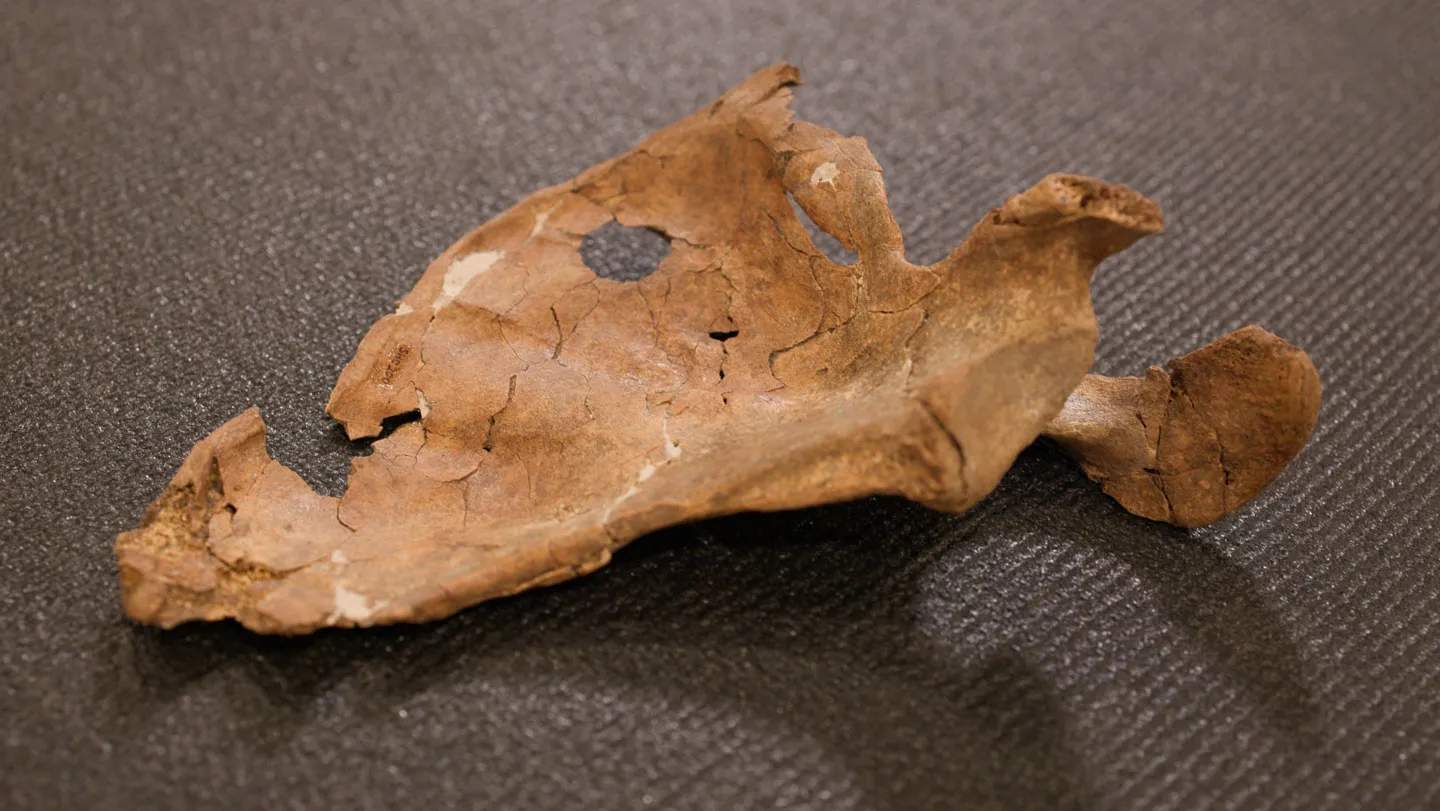
Deep in the limestone of Iraqi Kurdistan, in a cave that has already reshaped how we see our ancient cousins, a new set of bones tells a story that is both brutal and tender. The cave is Shanidar, one of the most famous Neandertal burial places in the world, and since 2019 archaeologists have been carefully uncovering remains there. Among the ribs, hand bones, and teeth of at least three previously unknown individuals, they found a shoulder blade with a strange, almost perfectly round hole in it. The team named the person to whom it belonged Shanidar A, and they think this individual lived roughly 75,000 years ago. At first, the hole was a puzzle. It was too neat to look accidental, too distinct to seem like ordinary decay. A biological anthropologist at the University of Cambridge, Emma Pomeroy, recalled thinking, “It’s so round, it’s like, what is it?” The researchers had to rule out the usual suspects: roots that sometimes grow through bone, insects that chew and tunnel, the slow crumbling of a fossil over millennia. None of those explanations fit the shape or the nature of the damage. Instead, when they sifted the sediment surrounding the shoulder blade, they found tiny fragments of bone from the wound itself. That discovery said the blow had happened while the body still had structure, not after the skeleton had fallen apart. The hole was not ancient decomposition; it was an injury. And, as the researchers reported on October 15 in Scientific Reports, the wound seems to have happened at the very end of this Neandertal’s life. There were no signs of healing around the puncture when the bone was examined under microscopes and with X-rays. The shoulder was pierced either just before death or very close to it. A round, unhealed hole in a shoulder blade is not the kind of thing you normally get to see, and it opens a door into a single human moment that happened tens of thousands of years ago.
But what made that hole? To answer the question, the team did not just speculate. They compared the damage to fossilized animal bones found alongside ancient human tools, and they looked at experimental wounds created by modern researchers who had recreated Paleolithic weapons and used them on animal carcasses. The shape of the wound was the key. Stone-tipped spears, the archaeologists knew, tend to leave a more angular, diamond-shaped puncture because of the way stone points slice and tear. Wooden spears, by contrast, often leave a round opening, because a sharpened shaft of wood makes a cleaner, more circular impression as it enters the body. The wound in Shanidar A’s shoulder blade was unmistakably round. Bruno Maureille, an anthropologist at the University of Bordeaux in France who was not part of the research team, put it bluntly: the wound was “absolutely, without any question” made by a wooden spear. That does not necessarily mean Shanidar A was murdered in cold blood. It could have been a hunting accident, a violent encounter with another person, or even the deliberate piercing of a body after death. What is clear is that the individual’s life ended in a moment of shocking, visceral violence. A wooden spear, thrust or thrown by another hand, punched through the shoulder blade of someone who had already survived a great deal. It is a chilling image, but it is only half the story. The same skeleton that carries that fatal wound also carries evidence of something much more compassionate, and perhaps much more surprising.
Neandertals have long been known to live hard, dangerous lives. They hunted large animals with weapons that required getting close enough to be kicked, gored, or knocked down. They walked over rough terrain, broke bones, and suffered the wear and tear of a demanding life. Many skeletons from the Neandertal fossil record show injuries that had time to heal, evidence that they were not always left behind when they were hurt. But the archaeological record also contains occasional signs of something darker: stabbing, pummeling, and perhaps intentional violence between members of the same ancient human family. These hints go back hundreds of thousands of years, to hominids, both modern humans and their extinct cousins, who may have raised their hands—and their weapons—against one another as far back as 430,000 years ago. At Shanidar itself, another Neandertal has been found with a rib that was probably stabbed. Shanidar A now adds another possible case to that gallery of ancient conflict. Yet the same skeleton is the reason this discovery is so powerful, because it refuses to let us see these ancient people as only violent or only vulnerable. The shoulder wound tells us how one life ended. But another part of this person’s body tells us how they were able to keep living through something that should have been devastating. Alongside the other remains, the team found a broken incisor, a front tooth that had been shattered so badly it could only have been caused by a serious blow to the face. The tooth did not break at the end of life, though. Tartar buildup, or calculus, around the tooth showed that it had splintered many years before Shanidar A died. This person lived with a terrible facial injury for a long time, possibly years.
Living with a broken, shattered tooth is not simply a matter of enduring an ugly smile. It would have made eating painful, drinking agonizing, and speaking difficult. An exposed tooth root and the surrounding damage from a heavy blow to the face would have been a source of constant, grinding pain, especially at first. It would have been hard to chew the tough, fibrous foods that Neandertals ate, and harder still to bite into anything at all. Pomeroy noted that “given it would have affected their ability to eat, to drink—they’d have been in massive amount of pain at first—it’s likely [to] have needed some care.” In other words, Shanidar A could not have survived that facial injury alone. Someone had to help. Someone had to bring food, find softer things to eat, offer water, maybe tend to the wound and keep it clean. Someone had to simply stay close and make sure that a hurt and vulnerable person was not abandoned. This is not the picture of a cold, indifferent brute. It is the picture of a community that took care of its own, or at least of one person who mattered enough to be supported through a long recovery. The combination is remarkable: the same individual who died at the point of a wooden spear had once been someone who received help, who was allowed to live despite a disability, who was not simply left to die when they could no longer fully keep up with the group. As Pomeroy said, this single set of remains suggests that Neandertal behavior is complex, adding, “Like us.”
A finding like this matters because it challenges the simple stories we like to tell about ancient people. For a long time, Neandertals were imagined as brutish, dim, and solitary. In recent decades, science has pushed back against that image, revealing that they buried their dead, made tools, used fire, and probably shared complicated emotional lives. But even now, there is a temptation to separate the good and the bad: to imagine either noble savages or violent apes. What Shanidar A shows is that both cruelty and care can exist in the same life. This person was harmed, badly, early in life, and survived. This person was also killed, or at least found their body pierced by a spear, in a moment of violence. The two things are not contradictions. They are part of being human, and Neandertals, it seems, were deeply human in that complicated way. Libby Cowgill, a biological anthropologist at the University of Missouri, was not involved in the study, but she captured why the discovery is so exciting. There are, she said, “a lot of ways to die that leave absolutely no mark on your skeleton.” Disease, fever, starvation, old age, even many kinds of trauma can pass without leaving a trace in the bones. So any injury that does survive in the fossil record is a precious clue, not just to how someone died but to how they lived. The visible trauma on Shanidar A is especially precious because it tells a longer story: a story of a face broken and healed, a shoulder pierced and never healed, a body that carried the marks of both suffering and survival. It is rare to see so much of a single Neandertal’s biography written in their bones.
In the end, Shanidar A is not just a collection of ancient bone fragments from a famous cave. Shanidar A is a person, or at least as much of a person as the fossil record can ever give us. We do not know their name, their sex, their role in the group, or whether they were loved or feared in life. But we know they took a terrible blow to the face and kept living. We know that, years later, a wooden spear ended their life. We know that their body was cared for, or at least preserved well enough for us to find it seventy-five millennia later. We know that they were not the only one: the cave has yielded other Neandertals, some of whom also seem to have lived with injuries and been buried with intention. The researchers who studied Shanidar A suggest that the combination of violence and compassion in this one skeleton is a mirror for us. We are not so different. We hurt each other, and we help each other. We make mistakes, and we show mercy. We are capable of terrible violence and profound tenderness, often within the same lifetime, sometimes within the same family. The Neandertal who was saved after a shattered tooth and then died with a spear in his or her shoulder blade is a reminder that our ancestors, and our cousins, were not simple characters in a simple story. They were complicated, contradictory, and human in the fullest sense. And if we listen closely to what the bones are telling us, they can teach us something about ourselves: that care is ancient, that violence is ancient, and that somehow both have always existed side by side in the human heart. That is a hard truth, but it is also a beautiful one. It means that the capacity to help someone through pain is just as old as the capacity to cause that pain. And that, perhaps, is the most human thing of all.