



Paragraph 1
If you blinked somewhere between the dog days of summer and the golden glow of early autumn, you might have missed one of the most breathtaking stock market turnarounds in recent memory. Microsoft, the tech giant that seemed to be stumbling just a few months ago, has added roughly half an Amazon to its market value in less than four months. Yes, you read that correctly. Since late June, when Microsoft’s stock hit its lowest close in more than a year at $352.83, the shares have climbed with almost unrelenting momentum. By Tuesday, the stock closed at a record $543.45, pushing the company’s total value just north of $4 trillion. That’s a staggering $1.4 trillion gain in a little over three months—a number so enormous that it’s nearly equivalent to the entire market capitalization of Tesla. For context, this isn’t just a bounce; it’s a full-blown sprint. Investors who held their nerve through the shaky spring have been rewarded handsomely, and those who sold in panic are probably kicking themselves. The story feels almost human in its arc: a beloved giant gets knocked down, everyone starts doubting its future, and then it rises again with a renewed sense of purpose. But the real magic isn’t just in the stock chart—it’s in the story Microsoft has been telling about artificial intelligence, about control, and about why the next decade of computing might belong to the company that owns the platform, not just the model.
Paragraph 2
To understand just how extraordinary this rebound is, you have to remember how dark things looked at the start of the year. In January, Microsoft lost $357 billion in a single day—the biggest one-day drop in its entire history. That kind of loss isn’t just a bad day; it’s a seismic event that rattles nerves across the entire market. The culprit was a familiar mix of fear and uncertainty: investors were spooked by the company’s enormous spending on artificial intelligence and its deep, complicated reliance on OpenAI. The logic went like this: if Microsoft was pouring billions into AI infrastructure and still depending on an outside lab for its most important technology, maybe the future wasn’t as secure as everyone had believed. By midsummer, the anxiety had only deepened. According to Morningstar, Microsoft was the worst performer this year among the so-called “Magnificent Seven”—that elite group of tech stocks that includes Apple, Amazon, Alphabet, Meta, Nvidia, and Tesla. For a company that had long been seen as a steady, reliable winner, being at the bottom of that list was a humbling fall from grace. You could almost hear the whispers in trading floors and tech conferences: Was Microsoft losing its edge? Had it bet too heavily on AI too quickly? Was the OpenAI partnership a blessing or a trap? The narrative had shifted from celebration to doubt, and the doubt was loud enough to shave a third of a trillion dollars off the company’s value in a single January session.
Paragraph 3
Then came the late-July moment that changed everything. Microsoft reported its quarterly earnings, and the numbers were a thunderbolt. Azure, the company’s cloud platform, had grown by 43% and crossed the $100 billion annual revenue mark—a milestone that silenced a lot of skeptics. The market’s reaction was immediate and emphatic: the stock jumped 15.5% the very next day, one of the biggest one-day surges in the company’s recent history. It was as if a switch had been flipped. Suddenly, the story wasn’t about reckless spending or overdependence on OpenAI; it was about a tech giant that had quietly built a formidable cloud empire and was now connecting it to AI in ways competitors could only envy. But the rally didn’t stop with one good earnings report. Microsoft kept feeding the fire with a string of product moves: a revamped Copilot app designed to make AI assistants feel genuinely useful, a new AI push for Windows that promised to weave intelligence into the operating system itself, and new custom AI chips that signaled a long-term commitment to controlling its own hardware destiny. Each announcement added another layer of confidence, and the stock kept climbing. It also rode a broader wave: the entire market has been hitting record highs, driven largely by AI frenzy. The S&P 500 closed above 7,800 for the first time in the same week, even as the benchmark 10-year Treasury yield reached its highest level since 2002. In other words, Microsoft wasn’t just a lone success story—it was a leader in a race that had captivated the entire financial world.
Paragraph 4
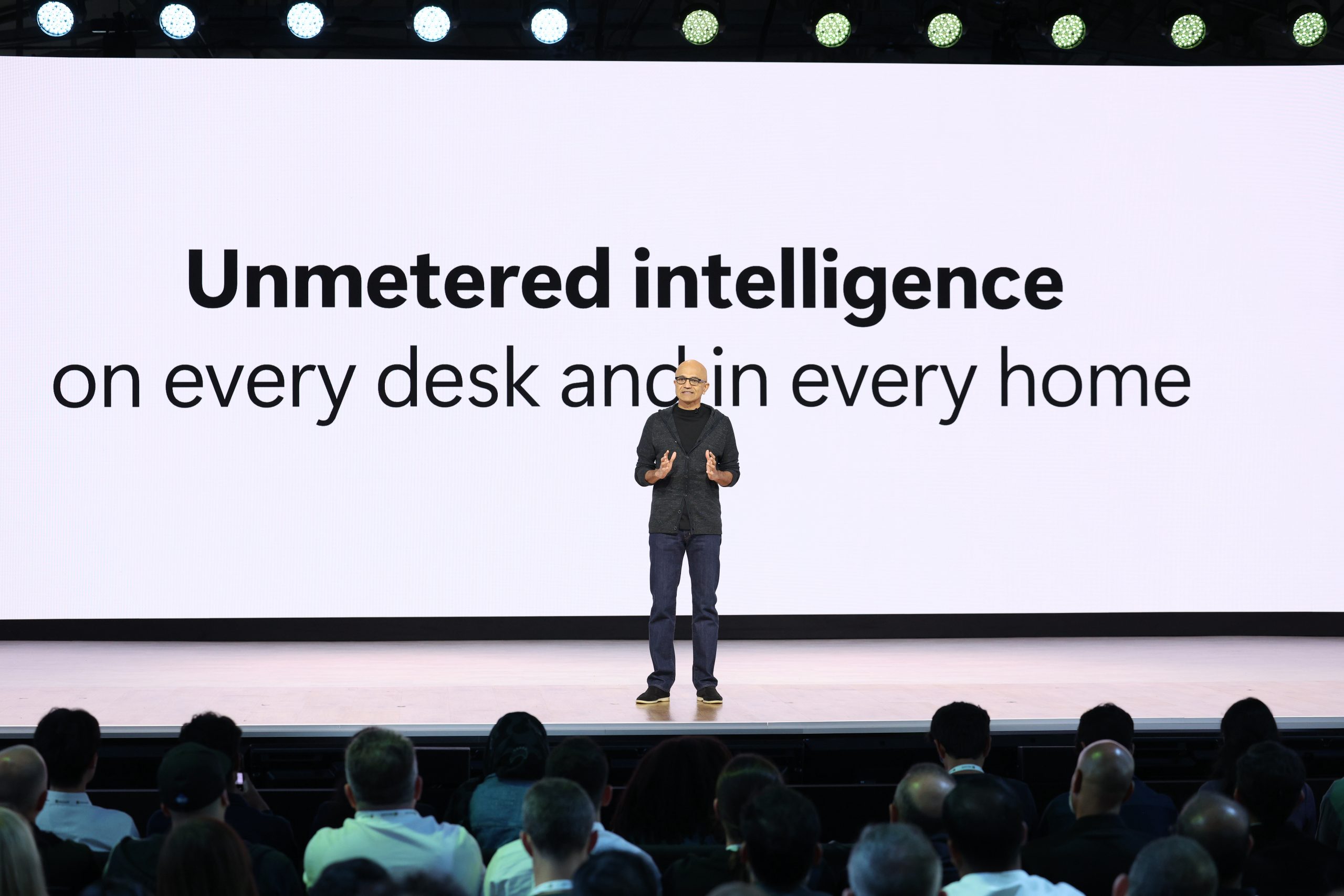
Amid all this market drama, Microsoft CEO Satya Nadella has been doing something that sets him apart from many of his peers: he’s been making a philosophical argument about the future of AI, and he’s been making it in public, in plain language, with a tone that sounds less like a corporate pitch and more like a warning from a trusted adviser. In an essay posted on X in July, Nadella cautioned companies against becoming too dependent on outside AI labs. His phrase was memorable: he warned that “paying for intelligence twice” means paying once with money and once with something even more valuable—your own knowledge. The idea is that if you hand over your proprietary data and workflows to an external model developer, you may get a clever tool in return, but you give away the very thing that makes your business unique. Nadella’s argument was not just abstract philosophy. He was steering the conversation toward a world where businesses keep control of their intellectual capital and use AI models as flexible, interchangeable tools rather than all-powerful masters. Microsoft, of course, has positioned itself perfectly for this vision. The company sells access to models from OpenAI, Anthropic, and others, alongside its own in-house models. That means Microsoft can honestly say to customers: we don’t care which model you use, as long as you use it on our cloud and in our software. It’s a clever strategy, and Nadella delivered it with the earnestness of a leader who genuinely believes he’s helping businesses avoid a costly mistake.
Paragraph 5
Last weekend, Nadella carried that message even further, with a call for an “emergency brake” on advanced AI models. It sounds dramatic, and in a way, it is. He argued that we must “separate the model from the harness that orchestrates its work” and, crucially, “assume a model is compromised and contain it from the start.” That language—containment, compromise, emergency—makes AI sound less like a shiny gadget and more like a powerful force that needs careful handling. It’s the kind of rhetoric that resonates at a moment when many people are genuinely nervous about what AI could do. But it’s also deeply aligned with Microsoft’s business interests. If companies are worried about AI safety and want to adopt multiple models from different providers, then the advantage shifts to the platform. The company that runs the cloud infrastructure and the workplace software—the place where business data actually lives—becomes the indispensable middleman. Nadella’s “emergency brake” isn’t just a safety precaution; it’s a subtle argument for why Microsoft should be the operator of the controls. By positioning itself as the responsible host, the company invites businesses to bring their data into Microsoft’s ecosystem, where they can experiment with any model they like, safe in the knowledge that the platform will keep them secure. It’s a brilliant piece of corporate storytelling, wrapped in a genuine concern for safety. And so far, the market is buying it.
Paragraph 6
Now, all eyes are on Microsoft’s next quarterly results, scheduled for October 28. That report will be the real test of whether this extraordinary rally has staying power or whether the stock has gotten ahead of itself. Analysts will be poring over Azure growth, AI-related revenue, and any hints about the company’s massive capital expenditures. But beyond the numbers, there’s a deeper question: Has Microsoft truly found a way to make AI profitable without sacrificing its identity? The past year has been a rollercoaster, from the historic January sell-off to the summer surge to the current record highs. Through it all, Nadella has tried to frame Microsoft’s journey as one of wisdom and resilience—a company that learned from its mistakes, doubled down on its strengths, and refused to be defined by someone else’s technology. For investors, the ride has been thrilling and terrifying in equal measure. For the broader tech industry, Microsoft’s rebound is a reminder that in the age of AI, the companies that own the platform, the data, and the trust of their customers may be better positioned than those that merely build the smartest model. The next few months will show whether that bet pays off, but for now, Microsoft is riding high, and the story it’s telling is one that many people want to believe. After all, who doesn’t love a comeback—especially one worth $1.4 trillion?