

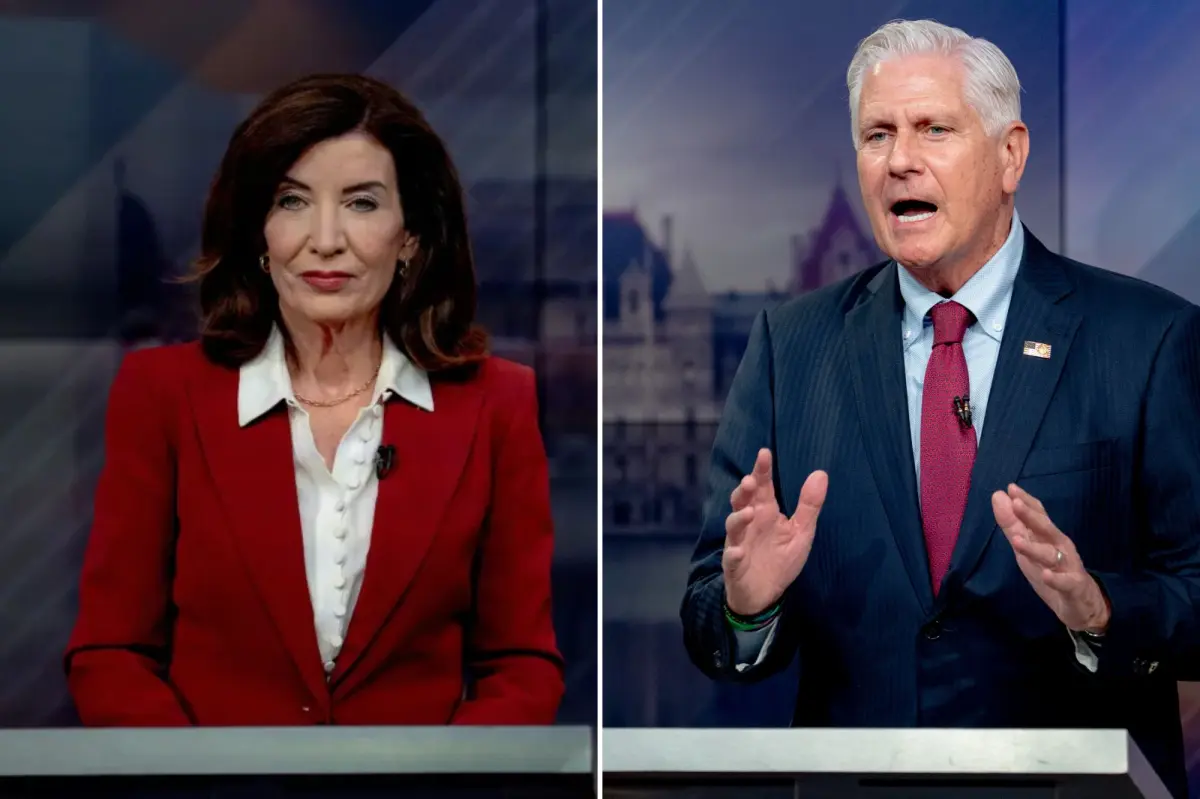
Tuesday night’s debate between Governor Kathy Hochul and Nassau County Executive Bruce Blakeman was not a policy seminar. It was a collision. For an hour on Spectrum News NY1, the Democrat and Republican went after each other with the kind of raw, personal energy that only emerges when two political rivals believe everything is at stake. They disagreed on nearly everything: immigration, sexual assault laws, taxes, crime, energy and New York’s business climate. But more than any single issue, the debate was about trust. Hochul, the incumbent, presented herself as a steady hand steering a state through crises, while Blakeman, the challenger, cast her as the product of a broken Albany culture that taxes too much, spends too freely and protects the wrong people. By the time the final question was answered, viewers had heard at least a dozen claims that were either exaggerated, stripped of context, or simply not true. A careful fact-check of the night’s most notable accusations—conducted by The Post’s reporters—shows how much of the truth was left on the cutting-room floor, and how much of what sounded confident and decisive was actually built on shaky ground.
The first big fight was over immigration. Hochul attacked Blakeman over Nassau County’s so-called 287(g) agreement with U.S. Immigration and Customs Enforcement, a program that deputizes local officers to enforce federal immigration law. She described these agreements as permitting “rogue agents roaming the streets.” The fact-checkers called that mostly false. Nassau’s agreement did let county police operate as deputized federal agents—before Hochul enacted sanctuary legislation earlier this year—but it was not a license to roam. It was a formal arrangement, and nearly a dozen other localities in New York have similar relationships with ICE, though most are limited to letting correctional facilities run detainees’ names through a federal database. The same kind of nuance was missing from Hochul’s defense of her decision to fire 2,000 state corrections officers during a 2025 staffing crisis in the prison system. She called the walkout an illegal work stoppage, and said she would “sure as hell” fire them again if thousands walked off the job. “They walked out the door and shut it,” she said. “You violated the law. Shame on you.” That was only half true. It is true that New York’s Taylor Law bars public employees from striking while a contract is in effect, and the corrections officers were indeed walking off the job. But many of the 2,000 fired guards were never supposed to be dismissed. They claimed they were on pre-approved medical leave and were swept up in Hochul’s mass termination. As of November 2025, 848 of the fired officers had been rehired, according to the state Department of Corrections and Community Supervision. That does not erase the union’s violation, but it complicates the governor’s story of simple lawlessness and makes her all-or-nothing rhetoric about the strike harder to swallow.
Energy policy produced some of the most ambitious promises and the most convenient villains. Blakeman said he would “extract natural gas from the Marcellus Shale,” the vast rock formation beneath much of upstate New York, and claimed that doing so would slash utility bills in half. The fact-checkers were blunt: highly unlikely. Fracking has been banned in New York since 2014, when Governor Andrew Cuomo issued an executive order, and the legislature codified that ban in 2021. Even if Blakeman managed to win the governor’s mansion, he would need a Democratic legislature to cooperate—not an easy task for a Republican from Nassau County. Hochul, for her part, was asked what she was doing about New York’s energy costs, which are roughly the third highest in the country. She quickly turned the blame outward. “You know what the real problem is?” she said. “I’ve got Donald Trump standing in the way of my energy projects.” She also cited the war in Iran. There is some truth there. President Trump has aggressively resisted wind farm development, both in New York and nationally, and his administration has offered energy companies billions of dollars to buy back their contracts in a bid to preserve fossil fuels. But Hochul’s hands are not clean. Some of her own initiatives, including the 2019 Climate Leadership and Community Protection Act, have arguably driven rates up by forcing providers to spend heavily to comply with ambitious mandates. That law, passed while Hochul was lieutenant governor, requires the state to get 70% of its electricity from zero-emissions sources by 2030 and 100% from clean sources by 2040. Blaming Trump for high energy bills may be politically convenient, but it omits a decade of New York’s own policy choices.
The battle over upstate’s future turned into a strange argument about data centers and smokestacks. Hochul, who signed a one-year moratorium on new data center construction in July, accused Blakeman of wanting to industrialize the entire region. “It feeds into your vision for upstate New York,” she said, “because you also want oil rigs, and gas rigs all over New York. You want to see data centers everywhere. You want smokestacks everywhere.” The fact-checkers found this half true—but in a way that cut against Hochul. Blakeman has indeed expressed enthusiasm for data centers. He called them “the fastest growing industry in the world” during the debate. But he has also been adamant that local communities should decide whether to accept them. In a WGRZ-TV interview three months earlier, he said data centers could “create prosperity, new jobs, and rebuild infrastructure in a lot of these communities, and repopulate some of these communities.” He stressed that they should be placed only where people actually want them. “If we make it so it’s a win-win,” he said, “then we can put these data centers in places where people actually want them.” He also supports bringing fracking to upstate, which may explain Hochul’s “smokestacks” line, but even there he said the approach should be community-focused. Hochul’s charge that Blakeman wants to blanket upstate with polluting industry was an exaggeration of his actual position. It made for a good sound bite, but it did not reflect the nuance of his record, nor did it acknowledge that many struggling upstate communities might welcome the jobs and tax revenue he was talking about.
Taxes and personal records were another flashpoint. Blakeman, who has made cutting income taxes the centerpiece of his campaign, tried to turn Hochul’s own past against her when she attacked him over property tax votes he cast as a Nassau County legislator in 1998 and 1999. “You didn’t want to give illegal migrants driver’s licenses,” he said. “Now you’re giving it to them. Property taxes? You’re going to talk about something I did 28 years ago.” On this point, the facts were on Blakeman’s side. Hochul received an “A” rating from the National Rifle Association during her unsuccessful 2012 congressional campaign, and she spoke openly about her opposition to then-Governor Eliot Spitzer’s 2007 executive order allowing undocumented immigrants to get driver’s licenses without proving legal residency. In a campaign ad the previous year, she said, “I led the fight against giving illegal immigrants drivers licenses.” She later won a special election to replace Republican Rep. Chris Lee, who resigned after it was revealed he had sent a shirtless picture and salacious emails to a woman he met on Craigslist. That is a far cry from the identity of a progressive champion that Hochul now presents to voters. But her own record on taxes is more complicated. Hochul insisted during the debate that she had cut middle class tax rates to their lowest level in 70 years. That is technically true, but only if you ignore the flip side. She did lower rates for middle-income earners—to 5.30% for single filers earning between $13,900 and $80,650, and 5.80% for those earning between $80,650 and $215,400 in 2026. Yet those cuts were financed by steep increases on the wealthy. In April 2021, while Hochul was lieutenant governor under Andrew Cuomo, New York raised income taxes on residents making more than $2 million, with rates climbing to 9.65% for the highest earners, and to 10.3% and 10.9% for those making $5 million and $25 million respectively. The increases were billed as temporary, set to expire in 2027—until Hochul extended them through 2032. Blakeman’s retort that income taxes had gone up by $8 billion under her watch may have been a simplification, but it pointed to a real problem with the governor’s boast.
Finally, there was Hochul’s most sweeping economic claim. Rebuking Blakeman for citing studies that placed New York last in the nation for economic outlook, the governor declared that the state had “the fastest growing economy in the United States of America.” She added, “we are exploding.” The fact-checkers gave her a technical pass: the U.S. Bureau of Economic Analysis did report that New York had the highest increase in gross domestic product between the first and second quarters of 2026, a 4% jump that was nearly double the national growth rate of 2.2%. But that statistic, while true, is a snapshot, not a trend. New York’s population has been stagnant for years, and the state has the highest tax burden in the country. According to the Citizens Budget Commission, it also has the second-highest government spending per capita, behind only oil-rich Alaska. Those structural problems do not disappear just because one quarter’s GDP numbers happen to be favorable. Blakeman, unsurprisingly, hammered on those points. “Fastest growing economy” sounds good in a sound bite, but it tells voters little about whether they can afford to live, work and raise a family in New York. After 60 minutes of accusations, it was clear that both candidates left out whatever did not fit their narratives. Hochul wants voters to believe that the state is finally on the verge of a boom, and that only Trump and Republican obstruction stand in the way. Blakeman wants them to believe that New York is being crushed by taxes, regulations and progressive mandates, and that only he can rescue it. The truth, as always, is more complicated. But for voters, the debate may have settled one thing: they have a clear choice between two very different stories about the state’s future, and the facts that actually matter are the ones that will determine whether those stories ever come true.