


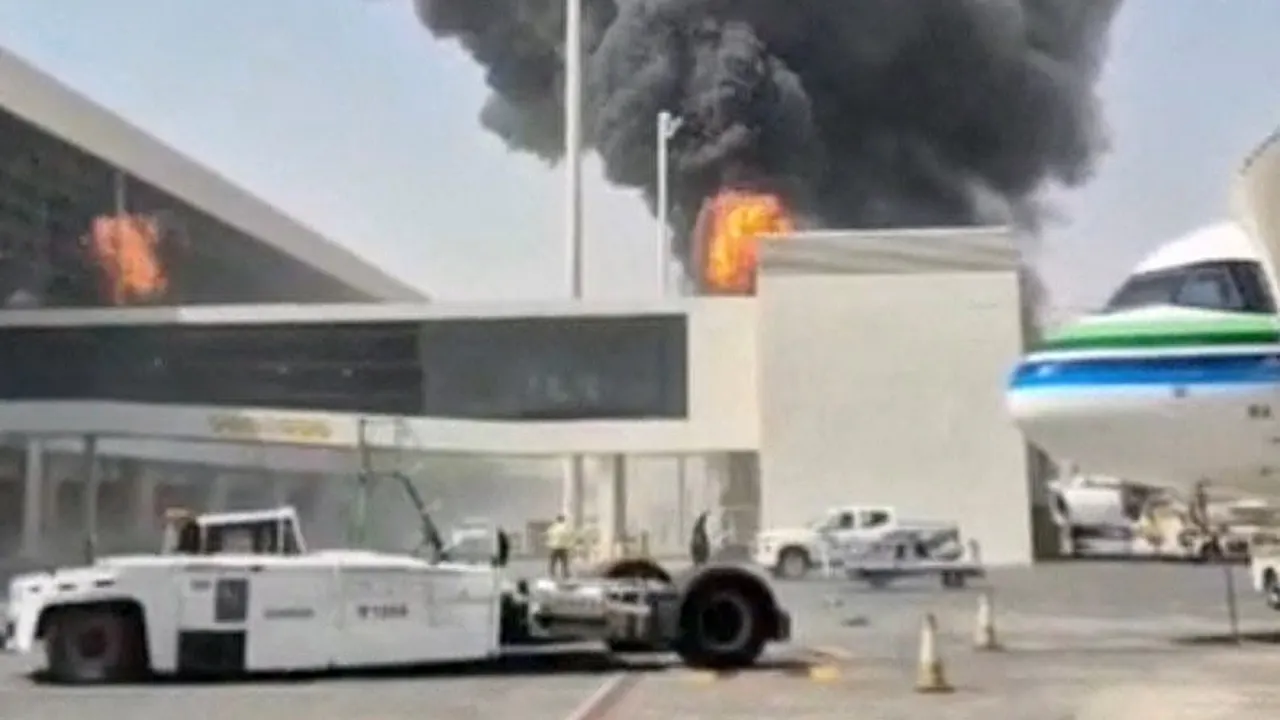
The weekend should have been an ordinary stretch of travel for thousands of people moving through the great airports of Saudi Arabia. Families were pulling suitcases, children were clutching toys, business travelers were checking watches, and airline staff were guiding crowds through security gates and boarding lounges. But the familiar rhythm of modern flight was shattered by explosions, smoke, and panic. Iran-backed Houthi forces launched a series of attacks on Saudi Arabian airports through Sunday, reportedly killing at least fourteen people, including an American, and wounding more than three hundred others. The deadliest strike hit King Khalid International Airport in Riyadh on Saturday, where thirteen people lost their lives and more than three hundred were injured. Another attack on Sunday killed a Pakistani resident and wounded eleven more. An airport in Dammam, in the kingdom’s Eastern Province, was also targeted. These were not remote military outposts or empty runways in some forgotten desert. These were civilian terminals, places where ordinary people gather to say hello, say goodbye, and carry on with their lives. The horror is not abstract. It is a father waiting for his daughter’s flight, a young mechanic fixing a luggage carousel, a nurse rushing to help a passenger in distress. When a missile or drone strikes such a place, it rips through the fabric of everyday existence. The Houthis claimed responsibility for earlier attacks and renewed their warnings to airlines, airport workers, and travelers, telling them to stay away from Saudi airports. Saudi Arabia, in turn, vowed retaliation. Regional experts warned that this is not an isolated episode but part of a dangerous escalation that could drag the entire Middle East into a wider war.
The question on many minds is why airports, and why now. To understand the attacks, one has to look at the larger strategic chessboard. The United States has imposed sanctions on Iran’s aviation sector as part of a maximum pressure campaign, effectively closing off Iran’s commercial airlines from many international connections. Iran, in turn, has long used armed proxies across the region to project power and inflict pain without directly engaging in conventional war. The Houthis, who control large parts of Yemen and have been fighting a Saudi-led coalition for years, have become one of Tehran’s most reliable partners. Behnam Ben Taleblu, senior director of the Iran Program and a senior fellow at the Foundation for Defense of Democracies, told Fox News Digital that “cross-domain escalation by Iran and its proxies will continue to be a primary strategy.” He specifically linked the airport attacks to Washington’s actions against Iran’s aviation sector. “The emphasis on aviation targets connects directly to the closing of Iran’s aviation sector and sanctions imposed on its commercial airlines under the U.S. maximum pressure campaign,” he warned. In other words, the Houthis are not simply firing randomly at Saudi infrastructure. They are sending a message that if Iran’s own aviation industry is strangled, then the region’s airports will bleed too. It is a chilling logic of collective punishment, one that turns ordinary travelers into pawns in a geopolitical war. The human cost is staggering. Beyond the deaths and injuries, there is the psychological weight: the dread of booking a flight, the fear of sitting in a terminal, the hesitation of a pilot before taking off. Airports are supposed to be gateways to opportunity and reunion. Now, in parts of the Middle East, they have become targets. That transformation is itself a victory for those who want to sow chaos.
The United States has responded with a mixture of outrage and cautious flexibility. Secretary of State Marco Rubio condemned Saturday’s attack, confirmed that an American was among those killed, and called for an immediate end to the violence. His words were strong, but they also carried a deep sadness. Behind the diplomatic language is a family somewhere in America that will never again see their loved one walk through the door. There will be an empty chair at a holiday table, a phone number that no longer gets answered, a voice that has been silenced forever. The American death is a reminder that conflicts abroad never stay neatly contained within borders. They reach across oceans and strike at the heart of communities that may have felt far removed from the fighting. President Donald Trump, meanwhile, left open the possibility of direct U.S. military involvement in Saudi Arabia’s campaign against the Houthis. “We may. We’re gonna look at it. We move very quickly,” he said. Those words are ambiguous, but they carry enormous weight. For the Houthis, they are a warning that Washington could step in with overwhelming force. For Saudi Arabia, they are a sign that its most powerful ally is not abandoning it. For the families of the victims, however, no promise of retaliation can bring back the dead. The phrase “we move very quickly” sounds decisive, but it also underscores how fast violence can spiral. One attack leads to another, one threat leads to a counter-threat, and before long, the entire region is sliding down a path that nobody intended to take. The United States has to weigh its interests, its alliances, and the risk of being dragged into another Middle Eastern war. But for the people sitting in hospitals with shrapnel wounds, or for the relatives waiting to identify bodies, such calculations seem impossibly abstract. They simply want the attacks to stop.
Iran’s fingerprints are visible in the timing and targeting of these assaults, even if the exact level of Tehran’s involvement has not been independently established. The Houthis have long received weapons, training, and financial support from Iran, and their actions often align with Iranian strategic interests. But this latest escalation also follows an explicit threat from a senior Iranian official. Mohsen Rezaei, secretary of Iran’s Supreme National Security Council, warned on September 23 that Iran would prevent neighboring countries’ airports from operating if they cooperated with Washington’s efforts to restrict Iranian flights. Reuters reported the warning, and it now sounds disturbingly prophetic. Taleblu noted, “This rapid targeting reflects earlier threats made by Iranian officials, including a veiled threat from the Secretary of Iran’s Supreme National Security Council, warning that U.S. sanctions on Iran’s aviation sector would lead to retaliatory threats against neighboring aviation infrastructure.” In other words, the attacks on Saudi airports are not a random act of terrorism. They are a calculated response to American sanctions, delivered through a proxy army. The strategy is to paralyze the region’s aviation network, disrupt economies, and create a sense of vulnerability among Iran’s adversaries. It is also a form of psychological warfare. When an Iranian official threatens to shut down airports, and then days later airports are actually attacked, the message is clear: Iran is willing to back its words with violence. For airline workers and travelers in Saudi Arabia, that message creates a constant undercurrent of fear. Every suspicious noise, every distant boom, every delay becomes a potential sign of danger. The Houthis have even urged airlines, airport workers, and travelers to avoid Saudi airports altogether. This is not just an attack on infrastructure; it is an attack on the very idea of normal life. It is designed to make people choose between safety and livelihood, between staying home and seeing distant loved ones.
The escalation has also renewed scrutiny of Russia’s role in the conflict. There have been persistent reports that Moscow has provided intelligence and technical assistance to the Houthis, though some allegations remain unproven. At a September 1 House Foreign Affairs subcommittee hearing, lawmakers pressed experts on the nature and extent of Russian involvement. Taleblu described the reports carefully: “Beyond offering diplomatic cover, there are persistent reports of Russian satellite collaboration, advisory support, and intelligence targeting assistance, as well as unproven allegations regarding select anti-ship systems.” If true, this would mean that the Houthis are not merely a local militia or a Middle Eastern proxy, but part of a broader alignment involving Iran and Russia, two adversaries of the United States and its allies. The implications are enormous. Russian satellite intelligence could help the Houthis locate targets with greater precision, including civilian airports. Russian advisory support could help them plan attacks that maximize casualties and chaos. And Russian diplomatic cover could make it harder for the international community to respond with unity. This is the new face of modern conflict: a tangled web of alliances and opportunistic partnerships, where a group in Yemen can draw on the resources of Tehran and Moscow while fighting a regional war. The human consequences are just as real as any traditional battle. A satellite image captured from space may lead to a missile that strikes a crowded terminal. A piece of intelligence shared in a faraway capital may result in a funeral in Riyadh. The attackers may never see the faces of their victims, but the victims are no less real. They are accountants and teachers, soldiers and students, mothers and sons. They are people who simply had the misfortune of being in the wrong place at the wrong time, caught between great powers that see them as collateral damage.
This surge in violence did not occur in a vacuum. As Taleblu pointed out, “Since April, the Houthis have made territorial gains and pushed back against Saudi forces despite a period of diplomatic lull.” The Houthis are not merely reacting to sanctions; they are also expanding their control on the ground in Yemen, seizing territory and consolidating power. The airport attacks are part of a broader military escalation that aims to shift the balance of power in the region. “Airport attacks allow Iran and its regional proxies to inflict pain on Arab states, Israel, and remaining U.S. forces,” Taleblu said. That is the strategic purpose: to make life so uncomfortable, so dangerous, so expensive for their enemies that they will eventually change their policies or withdraw from the region. But the human cost of that strategy is devastating. Fourteen dead, more than three hundred injured, and countless others traumatized. Behind each number is a story that will never be fully told. A Saudi father who went to the airport to pick up a relative and never came home. A Pakistani worker who had left his homeland to build a better life for his family and was killed in a foreign land. An American citizen whose death has now become a diplomatic incident between two powerful nations. The world is watching, and the choices made in the coming days will determine whether this escalation spirals into an even wider war or whether cooler heads will prevail. Saudi Arabia has promised retaliation, and the United States has not ruled out involvement. The Houthis have promised more attacks. Iran has signaled that it will not back down. And Russia, lurking in the background, may be quietly fanning the flames for its own purposes. In the midst of all this geopolitical maneuvering, it is easy to forget that the ultimate victims are ordinary people, Yemenis and Saudis, Iranians and Americans, Pakistanis and so many others who just want to live in peace. They do not want war. They do not want their airports turned into battlefields. They do not want to bury their loved ones because of a political dispute that has nothing to do with them. But they are the ones who will pay the price. The hope is that leaders on all sides will recognize the futility of this violence and choose a different path. Yet hope is a fragile thing in a region so accustomed to conflict. For now, the airports of Saudi Arabia remain open, but the shadow of fear hangs over every departure and arrival. And as the world moves forward, it must remember that every missile that strikes a civilian target is not just a military act; it is a human tragedy, a wound that will take years to heal, if it ever heals at all.