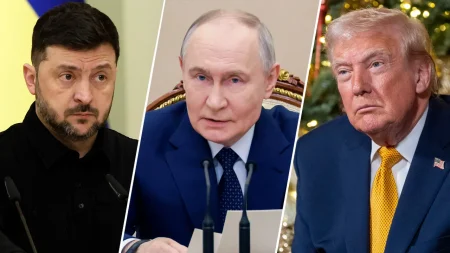




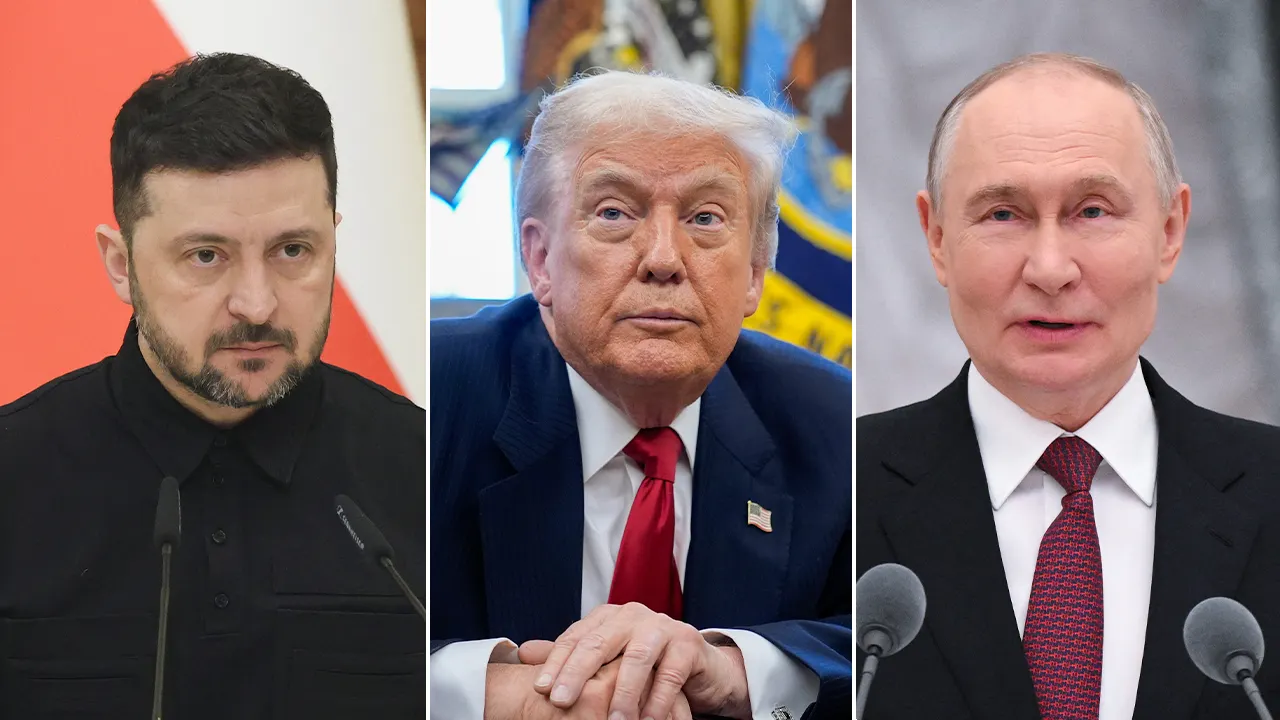
Ukrainian President Volodymyr Zelenskyy brought a clear and somber message to Fox News on Monday: while Ukraine is ready to honor the energy ceasefire announced by President Donald Trump, Russia is not. In a live interview with Bill Hemmer on “America’s Newsroom,” Zelenskyy said Russian forces continued to strike Ukrainian gas infrastructure even after Trump’s announcement, calling the attacks Vladimir Putin’s answer to Washington’s peace efforts. “We are ready today for energy ceasefire, as President Trump said. But I’m not sure that Putin is ready because even after yesterday’s messages from the president about energy ceasefire, Putin attacked our gas infrastructure,” Zelenskyy said. He insisted that Ukraine had already shown restraint, refraining from striking Russian energy facilities overnight. “We didn’t attack any energy objects on the territory of Russia because President Trump said that there will be an energy ceasefire between Ukraine and Russia. And we didn’t attack, but Russia attacked our gas stations, energy infrastructure, infrastructure and other things,” he said. The Ukrainian leader described the assault as a direct challenge to the president and an indication that Moscow was not serious about de-escalation. “It was his answer to President Trump. He attacked our energy infrastructure,” Zelenskyy said. “The communication from Russia was very clear that they don’t know anything about energy ceasefire.” The remarks came after Trump took to Truth Social on Sunday to announce an immediate halt to attacks on energy facilities, a claim that Moscow has not confirmed and whose precise scope remains unclear. Axios reported that a White House official described the proposal as initially centered on oil refineries, with a possible later expansion to power plants and electricity grids. That same official acknowledged Russia had not yet agreed, making Zelenskyy’s public uncertainty unsurprising. For Zelenskyy, the distinction was not academic: Ukraine’s energy grid has been a central target of Russian warfare, and the country enters the colder months with its capacity severely degraded. His interview underscored the growing gap between Trump’s optimistic framing and the battlefield reality described by Ukrainian officials.
The friction over the energy ceasefire was not limited to Russia’s behavior. Hemmer pressed Zelenskyy on whether Ukraine would agree to stop attacking Russia’s vast network of oil refineries, an issue that has become a quiet point of tension between Washington and Kyiv. Trump has repeatedly criticized Ukrainian drone strikes on refineries, arguing that they help push global fuel prices higher, and he recently announced a deal with Russia to release diesel supplies to American and global markets. Zelenskyy pushed back on the premise, explaining that an energy ceasefire cannot be a one-way concession. “When we speak about energy ceasefire, it means only one thing: that they don’t attack our energy infrastructure and we don’t respond to their energy infrastructure. This is called energy ceasefire,” he said. He argued that limiting the ceasefire to refineries would ignore Ukraine’s most serious vulnerability—its power supply. Asked directly whether Ukraine would stop targeting Russian refineries, Zelenskyy gave a cautious and conditional answer: “If Russia will not attack our energy, we will not attack the energy.” He also challenged Trump’s analysis of fuel prices, pointing to a factor far outside Ukraine’s control. “Everybody understands that the price on diesel doesn’t depend on our attacks on diesel in Russia,” Zelenskyy told Hemmer. “Everybody understands that it depends on the blocking of Hormuz Strait.” The reference to the Strait of Hormuz was a pointed reminder that global energy markets are being disrupted by attacks in the Middle East, not by a country defending its own infrastructure from missile strikes. The broader context of the exchange was unusual: Washington has publicly pushed Kyiv to show restraint, yet Moscow has continued bombarding Ukrainian cities and energy plants. For Ukrainian officials, the request to spare Russian refineries while Russian missiles strike civilian infrastructure felt less like a ceasefire and more like an asymmetry that would leave Ukraine exposed during the coming winter. The quiet tension between Trump’s desire for a quick diplomatic breakthrough and Zelenskyy’s demand for reciprocal action shaped the entire interview.
Beyond the ceasefire, the interview exposed another growing tension between Washington and Kyiv: Trump’s suggestion that Ukraine needs new leadership. Over the weekend, Trump criticized Zelenskyy and floated the idea that Ukraine should hold presidential elections, arguing that Kyiv had missed diplomatic opportunities to settle the war earlier. Zelenskyy responded with a mix of defiance and practicality. “If President Trump wants to change the leader in Ukraine, he has to know that only our people can change,” he said. But he did not dismiss the idea outright. Instead, he made the case that holding elections while the country is under daily attack is not feasible. “I’m ready for elections. Really, we need a minimum 60 days for security of infrastructure to prepare for elections,” he said. He painted a dark picture of what voting would look like under continuous Russian fire, mentioning the thousands of drones, ballistic missiles and cruise missiles that make ordinary civic life impossible. “How can people vote?” he asked. “It’s not even about the law. The law is very important. But we speak first of all about security.” The election question cuts to the heart of a larger diplomatic dispute. Trump and some of his allies have argued that Ukraine’s refusal to negotiate is prolonging the war, and that new leadership might be more open to a settlement that involves territorial concessions. Zelenskyy, by contrast, insists that any election held during an ongoing invasion would be impossible to conduct fairly and safely, and that the urgent priority is stopping Russian attacks rather than reorganizing Ukraine’s government. He also revealed that his last direct conversation with Trump took place in New York during the United Nations General Assembly in late September, a disclosure that underscored how little direct communication has occurred since. The distance between the two leaders was visible in the interview: Trump speaking in broad strokes about ending the war and reopening markets, Zelenskyy speaking from inside a country that faces nightly strikes on its power grid and residential neighborhoods.
Even as Zelenskyy spoke, the reality of Russia’s continued strikes was still unfolding across Ukraine. Ukraine’s charge d’affaires in Washington, Denys Sienik, reported that Russian forces struck a power plant in Kyiv on Sunday, knocking out electricity and water in parts of the capital before attacking a thermal power plant in Kharkiv after Trump’s announcement. According to Sienik, Russian forces had hit electricity generation and transmission facilities more than 200 times over the course of the previous week. The civilian toll was equally grim. East2West News reported Monday that three people—a 16-year-old boy and two women, ages 19 and 51—were killed in a strike near a grocery store in the Kharkiv region, and that five more were wounded in an attack on a residential high-rise. In Pisochyn, a town near Kharkiv, one woman described the shock of watching a power plant come under bombardment just minutes after Trump had assured the world that energy infrastructure would be spared. “We believed the statement that they wouldn’t strike energy infrastructure,” she said, according to East2West. “Just ten minutes after that promise was made, there were already five strikes.” There was also evidence that Ukraine was not sitting entirely passive. The same agency reported a Ukrainian strike on a Russian military base in occupied Khrustalnyi in the Luhansk region, where three large fires were reportedly visible. Casualty and damage figures could not be independently confirmed, but the strike was a reminder that Kyiv retains the capacity to hit back even as it exercises restraint in the energy sphere. Reuters separately confirmed that Russia continued striking Ukrainian energy targets despite Trump’s announcement, while Kyiv maintained it had refrained from attacking Russian refineries. The diplomatic response from Moscow was blunt. Russian Foreign Minister Sergey Lavrov rejected the idea of a 60-day ceasefire meant to facilitate Ukrainian elections, arguing that European countries would use the pause to replenish Ukraine’s weapons supplies. “I don’t think he deserves a respite,” Lavrov said, according to the BBC. His comments reinforced the impression that Moscow was not interested in the off-ramp Trump has been trying to construct.
Trump’s approach to Russia, particularly his decision to ease restrictions on Russian diesel sales, has drawn sharp criticism from some national security voices. Carrie Filipetti, executive director of the Vandenberg Coalition and a former deputy assistant secretary of state in Trump’s first administration, pointed to the energy ceasefire announcement as evidence that Moscow is playing for time. “Both Russia and Ukraine seemed surprised by the announcement of an energy ceasefire, and unsurprisingly, Russia has continued to attack Ukrainian energy facilities—reportedly as recently as a few hours ago,” Filipetti told Fox News Digital. She argued that the new diesel deal undermines recent U.S. legislation calling for increased tariffs and sanctions against Russian energy, and could give Putin the impression that he can continue his campaign without consequences. “Putin probably hopes the new diesel deal—which directly undermines recent US legislation calling for an increase in tariffs and sanctions against Russian energy—will discourage President Trump from holding Putin accountable for these continued violations and attacks,” Filipetti said. She saw a direct line between Russian energy revenue and the war effort. “If we want a real ceasefire, paying directly for Putin’s war machine through this new diesel deal is not the way to do it,” she said. “President Trump’s goal of a ceasefire could be a real win—but it’s only going to happen if we stop the diesel deal.” Not everyone in Trump’s orbit shared that view. Morgan Murphy, former head of public diplomacy for the Special Presidential Envoy to Russia and Ukraine, defended the administration’s strategy. “President Trump has consistently prodded both sides toward the only realistic outcome—negotiation,” Murphy told Fox News Digital. He argued that the current war is unsustainable for both countries, though in different ways. “Both sides are losing right now: Ukraine doesn’t have the combat power to retake seized land, and Russia is destroying its future demographics with every passing day,” Murphy said. He framed the push for a ceasefire as a humanitarian imperative rather than a concession to Moscow. “Trump is right to push for a ceasefire. An endless war of attrition benefits only the makers of weapons and coffins.” The split between Filipetti and Murphy mirrored a broader divide in American politics: one side sees Trump as too lenient on Putin and too willing to reward aggression; the other sees him as the only person capable of forcing an endgame. For Zelenskyy, the most important audience is not in Washington’s opinion pages but in the command centers and bomb shelters of Ukraine.
Throughout the interview, Zelenskyy returned again and again to the human stakes of the conflict. He described Russia’s daily strikes as killing between 20 and 30 civilians each day—a figure Fox News has not independently verified, but one that captures the relentless toll of a war now entering its fourth year. “We want to end this war as quickly as possible,” he said. “Ceasefire is a good first step from both sides. This is very important.” Those words carried a note of exhaustion and frustration: exhaustion with the war itself, and frustration that a ceasefire, which should be a simple reciprocal arrangement, had become another arena for Russian escalation. The contrast between Trump’s public declarations and Zelenskyy’s battlefield reports could not be starker. Trump framed the energy ceasefire as a breakthrough, an immediate halt to attacks on infrastructure that would pave the way for broader negotiations. Zelenskyy’s account of the past 24 hours was one of broken promises and continued bombardment. Yet he did not close the door to diplomacy. He made clear that Ukraine is willing to stop striking Russian energy targets, if Russia does the same. He said he is willing to hold elections, if security can be guaranteed. He even welcomed the idea of a ceasefire, calling it “a good first step from both sides.” What he rejected was the notion that Ukraine should make unilateral concessions while Moscow continues to bomb its cities and cripple its power grid. The next move belongs to Trump, who will have to decide whether to hold Putin to the standards of the ceasefire he announced or to accept Moscow’s explanations as a basis for further engagement. Fox News Digital reached out to the White House for comment but did not receive a response in time for publication. For now, the ceasefire exists more as a slogan than as a reality on the ground. Zelenskyy’s message to Washington was clear: Ukraine is ready to match Russian restraint if it actually exists, but it will not mistake a one-sided pause in strikes on oil refineries for a genuine path to peace. The coming weeks will reveal whether Trump’s diplomatic push can transform what Russia has so far treated as empty words into a concrete end to the destruction.