


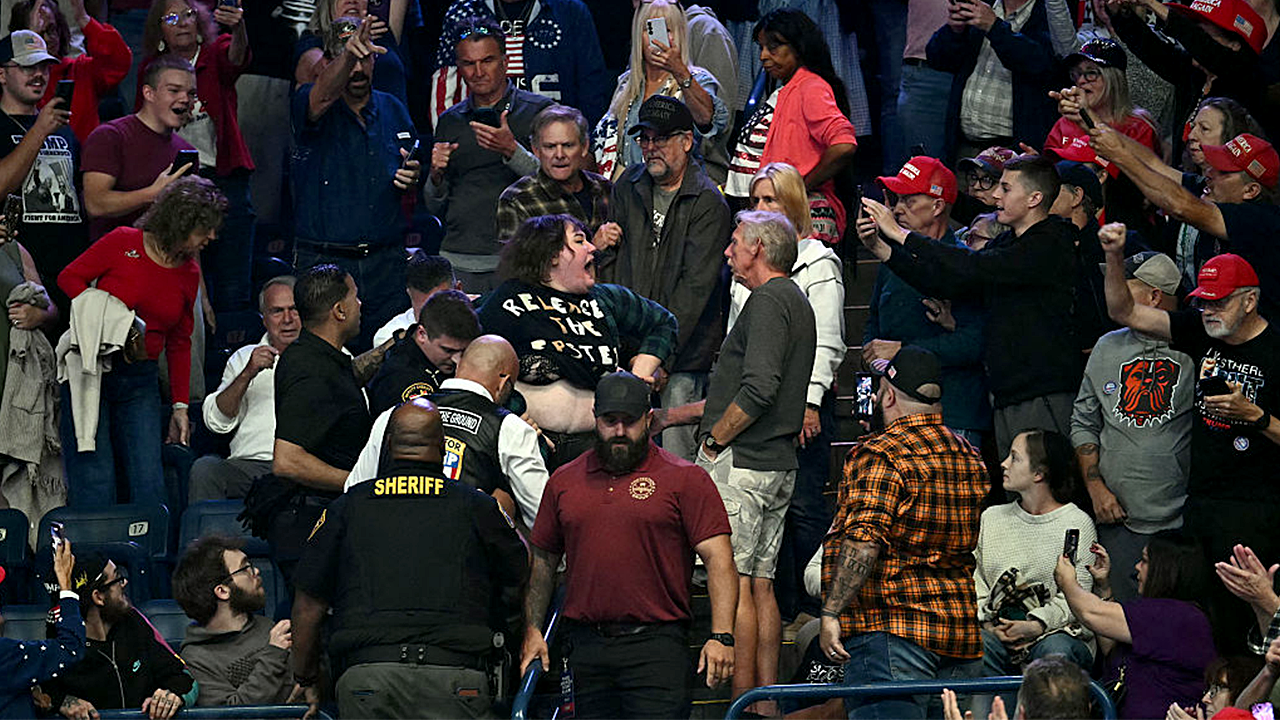
It was supposed to be another rally, another moment of political theater in the industrial heartland, but the scene that unfolded inside the arena in Youngstown, Ohio, on Monday was jarring even by the standards of today’s hyper-charged politics. President Donald Trump was speaking, criticizing Ohio Democratic Senate candidate Sherrod Brown, when the crowd’s attention suddenly shifted from the stage to a disturbance in the stands. A woman wearing a T-shirt that read “Release the Epstein Files” had apparently made her presence known, and the reaction from those around her was swift and brutal. Video captured the moment a man who appeared to be a Trump supporter shoved the woman, then punched her in the face, all while the crowd around them erupted in chants of “USA! USA!” The scene was chaotic, visceral, and deeply unsettling. There was no pretense of debate or even the usual back-and-forth of political heckling. This was raw physical aggression, a violent flashpoint that turned a political rally into a scene of confrontation, all over a slogan printed on a shirt. For those watching from home, the footage was hard to process, but for those in the arena, it was apparently just another moment of excitement, a brief interruption before the president returned to his speech.
The details of the altercation, as captured in cellphone video and described by witnesses, are disturbing in their precision. The man did not merely shove the woman away; he struck her squarely in the face, then grabbed her by the hair and attempted to force her head toward the ground, as if trying to subdue her with a level of force that far exceeded any reasonable response to a shouted slogan. The woman, whose shirt identified her with the ongoing demand for transparency regarding the late financier Jeffrey Epstein, was not seen striking back. She was simply a presence, a provocation, and that was enough. Eventually, police intervened, breaking up the fight and escorting the woman out of the venue. But what happened next may be even more telling. The man who threw the punch remained in the arena, seemingly unrepentant, even exchanging high-fives with other attendees. There was no immediate consequence for his actions, no visible shame, no indication that anyone around him thought he had crossed a line. Instead, he was treated as something of a hero, a man who had dealt with an unwanted disturbance in the most direct way possible. That image, of a man being celebrated after assaulting a woman over a shirt, captures something deeply troubling about the current moment in American political life, where aggression is often mistaken for patriotism and violence is framed as a form of loyalty.
When President Trump eventually acknowledged the commotion, his response did nothing to lower the temperature. He seemed unaware that the heckler was a woman, referring to her as “he” and immediately labeling her a “paid protester,” a claim he offered without evidence. “He’s a paid protester,” Trump said, repeating the accusation as if saying it made it true. “They’re all paid. They get paid by the lefties in order to destroy our country. They’re scum.” Then, instead of expressing concern about the physical attack that had just occurred in his own audience, Trump pivoted to mock the protester’s appearance, adding, “But he’s going back home to Mom. He’s going back home to Mom. Look at him. Look at him. Terrible. Don’t we love law enforcement? Oh, he’s gotta go on a diet! He’s a fat guy. Wow. Wow. Gotta go on a diet fast. We all do.” He later called the protester “very low-class.” The president’s words, delivered with a mixture of derision and humor, effectively erased the violence that had just taken place. There was no condemnation of the man who threw the punch, no expression of concern for the woman who was struck and grabbed by the hair. Instead, there was mockery, misdirection, and a familiar narrative about paid disruptors, a story that has become a staple of Trump’s rally rhetoric. For many observers, the most disturbing part was not just the attack itself, but the ease with which the president turned the victim into the villain, using his platform to pile on rather than to call for calm.
The slogan on the woman’s shirt, “Release the Epstein Files,” carries significant weight in the current political climate. Trump and his Justice Department have faced bipartisan scrutiny over the delay in releasing additional documents related to the investigations into Epstein, the wealthy convicted sex offender whose death by suicide in 2019 left behind a trail of unanswered questions and conspiracy theories. The demand to release the files has become a rallying cry across the political spectrum, fueled by online speculation, congressional pressure, and a general distrust of institutions. For some, the phrase is a genuine call for transparency; for others, it has become a symbol of resistance to the establishment. The woman’s choice to wear that shirt to a Trump rally was clearly deliberate, a provocation designed to make a statement. But the response she received, physical assault and public humiliation, is not something that can be dismissed as simply the cost of political engagement. It is also worth noting that this was not an isolated incident. Just days before the confrontation in Ohio, a similar scene played out at another Trump rally in San Antonio, Texas, where a man wearing a MAGA hat grabbed a heckler by the hair and pulled him to the ground. The pattern is unmistakable. Political rallies, once places where people could express their views, even unpopular ones, are increasingly becoming zones of intimidation and violence, particularly when the object of the anger is seen as an outsider or a threat.
To humanize this moment is to consider what it must have felt like to be that woman. She arrived at the rally, presumably knowing that she would be in a hostile environment, but she may not have anticipated being physically attacked. She wore a shirt that expressed a political belief, a demand for information, and for that, she was punched, grabbed, and yanked by her hair, all while a crowd cheered for the country. The trauma of such an experience cannot be overstated. In a single, chaotic instant, she learned that her safety meant nothing to the people around her, that her body was considered fair game because of a message printed across her chest. And then, as if the physical assault were not enough, she had to hear the president of the United States mock her weight, call her a low-class scum, and suggest she was a paid shill. There is a profound cruelty in that sequence of events, a dehumanization that begins with a punch and ends with a punchline. It is the kind of moment that stays with a person forever, not just because of the pain, but because of the revelation that the institutions and leaders who should be calling out such behavior were instead participating in it. The crowd that chanted “USA” while she was being attacked seemed to believe they were celebrating patriotism, but what they were really celebrating was the silencing of dissent through force.
In the end, the incident in Youngstown is a stark reminder of how fragile civic decency has become. It is easy to blame the man who threw the punch, and he certainly bears responsibility for his actions, but the larger problem is the environment that made such violence feel acceptable. When political figures routinely describe their opponents as scum, when they suggest that protesters are paid operatives bent on destroying the country, when they mock the appearance of a woman who dared to speak out, they are sending a message that the rules do not apply, that contempt is more important than respect, and that anyone who disagrees is an enemy who deserves whatever they get. The woman in the “Release the Epstein Files” shirt was not just a heckler; she was a person with a life, a history, and a right to be in that arena. She deserved better than a punch to the face, and she deserved better than a president who responded to her assault with jokes about her weight. As the footage continues to circulate and the outrage grows, the question is whether anything will change. Will the man who attacked her face consequences? Will the president be held to account for his words? Or will this become just another flashpoint in a seemingly endless cycle of outrage, quickly forgotten and replaced by the next controversy? The answer, too often, is the latter. But moments like this have a way of lingering, forcing people to confront the ugliness that has crept into the nation’s political life. The woman’s shirt asked for the release of files, but the deeper demand, echoed by many who watched the video in horror, was for the release of a shared sense of humanity, a return to a politics where disagreement does not end in violence. Whether that demand will be heard remains to be seen.