


Paragraph 1: The Dawn Raid and Official Silence
The first hint of trouble came not with a phone call or a formal notice, but with the heavy, insistent pounding on the door in the pre-dawn darkness of a Monday morning in the Washington, D.C. suburbs. For Representative Ilhan Omar, a woman who has weathered political firestorms, personal attacks, and the relentless glare of national scrutiny, the sudden arrival of federal agents at her home was a jolt unlike any she had experienced. It was the Department of Homeland Security, acting on a judicially authorized search warrant secured by the Department of Justice, and they were there as part of an ongoing criminal fraud investigation. The official statement from a DOJ spokesperson was terse and characteristically bureaucratic: “Today in the Washington, D.C. area, Homeland Security Investigations executed a judicially authorized search warrant… This enforcement action is part of an ongoing federal investigation.” There were no details, no names, and no explanation given to the public, leaving a vacuum that would immediately fill with speculation, alarm, and the raw, human anxiety of a family caught in the machinery of federal law enforcement. For Omar, a Somali-born refugee who had risen to become one of the most recognizable progressive voices in Congress, the raid was not merely a legal procedure—it was a profound and deeply personal violation of the safety and sanctity of her home, a place that should be a refuge from the very public battles she fights daily. The image of federal agents combing through her personal belongings, her children’s spaces, and her private documents is one that resonates with a chilling fear, a reminder that no position of power entirely shields a person from the weight of the state when it decides to act.
Paragraph 2: A Life Story Written in Asylum and Ambition
To understand the weight of this investigation, one must understand the extraordinary arc of Ilhan Omar’s life, a narrative that has always been interwoven with the very immigration system she now stands accused of navigating improperly. Born in Mogadishu, Somalia, in 1981, she spent her early childhood in a country torn apart by civil war. Her family fled when she was young, spending four years in a Kenyan refugee camp before being granted asylum in the United States in 1995, settling in Minneapolis, Minnesota, which is now home to one of the largest Somali communities in the country. Her late father, a former teacher, filled out the necessary immigration paperwork for his children, as is common for countless refugee families. For decades, this was a straightforward story of displacement, survival, and eventual success. Omar went on to become a community organizer, a state legislator, and in 2018, one of the first two Muslim women elected to the U.S. Congress, alongside Rashida Tlaib. Her ascent was celebrated as a triumph of the American Dream, a testament to the idea that a refugee could not only find safety but also achieve the highest echelons of political power. She brought a unique and often unflinching perspective to foreign policy and social justice, becoming a lightning rod for both progressive adoration and conservative criticism. Now, this very origin story—the path from refugee camp to Capitol Hill—is the focus of a criminal investigation, specifically into the immigration documents her father had signed on her behalf when she was a child. The question of whether any errors, omissions, or technicalities in those forms constitute fraud is a legal minefield, and one that carries existential weight for someone whose entire identity is rooted in that journey.
Paragraph 3: The Fine Print of a Paper Trail
The core of the federal probe centres on the minutiae of immigration paperwork, a bureaucratic labyrinth that is notoriously complex and unforgiving. The investigation is examining the forms that were submitted by Omar’s father when she was a minor, raising the possibility that there may be discrepancies between what was stated on those documents and her actual circumstances, such as her age, marital status, or family relationships. Immigrations officials often scrutinise such filings for signs of fraudulent misrepresentation, which can have severe consequences, including deportation proceedings. The fact that the forms were completed by her late father, a man who himself was navigating a new country and a new legal system, adds a tragic and humanising layer to the case. It is a far cry from the image of a sophisticated adult deliberately deceiving the system; rather, it evokes the heartbreaking reality of a desperate parent trying to secure a future for his children in a foreign land. Legal experts point out that errors on immigration applications are common, and that the burden of proof lies with the government to demonstrate malicious intent, not just a mistake. For Omar, the development is deeply painful, as she often speaks about her father with reverence and gratitude. To have his memory and his actions now at the centre of a criminal fraud inquiry is a brutal twist of fate. The investigation also seems to be part of a broader pattern of scrutiny of the Minnesota congresswoman, who has already been the subject of previous ethics complaints and has faced a barrage of opposition from right-wing media and political adversaries who have long questioned her legitimacy, her patriotism, and her very presence in the halls of power. The raid, therefore, is not just a legal event; it is the latest and most severe escalation in a long-running campaign to delegitimize her.
Paragraph 4: The Political Storm Surrounding the Search
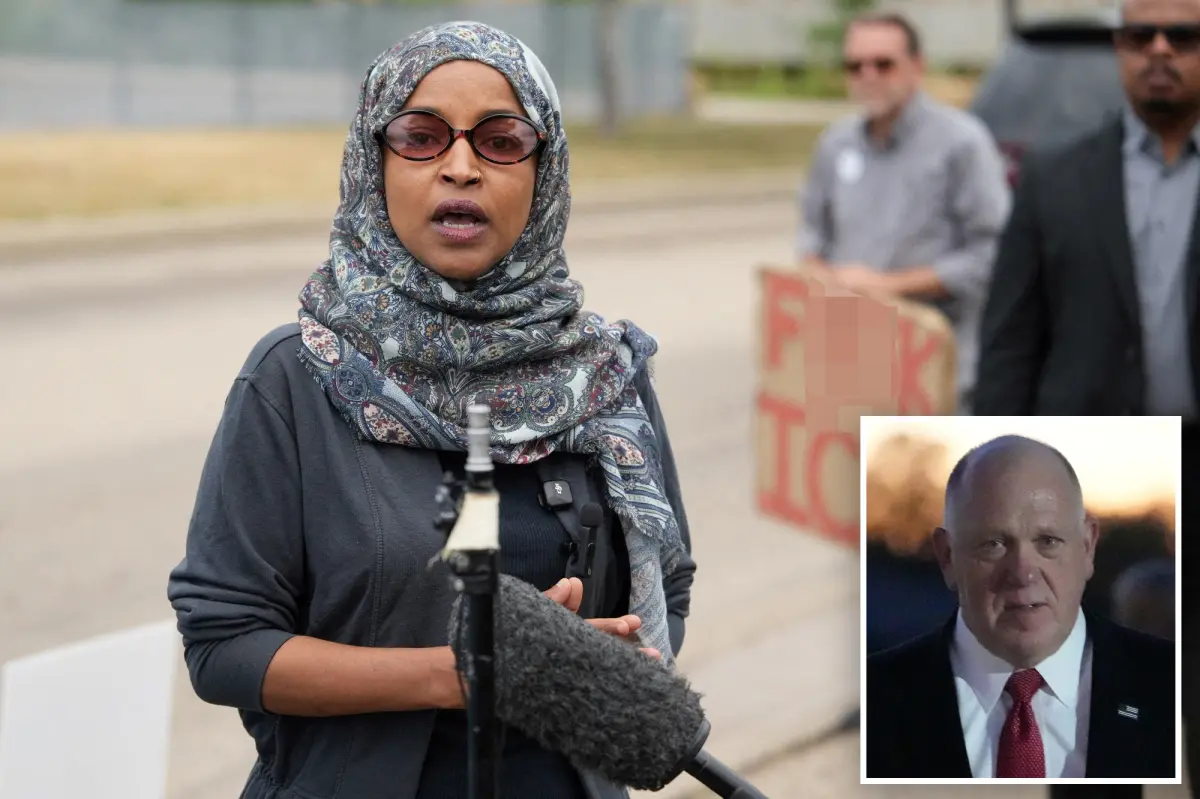
The raid did not occur in a political vacuum. Weeks before the search, Tom Homan, the appointed border czar in the previous administration, had made the highly unusual and public declaration that Omar was subject to an ongoing “criminal” investigation. His statements were vague but loaded, hinting at a case that had been building for some time. This public commentary, before any charges were filed and before any search warrant was executed, immediately drew criticism from civil liberties groups and Democratic lawmakers, who accused the administration of weaponizing federal agencies for political purposes. Omar herself, upon learning of Homan’s earlier remarks, had denied any wrongdoing, saying her immigration documents were handled legally, and she dismissed the claims as a political stunt designed to harass her and intimidate her constituents. The raid, executed by the Department of Homeland Security’s investigative arm and authorized by a judge, now gives those earlier threats a concrete, physical manifestation. The reaction to the news was split precisely along ideological lines. Supporters of Omar saw it as an act of state-sponsored intimidation, a blatant attempt to punish a vocal critic of the U.S. government’s foreign policy, particularly its stance on Israel. Her detractors viewed it as a long-overdue measure of accountability, pointing to the federal investigation as proof that the congresswoman was not beyond the reach of the law. The fact that the search was for immigration fraud—a crime that is often handled as a civil administrative matter—and that it was executed at her home with such dramatic force, has only deepened the sense that this is a politically charged action, rather than a routine law enforcement procedure. For the average onlooker, the muddle of claims and counterclaims is dizzying, but the image of DHS agents at the home of an elected federal official is an arresting one, shaking the notion that such actions are reserved for ordinary citizens, not the lawmakers who oversee the agencies themselves.
Paragraph 5: The Human Toll Behind the Headline
Amid the legal maneuvering, the political posturing, and the media frenzy, it is essential to remember that at the centre of this story is a human being—a mother, a widow, a community leader—and her family. The raid on Monday morning was not just a political event; it was an intrusion into the lives of Omar’s children and loved ones. Imagine waking up to the sound of federal agents in your home, their boots on the floors, their hands rifling through the drawers of your bedroom, the quiet terror of not knowing what they are looking for or what they might find. The psychological impact of such an experience is profound, leaving a lingering sense of vulnerability and distrust even if no charges are ever filed. For Omar, who has previously spoken about the trauma of her childhood in a war zone and the constant threat of violence, this new ordeal adds another layer of anxiety to a life that has already known far too much instability. She has spent her career advocating for the rights of the marginalized, for refugees, for the poor, and for justice, and now she finds herself the subject of the very system she has often criticized. Her office released a statement maintaining her innocence and promising to cooperate with the investigation, but the personal cost is already evident. The community in Minneapolis, which has long supported her, has rallied around her, organizing vigils and statements of solidarity, but they too are shaken by the aggressive tactics of the federal authorities. The investigation is ongoing, and no charges have yet been filed, but the mere existence of a criminal inquiry into her immigration status has already stained her reputation and provided ammunition to those who have always doubted her rightful place in American society. The true human cost of this legal battle will likely be measured in years of stress, legal fees, and the emotional scars left on her family.
Paragraph 6: An Unfolding Story with National Implications
As the news continues to develop, the investigation into Ilhan Omar’s immigration paperwork stands as a crucial test of the American justice system. It raises fundamental questions about the balance between rigorous law enforcement and the protection of elected officials from political persecution. The DoJ’s statement confirms that the search warrant was judicial, meaning a judge found probable cause to believe evidence of a crime might be found at her home. This is a significant legal hurdle, suggesting that the investigation has moved beyond mere suspicion and into concrete evidence gathering. Yet, the public nature of the case, the involvement of the border czar in pre-announcing it, and the political animosity surrounding her will inevitably cast a shadow over whatever comes next. If the investigation finds no wrongdoing, Omar will emerge as a victim of a baseless political attack, and the agencies involved will face accusations of egregious overreach. If, on the other hand, charges are filed and she is convicted, it would be a stunning fall from grace for one of the most prominent progressive voices in the country, and a landmark victory for her political opponents. Either way, the raid has already altered the political landscape, giving her supporters a rallying cry and her detractors a vindication of their suspicions. For the public, the story is a poignant reminder that the immigration system, with all its complexities and flaws, can reach into the highest levels of power. The fate of Ilhan Omar’s political career, and indeed her very freedom, now hangs in the balance of an investigation that is still in its early stages. As we await further details, we are left with a profound sense of unease, a recognition that in the world of human politics, even the most inspiring personal stories can be broken by the cold, grinding wheels of a federal investigation. The developing story is not just about one woman; it is about the fragility of the American dream and the ever-present question of who truly belongs.