


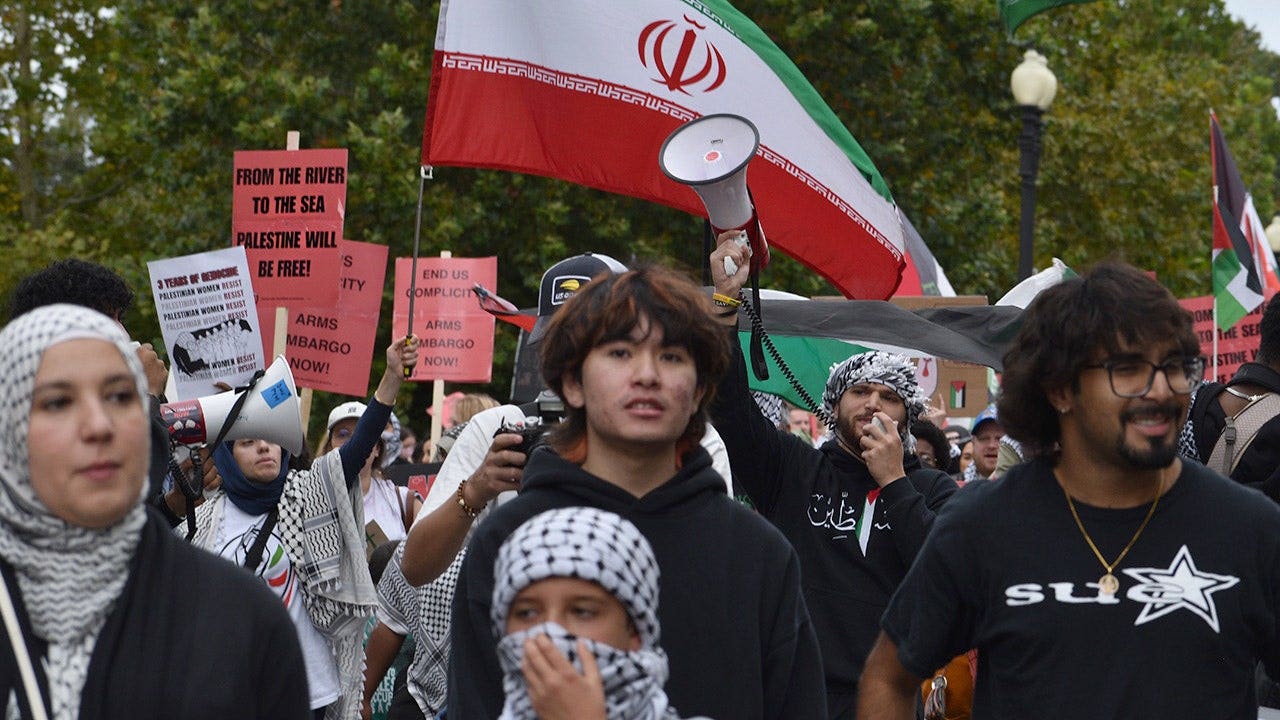
This past weekend, the familiar rhythm of mass protest returned to the streets of Washington, D.C., London, Paris, Madrid, and Kuala Lumpur, as hundreds of thousands of demonstrators gathered for coordinated “Global Day of Action” rallies. The chants were as recognizable as ever: “Free, free Palestine,” “From the river to the sea, Palestine will be free,” and the rhythmic rejection of a two-state compromise. But beneath the slogans and banners, something shifted. In exclusive interviews with Fox News Digital, three leaders from within the anti-Israel movement dropped the carefully crafted ambiguity that has long characterized public activism on this issue. They did not speak of negotiated borders, shared capitals, or a future Palestinian state alongside Israel. Instead, they laid out a clear, unapologetic vision: one single state called “Palestine,” stretching from the Jordan River to the Mediterranean Sea, encompassing what is now Israel, the West Bank, and Gaza. In that vision, Israel as a Jewish nation-state would cease to exist. The Palestinian right of return would be implemented, and Palestinian refugees and their descendants would be welcomed into a new country where Jews and Palestinians would hold equal voting and citizenship rights. For many observers, the candor was striking—not because the demand was new, but because leaders were finally saying, without euphemism, what the movement’s ultimate political horizon actually entails.
The demographic math behind this vision is central to understanding why it carries such profound consequences. Israel’s current population is roughly 10 million, including about 7.8 million Jews, 2 million Palestinian Arabs (most of them Muslim), and 200,000 people from other communities. Worldwide, there are about 10.2 million Jews. The Palestinian population in the West Bank and Gaza is around 5.5 million, with an additional 8 million Palestinians living in the diaspora, bringing the total to roughly 13.5 million. If Israel were to be replaced by a single binational state with a right of return for all Palestinian refugees and their descendants, the demographic balance would shift dramatically. In that new country, Jews would quickly become a minority, outnumbered by a Palestinian population that would overwhelm the current Jewish majority. That one-state outcome is the logical conclusion of years of activist messaging that has painted Israel as a “settler colonial” state practicing “apartheid” and “genocide.” Israeli leaders and their supporters fiercely reject those labels, insisting that Israel is the sovereign nation-state of the Jewish people, founded in the ancestral homeland, while also providing equal civil and political rights to all citizens, including Jews, Christians, and Muslims. They also note that the international human-rights framework used to indict Israel is rarely applied with the same vigor to Arab and Muslim-majority states, many of which emerged from the collapse of empires and wars that displaced millions, including hundreds of thousands of Jews expelled from their own countries, and many of which continue to restrict religious and minority rights today.
Speaking from Chicago, Hatem Abudayyeh, the Palestinian-American founder of the U.S. Palestinian Community Network and a Muslim community leader, was explicit about what his movement is working toward. “Our points of unity, from the very beginning of our existence, included one democratic secular state of Palestine,” he said. That state, he explained, would encompass the West Bank, Gaza, and what he called the “1948 Palestinian territories”—a term that refers to the land where Israel declared independence in 1948, and which Palestinians commemorate as the “Nakba,” or catastrophe. Abudayyeh said the new country would be built on a Palestinian “right of return” for refugees and their descendants. “If all of our refugees, who have the internationally recognized right to return to Palestine, are able to return, and the system, the racist system is dismantled, then all the people there can live in peace and justice,” he said. He was quick to clarify that this does not mean removing Jews from the land. “It doesn’t mean that we’re going to kick people out,” he said. “It just means that these folks have an internationally recognized right, and you will never get peace and justice there unless you uphold that right.” For Abudayyeh, the core issue is not coexistence between two states, but the dismantling of Zionism itself, which he described as a racist system. That comparison to apartheid South Africa is central to the movement’s argument: just as the international community eventually branded apartheid as illegitimate, he believes the world is now reaching a consensus that Israel, as a Jewish state, does not have the right to exist in its current form. “We’re adamant about that. We’re clear about it. Unabashed,” he said.
Two other leaders offered similar visions, each with their own twist. Sam Husseini, a Palestinian-American Christian journalist running for Congress in Maryland’s 4th Congressional District, stood near the U.S. Capitol and described his long-term vision as “one person, one vote,” alongside a Palestinian right of return. He acknowledged that his own family lineage is tied to displacement, saying, “I don’t know that I would actually move back there, but as a descendant of a Palestinian who was forcibly displaced, I should have that right or compensation.” Husseini also offered a provocative idea for the new country’s name, jokingly suggesting “1948”—a number signifying what he called “this cataclysm, which should be the last gasp of imperialism.” But he predicted that if the new state were called Palestine, “I think a lot of Jews, when they think about it, will say, so long as they have equal rights and all are protected, will adopt the term Palestine.” Miko Peled, an Israeli-born Jewish activist and founder of the Palestine House in Washington, D.C., was even more blunt. Standing on Pennsylvania Avenue as protesters marched toward the Capitol, Peled said that a “free Palestine” means a “post-Zionist, post-apartheid Palestine with equal rights and the right of the Palestinians to return.” He argued that the territory is already one state, albeit an apartheid one, and that the proper name for that state is Palestine. “Israel is a new name,” he said. “They renamed the country 78 years ago, so the proper name would be Palestine.”
The one-state demand is not simply a fringe idea whispered in interviews; it is increasingly visible in the streets and embedded in the broader protest infrastructure. In New York City, the Party for Socialism and Liberation circulated video of protesters chanting, “1-2-3-4. Occupation no more. 5-6-7-8. Israel is a terrorist state,” followed by the unambiguous declaration, “We don’t want no two state!” In London, the Palestine Solidarity Campaign promoted video of a woman with a megaphone shouting, “There is only one state!” and protesters responding, “Palestine, ’48!” In Washington, signs proclaimed, “LAND YOU HAVE 2 KILL FOR IS NOT YOURS,” directly challenging Israel’s claim to the land itself. Meanwhile, the movement enjoys substantial organizational and financial backing from a so-called “red-green” alliance that unites socialist and communist groups with Palestinian and Muslim activist organizations. Key players include the Democratic Socialists of America, CodePink, the People’s Forum, the Party for Socialism and Liberation, BreakThrough News, and the ANSWER Coalition. Much of this network is funded by Neville Roy Singham, an American-born tech tycoon living in Shanghai, who has poured at least $278 million into a pro-communist network that organizes, promotes, and amplifies anti-Israel demonstrations. This infrastructure ensures that slogans like “Free Palestine” and “from the river to the sea” reach millions of people, even when the organizations themselves do not explicitly spell out the one-state political vision that leaders like Abudayyeh, Husseini, and Peled described.
The clarity of these interviews reveals a deeper truth about the current moment: the two-state solution, long the cornerstone of international diplomacy, is no longer the assumed endpoint of this movement. For years, activists have used language of “liberation,” “justice,” and “right of return” without always articulating what those words mean in concrete political terms. Now, some leaders are willing to say it openly: their goal is not a Palestinian state alongside Israel, but a single state that replaces Israel altogether. That vision carries obvious and profound implications for Jewish self-determination, for the identity of the region, and for the lives of millions of people. It also underscores the deep ideological divide between those who see Israel as an indigenous nation with a right to exist securely and those who view it as an illegitimate colonial project that must be undone. The movement’s supporters insist that their goal is equality and democracy for all, while its critics warn that the one-state idea is a euphemism for the elimination of Israel as a Jewish homeland. In the streets, the chants remain simple and stirring, but behind them lies a boldly stated political project that challenges the very foundations of the post-1948 international order. What was once a demand for two peoples and two states has, for many protesters and their leaders, become a demand for one state called Palestine—and an explicit farewell to Israel as a Jewish nation.