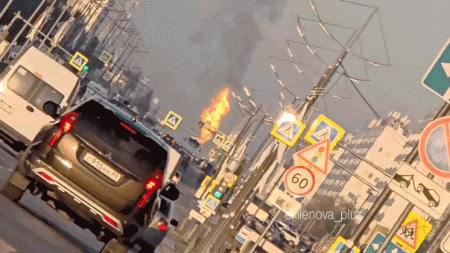




On a quiet Thursday morning in Qingdao, a major port city on China’s northeastern coast, the ordinary rhythm of industrial work was shattered in a matter of minutes. A cargo ship named the Ocean Melody, flying the Liberian flag, was docked for routine repairs at the Beihai Shipbuilding yard when a fire broke out aboard around 11:15 a.m. local time. For the 42 people working on the vessel that morning, this was just another day of welding, checking systems, and maintaining the massive steel structure that had likely crossed oceans and endured storms. But within moments, the ship became a trap of smoke and flame. Chinese state media later confirmed that at least 25 of those on board lost their lives, while 12 were rescued alive. Five others were pulled from the scene with injuries and rushed to local hospitals, where officials said they were in stable condition. The fire was eventually extinguished by around 2:30 p.m., a little over three hours after it began, but the aftermath was already one of grief and unanswered questions. Videos circulating online showed thick plumes of white smoke rising from the vessel, a stark reminder that even in the most modern ports, danger can arrive without warning.
The human weight of this tragedy is difficult to overstate. Every number in the official report represents a person with a family, a history, and a reason to be on that ship that day. The 25 dead were likely workers — shipyard employees, contractors, or crew members — who were performing repairs in cramped, industrial spaces below deck, where escape routes can be narrow and smoke spreads quickly. The 12 who were rescued may have emerged with burns, bruises, and the haunting memory of hearing colleagues trapped behind bulkheads. The five in the hospital, now stable, face a slow recovery and the knowledge that they lost friends and coworkers in the same blaze. In the surrounding community, families waited for hours outside hospitals and the shipyard gates, hoping for news, then dreading it. Local emergency responders, firefighters, and medical teams worked through the afternoon under enormous pressure, not only to extinguish the flames but to reach anyone still alive. Their efforts, while heroic, could not undo the scale of the disaster, leaving Qingdao to mourn in the way that industrial cities often do: quietly, privately, and with the grim understanding that such accidents are sometimes an unavoidable cost of keeping the world’s goods moving.
The ship at the center of this disaster, the Ocean Melody, is not a famous vessel, but it is part of the vast, invisible network that connects global economies. According to ship-tracking website VesselFinder, it sails under the Liberian flag, a common arrangement in international shipping that allows owners to register vessels under more flexible regulatory regimes. The ship was at the Beihai Shipbuilding facility for repairs, a routine but hazardous phase in a ship’s life. Shipyards are places where massive structures are cut, welded, blasted, painted, and refitted, and the work is inherently dangerous. The Beihai Shipbuilding Co., a subsidiary of the state-owned China State Shipbuilding Corporation, is the world’s largest shipbuilder, and its facilities in Qingdao are among China’s busiest. Qingdao itself is no minor port; it handles millions of containers every year and serves as a critical hub for international trade, shipbuilding, and maritime logistics. That such an important center should experience this kind of tragedy underscores a broader truth: the industrial systems that sustain modern life are staffed by human beings, and when something goes wrong, the consequences are deeply personal.
As the smoke cleared, the focus shifted immediately to the cause of the fire. Chinese authorities have not yet provided any official explanation, and the investigation remains open. What is known is that the fire began while the vessel was undergoing repairs, a time when hot work such as welding, grinding, or cutting can easily ignite flammable materials, especially in confined spaces where fuel residues, paints, or solvents may be present. The exact sequence of events — whether a spark, a mechanical failure, or a violation of safety protocols triggered the blaze — will likely take days or weeks to determine. At the political level, the response was swift and solemn. President Xi Jinping called for intensified efforts to support those affected and ordered that preventive measures be thoroughly implemented, according to Xinhua. Premier Li Qiang echoed this, specifically urging that trapped people be rescued with urgency and that similar catastrophic accidents be resolutely prevented. These statements are standard in the aftermath of such disasters, but they also signal the gravity of the situation. In a country where industrial safety standards have improved significantly in recent decades, a fire claiming 25 lives is a moment of reckoning, not only for the shipyard but for the broader system of oversight in high-risk industries.
This tragedy also arrives at a time when shipbuilding itself has become a matter of geopolitical and economic significance. China is by far the world’s dominant shipbuilder, and the China State Shipbuilding Corporation is a central pillar of that dominance. The company builds everything from massive container ships to advanced naval vessels, and its yards employ hundreds of thousands of workers. In the United States and elsewhere, officials have sometimes pointed to China’s shipbuilding capacity with a combination of admiration and concern, noting that the industry is both an economic engine and a strategic asset. But the human cost of this industrial prowess is rarely part of the conversation. When a fire breaks out in a Chinese shipyard, it is easy to forget that the workers who died were not abstract figures in a trade dispute or statistics in a global supply chain. They were people who showed up to work on a weekday morning, in a port city by the sea, expecting to go home at the end of their shift. Their deaths are a reminder that every ship that crosses the ocean, every container that reaches a store, and every product that arrives on a doorstep has been touched by human hands, often in conditions that are uncomfortable, demanding, and sometimes lethal.
In the end, the story of the Ocean Melody is not just about a fire, a shipyard, or even a nation; it is about the fragility of life against the machinery we build. The survivors will carry scars that are not only physical but emotional, and the families of the dead will seek answers that may never fully soothe their loss. The port of Qingdao will eventually return to its normal rhythm, with cranes moving and ships arriving, because the world does not pause for grief. But for those who were on board that vessel, or who loved someone who was, time will be divided into before and after. As investigators work to determine the cause and officials promise reforms, there will be calls for accountability, for stricter safety measures, and for a deeper examination of the culture of speed and productivity that often pressures workers to take risks. These calls are important, but they cannot bring back the lost. What can be done, perhaps, is to honor their memories by making sure that such a disaster never happens again. In the quiet corners of Qingdao, in the hospitals, in the homes where chairs will remain empty, that is the only hope left.