



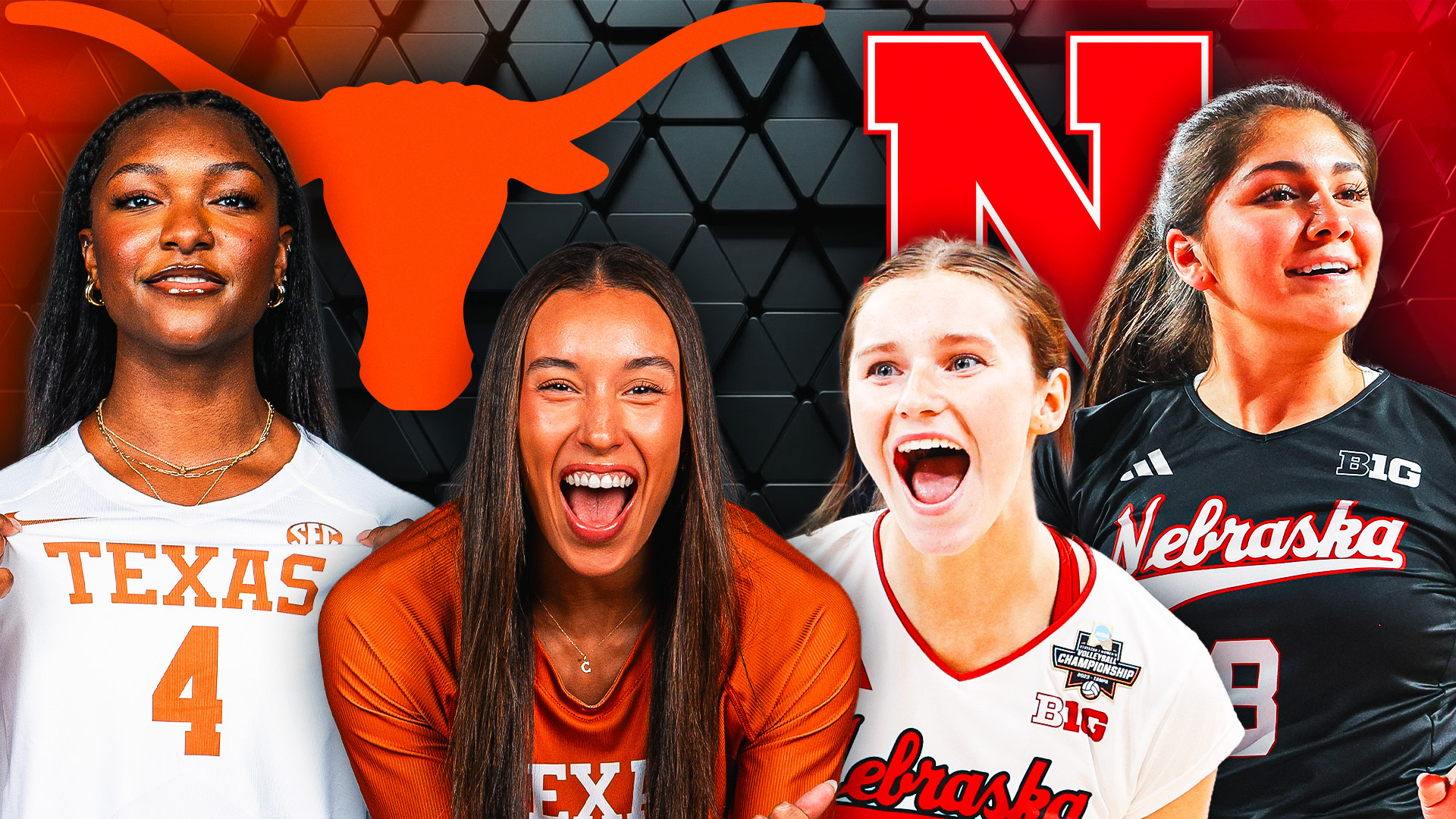
On Sunday afternoon, two of the most storied programs in women’s volleyball will finally share the same floor again, and it feels less like a season opener and more like the reunion of old friends who have spent decades trading punches. Texas and Nebraska have not met in the regular season in ten years, which feels almost wrong for a rivalry this deep, this personal, and this woven into the sport’s modern history. There have been longer gaps between their meetings, sure, but not many, and not with this much on the line. The Players Era Volleyball Showcase in Las Vegas on Aug. 30 gives them the perfect stage to renew what used to be a Big 12 blood feud, and the timing couldn’t be better. Both teams enter as giants of the sport: Nebraska ranked No. 1, Texas No. 2, both carrying the weight of recent heartbreak and a long legacy of greatness. This is not just another non-conference match. It is a chance to measure a decade of changes against a familiar rival, to feel the old sting and the old thrill again, and to remind each other — and the entire volleyball world — that some rivalries never really fade. They simply wait for the right moment to roar back to life. And if you know anything about these two programs, you know that Sunday will not be polite. It will be a collision. It will be loud. And it will be a reminder that even in a sport as graceful as volleyball, the fiercest battles are always personal.
To understand why this matchup matters so much, you have to go back to the beginning, when both programs were still finding their footing. Nebraska and Texas first met in 1981, less than a decade after each school had started its volleyball program, and fittingly, that very first encounter took place on neutral ground — the Oral Roberts Invitational, to be exact. Texas won both matches that day, and those wins proved to be a preview of the Longhorns’ future dominance. That 1981 Texas team went on to win the final national championship under the Association for Intercollegiate Athletics for Women banner, cementing its place in history just before the NCAA fully took over women’s athletics. Nebraska, interestingly, was already an NCAA program by then, but 1981 remains a strange footnote in Huskers history: despite going unbeaten in Big 8 conference play for the fourth straight season, the team was not invited to the 20-team NCAA Division I tournament. It was the only time in program history that Nebraska missed the postseason, a bizarre and bitter irony for a squad that had been so dominant in its own conference. The rivalry simmered the following year, when Nebraska finally got its first win over Texas at the 1982 Oklahoma Invitational, taking that match 3-1. But that victory did not exactly open the floodgates. In fact, the Huskers would not beat the Longhorns again until Nov. 5, 1988. By then, both programs had become bona fide powerhouses, and the stakes had grown far beyond bragging rights. Nebraska had suffered a heartbreaking loss to Pacific in the 1986 national championship, while Texas was busy building its own dynasty, winning its second national title later in 1988. The Longhorns seemed to have Nebraska’s number, and for a while, that was just the way the volleyball world worked.
But rivalries are not built on one-sided domination, and Nebraska’s breakthrough came at the most dramatic possible moment. After losing the national championship again in 1989 to Long Beach State, the Huskers spent the next few years climbing back to the mountaintop, carrying the sting of those two near-misses with them. The squad that finally broke through in 1995 was led by Allison Weston, a first-team All-American and the AVCA Co-Player of the Year, but she was not just playing for a title. That Nebraska team was playing for something bigger: bragging rights in a conference that did not even exist yet. At the time, Nebraska represented the Big 8 and Texas represented the Southwest Conference, but that alignment was already a relic of the past. Back in February 1994, Texas had committed to joining the Big 8 along with three other schools, creating the Big 12 in 1996. So when the two teams met for the 1995 national championship, they were not just competing for the sport’s ultimate prize — they were also competing for the psychological edge before becoming conference rivals. Nebraska had won 31 straight matches to close the season, a remarkable run that began with a loss to Stanford in the opening game and then simply never repeated. Texas, meanwhile, was ranked No. 2 in the country and had been a model of consistency, while Nebraska was hoping that the third trip to the championship match would finally be the charm. It was. Nebraska won, and the victory instantly changed the dynamic between these two programs. No longer were the Longhorns the big sister who always won. The Huskers had arrived, and they were moving into the Big 12 with a national title sparkling in the rearview mirror.
What followed was one of the most spectacular conference rivalries in NCAA volleyball history. Once Nebraska and Texas began sharing a conference, the championships started stacking up on both sides of the ledger. Nebraska took the Big 12 in 1996, Texas answered in 1997, and then Nebraska went on an absolute tear, winning the conference from 1998 through 2002 and again from 2004 through 2006. That near-unbroken stretch of supremacy was interrupted only by a single Kansas State title, but even that could not dim the luster of Nebraska’s dominance. Sandwiched around that run were two more national championships for the Huskers, in 2000 and 2006, proof that their Big 12 dominance was translating to the biggest stage. Texas was not exactly a bystander, though. In 2007 and 2008, the two teams tied for the conference championship, and Texas finally broke through for an outright title in 2009. Then, in 2010, Nebraska won one last Big 12 crown — a fitting farewell, because it was the program’s final year in the conference. The Huskers made the leap to the Big Ten in 2011, and the tectonic plates of the sport shifted again. Texas, predictably, seemed to thrive in Nebraska’s absence. The Longhorns won 12 of 13 Big 12 regular-season titles before eventually moving to the SEC in 2024, adding national championships in 2012, 2022, and 2023 along the way. There were also three championship-loss heartbreaks in there, because a program as consistent as Texas is never fully satisfied. But the move to the Big Ten did not erase the rivalry. It just made its moments rarer — and therefore sharper.
The two programs continued to find each other anyway, often in the biggest arenas the sport has to offer. Texas’s 2023 national championship victory over Nebraska was the latest chapter in that story, and it came after the Longhorns had also eliminated the Huskers in the regional final of the delayed 2020 season and again in 2021. Even without conference meetings, these two could not stop running into each other when everything was on the line. The all-time series remains remarkably close, with Nebraska holding a slight 25-23 edge thanks to its dominance in Big 12 play — where the Huskers compiled a 12-2 record against Texas — which more than made up for the Longhorns’ early winning streaks in the 1980s. Lately, though, the pendulum has swung back toward Texas, with the Longhorns winning seven of the last ten matchups between the two. Nebraska has enjoyed its own success since leaving the Big 12, rolling to national championships in 2015 and 2017 while also suffering title-game heartbreak in 2018, 2021, and 2023. But the most recent season left both teams with a bitter taste in their mouths. Nebraska entered the postseason as the favorite to win what we can call the 2025 national title, carrying a perfect record into the regional final against Texas A&M. The Aggies, seeded sixth, stunned the Huskers and ended their dreams of an undefeated championship season, a feat that would have been only the second in Nebraska history, joining the 2000 team. And in a strange twist of fate, the last two undefeated teams standing in Division I the previous season were Texas and Nebraska, with the Longhorns losing on Halloween to none other than Texas A&M. It was as if the sports gods wanted both programs to understand exactly how fragile perfection really is.
Now, after all that history, all those championships, and all those heartbreaks, the Longhorns and Huskers are finally face to face again. This weekend’s matchup in Las Vegas is a regular-season game, but it will feel like so much more. For a Texas team that lost to Wisconsin in the regional final as a No. 1 seed, and a Nebraska team that watched its undefeated season vanish against Texas A&M, Sunday is a chance to wash away the memory of those upsets. A win against a longtime rival — a team the other has not seen in years — can do a lot to heal old wounds. It cannot bring back a national title, of course, but it can restore belief, quiet doubts, and set the tone for an entire season. There is so much history packed into this matchup: the AIAW days, the Big 8 versus Southwest Conference tension, the Big 12 battles, the Big Ten shift, the national championship showdowns, and the decades of mutual respect and ruthless competition. Both programs have shown that women’s volleyball can thrive far beyond the West Coast, that the sport can be built on ambition, grit, and unapologetic greatness. And as No. 1 Nebraska and No. 2 Texas prepare to collide on Sunday, you can almost hear the echoes of every roar that came before. This is not just a rivalry. It is a living, breathing history of how far women’s volleyball has come — and a reminder that only one team can walk away on top. That is exactly how it should be.