



The concept of the “coolcation” has rapidly evolved from a niche travel trend into a dominant force shaping the summer holiday plans of millions. For years, the prevailing logic suggested that to escape the sweltering heat of July and August, one had to journey north to Scandinavia. However, the landscape of European travel is shifting, and new data reveals that travelers are looking far beyond the Nordic countries to beat the heat. As we close out a summer marked by record-breaking temperatures across the continent, the search for cooler climates has intensified. Research indicates that searches for “coolcations” have surged by an astounding 74% year-on-year, with 65% of holidaymakers now stating they would prefer to avoid traveling during the hottest months. This sea change in consumer behavior has prompted a fascinating revision of the map of where the average European, and indeed Global traveler, considers the most idyllic active summer destination. The new unexpected victory, according to a comprehensive analysis by the travel insurance provider SportsCover Direct, is not the Arctic fjords or the windswept islands of the Atlantic, but the majestic, sun-soaked peaks of the Alps, which are now emerging as the ultimate champion of the active summer getaway.
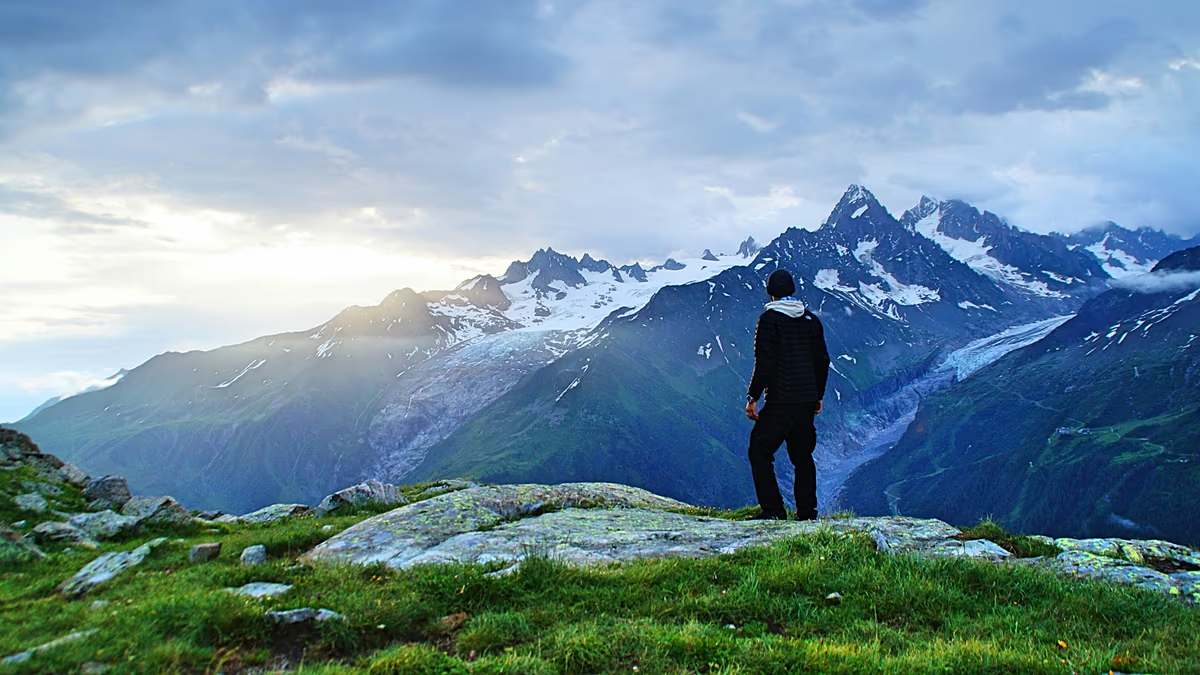
This assessment, presented in the SportsCover Direct study, specifically narrows its focus is on active holidays, scoring destinations across multiple categories including summer temperatures, humidity levels, available hiking and cycling trail networks, and overall accessibility, all distilled into an index score out of 100. The results are a vindication for those who have always viewed the mountains, rather than the coast, as their natural summer sanctuary. The prestigious Mont Blanc region of France has claimed the #1 focus party, achieving a robust index score of 73.7. Even more striking than this first-place finish, is the overwhelming dominance of the Alps across the board. In a stunning turn of events, the mountain range claimed four of the eight top spots in the overall list, beating the conventional wisdom that the Nordics are the only viable option for a refreshing summer escape. Austrian Tyrol secured the fifth position in the overall cumulative index, followed by Hohe Tauern National Park in Austria and Switzerland’s Valais canton, which took eighth and ninth positions of the listed top ten. This is an unexpected turn for the travel industry, which has been heavily promoting the Nordic – more to be seen in the latest rankings. This newfound interest isn’t just a clever guess or a trend popping up on a single ranking; it’s backed up by global search data. The internet echoes this sentiment, y-y: Google from worldwide “Alpine summer” searches have exploded by a staggering 222% year over year. For destination-marketing all, it reflects a new reality that the unique combination of altitude, climactic comfort, and the quality of infrastructure is creating the definitive romantic, active summer escape.
What exactly is driving this alpine renaissance? It is that heat refuge doesn’t solely come down to raw temperature, but a mix of factors that amount to overall well-being. Much of this appeal is the remarkably excellent trail network and peak-level accessibility. For instance, the French Alpine resort town of Chamonix, nestled directly at the foot of the Mont Blanc massif, alone boasts a staggering 217 hiking and cycling trails for every 100 square kilometers (38.6 square miles). This dense network represents one of the most substantial and accessible network densities among all the destinations that the analysts considered, making it the perfect mecca for an active vacation. Austrian Tyrol was found to have a similarly strong trail density, with 178 trails per 100km². This allows for easy expansion, adaptable to both seasoned hikers to attack at a challenging route, but also families looking for a gentle stroll against a sightline that is beyond majestic. The benefit of these high-density networks means visitors have greater flexibility with their days, avoiding the crowds that can be seen “in certain alpine valleys. People are also realizing that the Alps offer a unique balance—the high altitude keeps the air fresh and cool, even during heatwaves, but the solar radiance is still palpable, granting that quintessential summery feel without coming as a suffocating quality that a hotspot of Southern Europe would. The Alps are now not just a winter destination but a cool climate resort, but of right to be a dynamic summer hub, with fresh mountain air, cool temperatures, and a high adventure quotient.
Dare we think Scandinavia has been humbled into obscurity? Not entirely. For all the Mediterranean-dwellers are flocking to the mountains, the allure of the North still holds a special place. Sweden’s Åre and Jämtland Mountains claimed a strong second place, firmly establishing their credibility with an index score of 65.1, and Norway’s iconic Lofoten Islands also made the cut, coming in seventh in the ranking. But their fewer absolute top placements being analyzed and regions have nevertheless provided a critical topic for how we frame the experience of the get-away-from-the-heatment. While their northern latitudes typically grant them cool summer temperatures, these destinations have their own unique set of challenges. The Lofoten Islands, for example, despite their famously dramatic and jagged scenery, are located above the Arctic Circle, making them rather tricky to access. Travel logistics can eat into holiday time and costs, and this accessibility factor is now central to making a choice as people evaluate their active vacations. Furthermore, humidity seems to be the pivotal differentiator. Humidity plays a role—a vital detail often lost when celebrating the northern escapes. The Nordics generally run significantly more humid than their Alpine counterparts, which can change how the temperature feels in reality. For instance, the Lofoten Islands averaged 82% humidity in August, leaving a heavier, muggier tactile feel on the skin. In contrast, Mont Blanc and Valais stay at a comfortable 74% humidity. At the same temperature, this makes the Alpine regions feel genuinely more comfortable, not subject to the sticky heat and persistent overnight warmth one gets in an oceanic coastal climate, and is perhaps better for long distance treks.
Much of the ranking’s surface area points to the UK, Ireland, not only anymore the beacons of rainy summers, but as surprise battlegrounds of the “active coolcation”. The research shows graphic variety in the top-ten breakdown, including three specific entries from the British Isles and Ireland, locations that tend to boast exceptionally pleasant temperatures—even in peak season. The Scottish Highlands came in at third overall, with Eryri (Snowdonia) National Park in Wales having found its own fourth-place spot in the ranking. Connemara in Ireland also managed to claim the tenth spot. These rugged environs stand out for a rarely-achievable, but highly desirable combination: comfortable temperatures, dense trail networks, and excellent accessibility. In August, the temperatures in the Highlands average just 13.6°C, providing a deep, cool sanctuary from the ongoing European heatwave. And despite its untouched wilderness, the Highland network isn’t sparse: it has 211 hiking and cycling trails per 100km² (38.6 square miles), almost matching the density of their Alpine rivals. Snowdonia follows a similar pattern, boasting a staggering 28 high-quality trails per 100km², a number that rivals the best alpine hubs and connects easily to cities. It means the “active traveler” doesn’t need to fly to a far-flung place to get the access; they can essentially pick and choose amongst and sleep in the familiar, comfortable location to avoid humid weather.
This list is a testament to a broader geo-reorientation of the European summer. The top ten list for reference is as follows: 🇫🇷 Mont Blanc Region, France, (score 73.7); 🇸🇪 Sweden’s Åre and Jämtland Mountains (65.1); 🏴 Scottish Highlands, Scotland (60.9); 🏴 Snowdonia/Park, Wales (58.0); 🇦🇹 Austrian Tyrol, (57.6); 🇫🇷 French Pyrenees, France (53.9); 🇳🇴 Lofoten Islands, Norway (53.1); 🇦🇹 Hohe Tauern National Park, Austria (51.1); 🇨🇭 Valais, Switzerland (49.0); and 🇮🇪 Connemara, Ireland (47.2). Interestingly, the results blur a simplistic idea that Europe is an island for summer, but effectively make up a sort of mountain and coastal mix. It is a complete rebuke of the primary thought that for comfort you can only swing to the Scandinavian North. Instead, we are seeing the incarnation of an increasingly diverse landscape for climate resilience in travel, leveraging altitude and local infrastructure to achieve something that everyone seeks; comfort, beauty, safety, and activity, all blended into one. The choice is now not a binary between a vibrant thermal experience or a manic escape to the poles, but a nuanced field of options, celebrating the scenery and infrastructure that connect the traveler to it.
Powerfully, this ranking speaks to a new psychological landscape in travel. While intenological specifics will always remain ever so interconnected, the eventual lesson is the advent of the adaptative traveler, interested in workable climates. The rise of the “coolcation” is not just about avoiding the unbearable heat, but a repositioning of what constitutes a vacation. It helps us tap into the ultimate joy of summertime—opening whole chapters of discovery—without the oppressive exhaustion of typical heat, or a sense of doomed claustrophobia. Whether it’s the sublime horror of Summit of Mont Blanc, the untouched miles of the Highlands and the crisp air of Sweden, Europe is now offering a pathway to hope, to be explored in active rituals. The modern traveler isn’t just searching for north migration; they’re looking smart, and they are now looking carefully THIS varied top ten. As climate patterns become more complex, the most compelling future of “trips” is defined in a promise to unlock new energy for exploration, and honor that fresh air and spirit of adventure can go together, wherever you decide to conquer.