


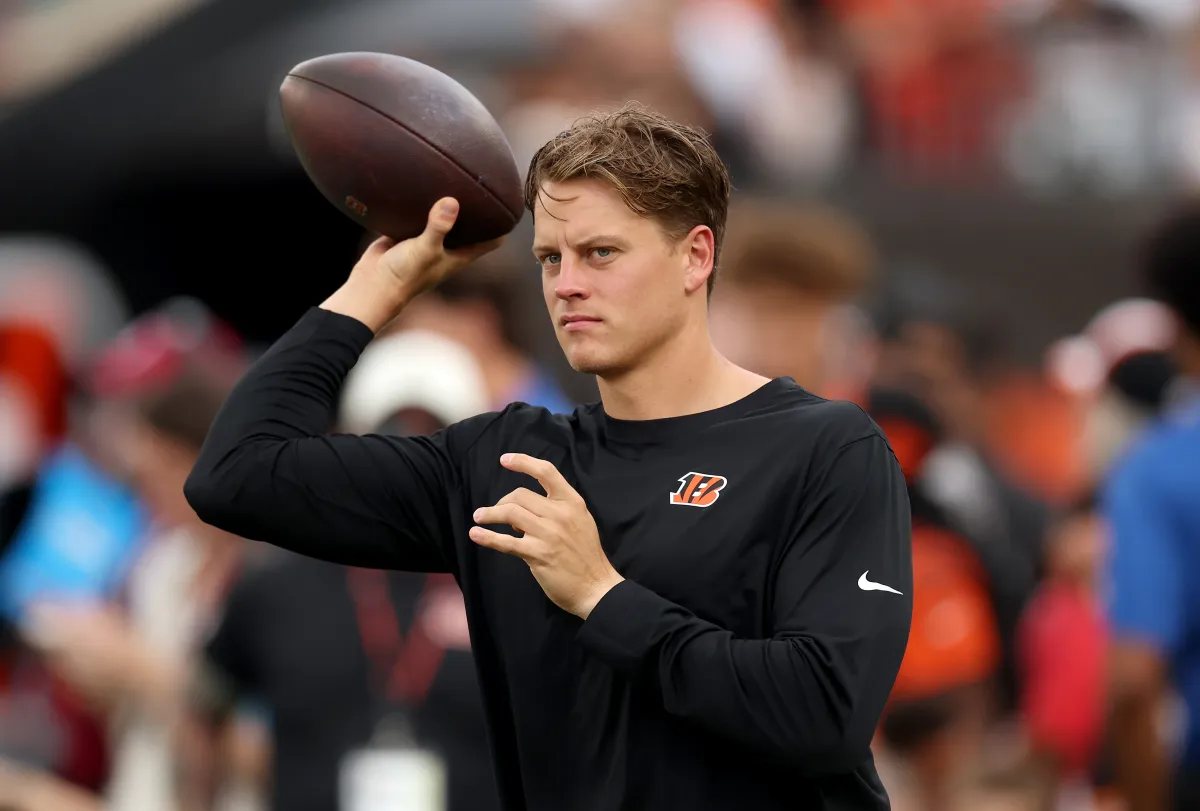
There is a particular warmth that floods the psyche of a fanbase when the universe seems to align perfectly around a singular superstar, and for the city of Cincinnati, that warmth is radiating off the field right now. As the 2026 NFL season looms on the horizon, Fox Sports has just delivered a seismic piece of validation that should make Joe Burrow feel like he is walking on air. They have officially named Cincinnati Bengals wide receiver Ja’Marr Chase the fourth-best player in the entire National Football League—a staggering accolade that places him ahead of a litany of legendary edge rushers, dominant offensive linemen, and even some of the game’s most celebrated franchise quarterbacks. In a league historically dominated at the top of these rankings by signal-callers who command hundred-million-dollar contracts and defensive monsters who collapse pockets with terrifying ease, seeing a pure wide receiver wedge himself between the game’s elite is nothing short of a paradigm shift in how offensive value is measured. For Burrow, the steely-eyed field general of the Bengals’ high-powered attack, this news should feel like pure oxygen in a vacuum. Knowing that when he drops back to pass, the man running downfield on his right side is considered a top-four talent on the planet—a designation reserved for individuals who can single-handedly alter the trajectory of a franchise—allows Burrow to operate with a level of unshakeable swagger that few quarterbacks can replicate. It is the official confirmation of what they have both known since their National Championship days together at LSU: the stage is meant for them, the ball is meant for their connection, and no defensive scheme in the world is designed to truly stop them.
Let’s crystallize the absurdity of Chase’s statistical portfolio, because numbers don’t lie, and Chase’s numbers are practically speaking a different language. Last season, he rewrote the record books by hauling in an almost inconceivable 185 receptions—a figure so far ahead of the NFL’s single-season benchmark that it would have sounded like a typographical error had it not been verified live on television. That staggering number shattered decades of accumulated history, eclipsing the previous marks held by legendary possession receivers and turning the idea of “volume” into a cartoonish concept. But sheer volume is only half the story of his dominance. Chase has compiled at least 1,000 receiving yards in every single one of his five professional seasons, a streak of consistency achieved through rigorous conditioning, an obsessive study of defensive film, and an innate understanding of how to manipulate the geometry of the field. He doesn’t just out-muscle corners; he out-thinks them, setting up explosive moves three steps ahead of the play unfolding in front of him. When you combine that elite yardage with his ability to convert on crucial third-and-elevens or rip the top off a defense on a deep go-route, you get a player who is not just prolific but wildly efficient—a scoring machine who catches the ball in traffic, breaks tackles with deceptive power, and accelerates into the open field with the shiftiness of a slot receiver despite possessing the sturdy frame of an outside threat. In a modern NFL where scoring has become a premium yet defenses have become faster and more complex, Chase has turned the act of catching a football into a veritable cheat code. It is a profound rarity when a player makes the routine look easy and the miraculous look routine, but Chase does so on a weekly basis, fundamentally bending the very architecture of the field in favor of the Bengals’ cause, ensuring Burrow always has an outlet, a target, and a miracle waiting.
Yet, the most staggeringly impressive aspect of Chase’s elevation to the fourth overall spot in the league lies in the sheer burden he carries every single snap. He is constantly shadowed by double teams, bracket coverages, and clouded safety looks designed exclusively by defensive coordinators to erase his existence from the game plan. These coaches spend eleven hours a week dreaming up nefarious schemes to deny him the football, drilling their corners to press him at the line, trailing a free safety over the top, and drifting a churning linebacker underneath to take away the crossing routes. And still, after all that dedicated defensive attention, he wins. This is what separates him from merely excellent receivers—his mastery of the chess match. He uses his formidable strength at the line of scrimmage to violently fight through jams, then unleashes a breakaway burst that leaves defenders grasping at air as he cuts his route. When the coverage collapses around him, he contorts his athletic frame into acrobatic, unnatural positions to snag contested balls with hands that seem to have their own magnetic attraction to the pigskin. He is the ultimate nightmare for a defensive back because he plays with a reckless, joyful aggression, actively inviting contact, then absorbing it, keeping his legs churning for additional yardage after the catch. The commitment offenses have to make to neutralize him creates a devastating ripple effect across the entire field; if you double him, the run game opens up, the middle of the field opens up for tight ends, and the opposite wide receiver finds himself isolated on a one-on-one island. Chase attracts so much gravitational pull that he makes the entire Bengals’ offense ten times more dynamic, turning Burrow’s job into a masterclass of misdirection. It is the ultimate compliment that the NFL’s top defensive minds spend the most resources planning for him, yet he still ended the season with the most catches in the history of professional football.
Now, steer the focus back to Joe Burrow, the bespectacled architect of this aerial assault, because this ranking is as much about him as it is about Chase. For a quarterback, having a player like Chase is akin to a pilot having an autopilot system that never fails, or a surgeon having a scalpel that never dulls. The telepathy they share is almost supernatural, born from hundreds of hours of practice and an unspoken sixth sense that developed in the swamps of Louisiana. Burrow knows exactly where Chase will be before the route breaks, and Chase adjusts his break on the fly based on the thickness of the coverage, flashing subtle hand signals and glancing eyes to communicate mid-play. This ranking gives Burrow undeniable peace of mind entering the 2026 season, a comfort that is perhaps more valuable than any playbook drawn up by the coaching staff. He knows that no matter how scrambled the pocket gets, how chaotic the defensive rush becomes, he has a bailout option who can turn a broken play into a 70-yard touchdown in the blink of an eye. The trust established during their college dominance seamlessly transitioned to the pro level, and they have evolved it into an art form that opposing defenses simply cannot solve. Chase’s presence also relieves the immense pressure off the rest of the offensive unit; with defenses keyed on him, players like Tee Higgins and the emerging tight end corps feast on easier matchups, the offensive line gains precious extra seconds to hold blocks because corners are playing deep, and running backs find softer, wider boxes to run through. Burrow can distribute the football with surgical precision, knowing that his primary weapon doesn’t demand the ball every play, but demands the defensive gravity regardless. This ranking is a collective raising of the ceiling for every single player on the Bengals’ offense, guaranteeing that the franchise’s window to win a Super Bowl is pried open wider than it has ever been before, transforming preseason hopes into tangible, realistic expectations.
However, to truly humanize the phenomenon, one must strip away the analytics, the yards after catch, and the contested catch rates, and look at the man behind the jersey. Ja’Marr Chase is a walking, talking celebration of football’s purest essence—unadulterated joy and ferocious, unyielding confidence. He plays with a Mardi Gras swagger that traces back to his vibrant Louisiana roots, dancing with reckless abandon after touchdowns, trash-talking Hall-of-Fame cornerbacks without a hint of hesitation, and exuding a charisma that electrifies every stadium he walks into. But under that brash, colorful bravado beats the heart of a relentless, blue-collar worker. Teammates often recount staying late to watch film with him, where he breaks down his own catches with the scrutiny of a hardened coach, searching for that thousandth of a second he might have shaved off his route or a single step he could have placed differently. That intensity is a double-edged sword; his passion can sometimes spill over, leading to animated sidelines or contentious back-and-forths that make for great television. Yet, it is this human fire that makes him so deeply beloved in Cincinnati and so viscerally hated by opposing fanbases. People don’t just tune in to see the stats; they tune in to see him. They watch to see if he’ll do a backflip after a touchdown, or wag his finger at a defender who just missed a game-changing interception. He embodies the idea that sports, at its very heart, is meant to be entertainment. For opponents, facing him on a Sunday is a psychological gauntlet; you can prepare all week, study all the tape, but when the ball snaps, his infectious smile, his boundless energy, and his relentless motor chip away at your confidence until you mentally break. He is a naturally gifted athlete, an obsessive competitor, and a vibrant personality all rolled into one—a rare breed in a league that sometimes takes itself far too seriously.
Ultimately, placing Chase at number four among all NFL players heading into 2026 signifies a massive passing of the torch in how we perceive the wide receiver position in the modern era. He is no longer just a flashy weapon for the Bengals’ passing attack; he is a foundational piece of the league’s entire landscape, mentioned respectfully in the same breath as the most valuable franchise quarterbacks and generational defenders. The implications for the coming season are enormous and exhilarating. The Bengals enter the year with an elite quarterback who has been to a Super Bowl, a reliably dynamic running game, an offensive line finally given time to gel, and a top-four player on the roster, all burning with a hunger to erase the memories of past playoff disappointments. For Burrow, to step onto the practice field knowing that the league just added another layer of validation to his partner in crime is the greatest early gift a franchise quarterback could ask for. It sets an emphatic tone for training camp, instills raw fear into the hearts of every defensive coordinator on the schedule, and galvanizes the entire city of Cincinnati into a state of fervent belief. But beyond the trophies, the records, and the spectacular one-handed grabs, Chase’s story is that of a kid who worked relentlessly to become the best version of himself, embracing the pressure of the spotlight and thriving under the weight of astronomical expectations. As the 2026 season kicks off, Joe Burrow shouldn’t just feel good about his target; he should feel invincible. Because while the ranking is a beautiful piece of paper to frame, the real proof lies in the way double teams fail, the way history bends to his will, and the way a single, joyful, impossibly talented player can make an entire city believe that anything—including a hoisted Lombardi Trophy—is absolutely possible.