



The Battle Against Weeds Goes High-Tech: How AI and Lasers Are Transforming Modern Farming
The next great frontier for artificial intelligence isn’t unfolding in some sterile data center with rows of humming servers and cooling systems. Instead, it’s happening right in the dirt of America’s farmlands—specifically, in the weeds that have plagued growers since the dawn of agriculture. Two innovative startups from the Seattle area are wagering that cutting-edge AI can revolutionize how farmers identify and eliminate unwanted plants, though they’re taking remarkably different paths to achieve this goal. One company is creating detailed digital maps that pinpoint every single weed across vast expanses of farmland, while the other has developed autonomous robots that literally zap unwanted plants with lasers. Together, these approaches represent a fundamental shift in how we think about one of agriculture’s oldest and most persistent challenges, and they signal that the future of farming will be driven as much by silicon and software as by soil and sunshine.
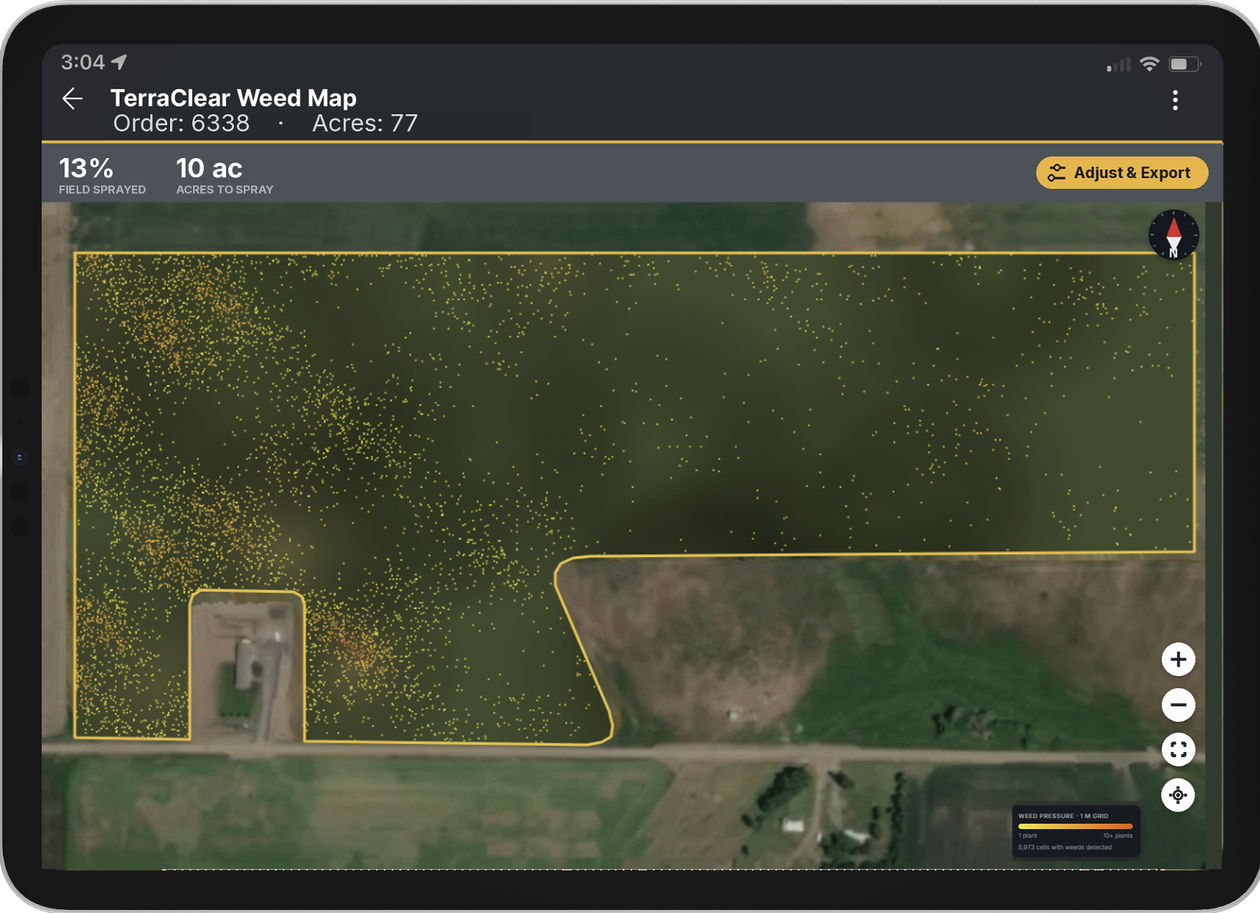
TerraClear, based in Issaquah, Washington, is commercializing an ambitious new system that harnesses ultra-high-resolution imagery and sophisticated machine learning to create comprehensive maps of individual weeds across entire fields of corn and soybeans. The technology, which the company calls Weed Maps, captures imagery at an astonishing 1.5-millimeter resolution—detailed enough to identify weeds as small as a quarter inch, roughly the size of a pencil eraser. What makes this particularly impressive is that unlike traditional methods that sample portions of a field, TerraClear’s system photographs every single acre and produces a geo-referenced map that can be uploaded directly to modern precision sprayers. These maps essentially provide farmers with a digital prescription for exactly where weeds are located, and the sprayers can then activate individual nozzles only in those specific locations. This level of precision would be virtually impossible for a human to achieve manually, as it requires tracking the position of individual weeds across thousands of acres of farmland. The company promises that these maps can be delivered to farmers within a day, giving them the crucial ability to act while weeds are still young and easier to control—a critical window in the battle against invasive plants.
What’s particularly clever about TerraClear’s approach is how it sidesteps what the company’s CEO, Devin Lammers, calls “the capital problem entirely.” Rather than requiring farmers to invest in expensive new equipment, the company has designed its system to work with sprayers that growers already own. Modern grain and oilseed sprayers already come equipped with individual nozzle control and RTK positioning systems—the hardware necessary for precision application is already sitting in the farmer’s shed. TerraClear simply provides the intelligence that tells this existing equipment exactly where to spray. As Lammers explained, the company essentially hands the sprayer a digital file of individual weed locations, and the machine responds by turning on nozzles only where weeds actually exist. This is a crucial distinction in the agricultural market, particularly for large commodity farmers who manage thousands of acres at relatively thin profit margins. These growers need every dollar to pencil out, and asking them to invest in expensive new machinery is a tough sell. Instead, TerraClear’s model is elegantly simple: the farmer buys a map, not a machine. It’s a strategy that acknowledges the economic realities of modern farming while still delivering dramatic improvements in efficiency and chemical reduction.
Meanwhile, across the Seattle area, Carbon Robotics is pursuing a completely different strategy that’s capturing attention from farmers and tech enthusiasts alike. The company has developed an autonomous machine called the LaserWeeder that uses computer vision to identify weeds in real-time and then destroys them with high-powered lasers—no chemicals required whatsoever. It’s a solution that sounds almost like science fiction, but it’s already being deployed on farms around the world, accumulating an enormous dataset in the process. The LaserWeeder represents a different philosophy about how technology should integrate into farming: rather than simply making existing equipment smarter, it replaces the equipment entirely with something new and autonomous. The machine makes decisions in the field, distinguishing between crops and weeds instantaneously, and then eliminates the unwanted plants with precision that chemical applications simply can’t match. And the technology keeps getting more sophisticated. The company recently introduced what it calls a Large Plant Model, trained on an astounding 150 million labeled plants, which Carbon Robotics describes as the largest agricultural plant dataset of its kind. This represents a fundamental evolution in how these systems learn and operate.
The Large Plant Model, and a related feature called Plant Profiles, represents a significant leap forward in agricultural AI. Previously, computer vision systems in agriculture were narrowly trained and needed to be retrained whenever they encountered a new weed species, a different crop variety, or unfamiliar field conditions. This made the technology difficult to scale and limited its utility for farmers who grow diverse crops across varied environments. The new approach, however, aims to create a foundational understanding of plants that can adapt to virtually any situation. Farmers can use Plant Profiles to show the system a handful of images and customize what the machine should recognize and target in their specific fields. This is crucial because weeds change dramatically at different stages of growth, and their appearance can be influenced by soil conditions, weather patterns, and crop varieties. The ultimate goal, according to Carbon Robotics CEO Paul Mikesell, is to create machines that can understand any plant in any field immediately and adapt their behavior in real-time, delivering maximum value to farmers regardless of their unique circumstances. It’s a vision that transforms the laser weeder from a specialized tool into a universally applicable solution.
Both companies are operating within a broader Pacific Northwest agricultural technology ecosystem that has been quietly developing world-leading innovations at the intersection of farming and computing. This ecosystem builds on the region’s unique combination of agricultural heritage and tech expertise, creating a powerful synergy. TerraClear’s founder, Brent Frei, embodies this dual identity perfectly—he grew up on a family farm in Grangeville, Idaho, before attending Dartmouth and eventually moving to the Seattle area, where he co-founded successful software companies including Onyx Software and Smartsheet. This background gives him insight into both the practical realities of farming and the potential of technology to solve agricultural challenges. TerraClear itself was founded in 2017 with a focus on a decidedly unglamorous problem: identifying and removing rocks from farmers’ fields. The company has grown significantly since then, raising $15 million in 2024 and bringing its total funding to $53 million. By early 2025, it had expanded to about 50 employees and was approaching 1,000 customers. The company has also launched an autonomous field robot called TerraScout that collects high-resolution imagery across fields and converts that information into actionable maps for existing farm equipment. Remarkably, TerraScout can collect more than 4 billion image samples per acre and map more than 1,000 acres per day under favorable conditions, making it an incredibly powerful data collection tool.
The environmental implications of these technologies are substantial and increasingly politically relevant. Both approaches have the potential to dramatically reduce the amount of chemicals applied to agricultural lands, a topic that has gained significant attention in Washington D.C. President Trump earlier this year committed $1 billion to modernize farming and reduce chemical use in agriculture, and Robert F. Kennedy Jr., the current Secretary of Health and Human Services, has specifically touted Carbon Robotics’ machines as a potential solution for cutting pesticide use. This federal attention could help accelerate adoption of these technologies and spark additional innovation in the agricultural technology sector. In TerraClear’s case, the company claims that its precision mapping technology alone could cut pesticide and herbicide use by up to 80% while maintaining the same level of effectiveness. This is a staggering potential reduction that would have significant environmental and economic benefits. For farmers, reduced chemical costs directly impact their bottom line, while the environmental benefits extend to water quality, soil health, and biodiversity. The timing of these technologies is also significant, as consumers increasingly demand food produced with fewer synthetic chemicals, and regulatory pressures on agricultural chemical use continue to mount globally.
The business models of these two companies reflect different philosophies about innovation in agriculture. TerraClear has positioned itself as an enabler of existing equipment, providing intelligence that makes conventional machinery dramatically more precise and efficient. The company’s approach acknowledges that replacing all of America’s agricultural equipment overnight is neither feasible nor desirable—instead, it extracts maximum value from the infrastructure that already exists. Carbon Robotics, by contrast, is betting on wholesale transformation, developing entirely new machinery that replaces both the equipment and the operator in certain contexts. Their laser weeders are autonomous, meaning they don’t require a tractor driver, and they eliminate the need for chemical application in the first place. Both approaches have merit, and their coexistence suggests that the future of agriculture will likely involve a mix of retrofitted precision equipment and entirely new autonomous machines, depending on the scale of operations, the types of crops grown, and the specific challenges faced by individual farmers.
Perhaps the most intriguing aspect of this technological revolution is what it means for the future of agricultural data. Both companies are accumulating enormous datasets through their operations. Every time a camera passes over a field—whether mounted on a ground robot or an aerial drone—it collects information about plants, soil conditions, crop health, and growing patterns. This data has immense potential value that extends far beyond weed identification. Seed companies could use it to better understand crop performance under different conditions. Researchers could gain insights into soil health and agricultural practices. Equipment manufacturers could use it to design better tools. Insurance companies might use it to assess risk. The data that TerraClear and Carbon Robotics are collecting could become as valuable as the weed control services they provide, opening up entirely new revenue streams and applications. TerraClear’s CEO has noted that the imagery his company gathers is field-level, repeated season over season, and specific to commodity acreage—creating a cumulative dataset that becomes more valuable over time. As he put it, better models produce better maps, which attract more acres, which generate more data, which creates even better models. It’s a virtuous cycle that could fundamentally transform our understanding of agricultural ecosystems and enable continuous improvement in farming practices.
For farmers, the ultimate promise of these technologies is liberation from one of the most tedious and persistent aspects of agricultural work. Weed management has historically consumed enormous amounts of time, labor, and money, requiring either extensive chemical applications or physical removal. The new AI-powered approaches offer the possibility of precise, efficient, and increasingly autonomous weed control that frees farmers to focus on other aspects of their operations. For consumers, these technologies offer the promise of food produced with fewer chemicals, which could have significant health benefits. For society as a whole, they represent a more sustainable model of agriculture that reduces environmental impact while maintaining or increasing productivity. The fact that these innovations are happening in the Pacific Northwest—a region better known for coffee and software than for corn and soybeans—is a testament to the power of cross-disciplinary thinking and the willingness of entrepreneurs to tackle problems far outside the traditional tech industry playbook.
As these technologies continue to evolve and mature, they will likely become more affordable, more capable, and more widely adopted. The challenges of feeding a growing global population while reducing agriculture’s environmental footprint are among the most pressing issues of our time, and it’s becoming increasingly clear that technology will play a central role in addressing them. The weed-mapping systems and laser-equipped robots developed by these Seattle-area startups may seem like niche innovations today, but they could well be remembered as early milestones in a broader revolution in agricultural technology that’s fundamentally reshaping how we grow food. The story of AI in agriculture is still being written, but one thing is certain: it’s no longer confined to science fiction or speculative theory. It’s in the fields, in the soil, and very much in the weeds.