


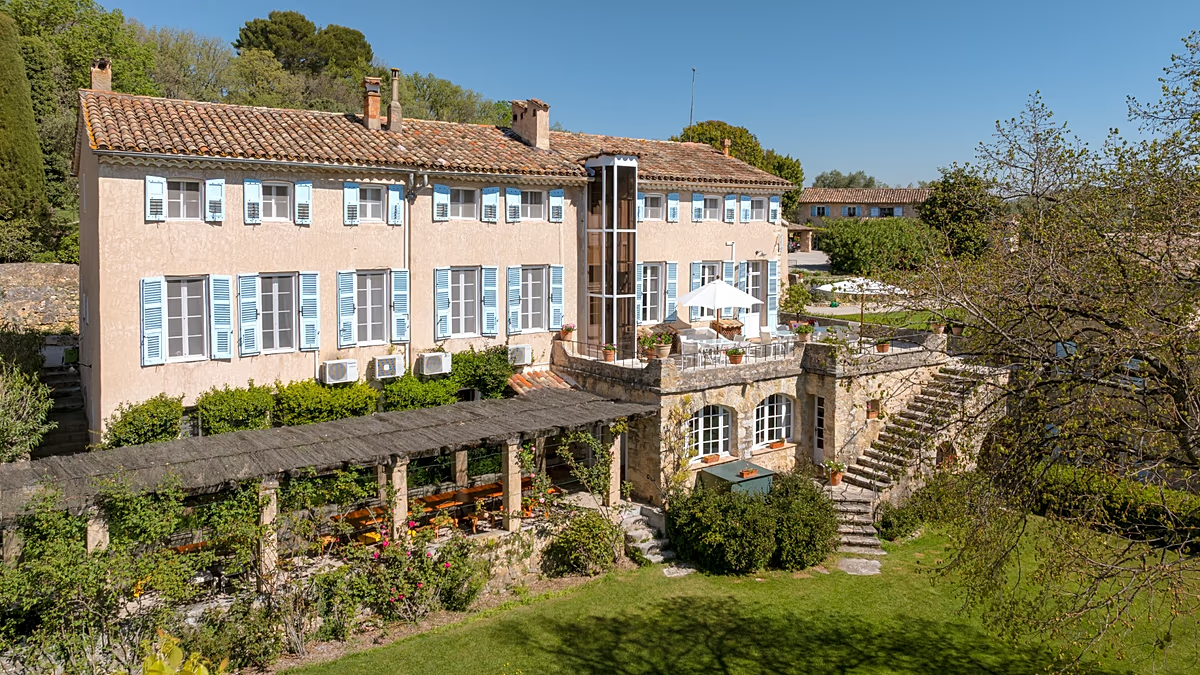
In the hush of the Provençal countryside, inland from the warmand glamorous pressures of the French Riviera, there is a village called Valbonne. It is not the Riviera of billboards, but the one that exists before and after the season, when the afternoon light settles on pale ochre walls and cobblestones hold the coolness of a thousand mornings. Valbonne is one of those medieval villages that travellers fall in love with for its simplicity: a compact tangle of pastry-coloured houses, an arcaded central square, café tables gathering like doves, and the sense that time moves at walking pace. Just a short stroll from that square, screened by ten hectares of olives and holm oaks, stands an extraordinary estate called Domaine de La Sylviane. The property has been quiet in recent years, but its long life has never been devoid of drama. In the 1980s, English pop rock band Duran Duran chose this spot as a refuge and a base while they worked on their third studio album, Seven and the Ragged Tiger. It must have been a beautiful place for creative rest: far enough from the roaring coast to feel hidden, near enough to still catch the electricity of the era. Yet the famous musicians are only one thread in the house’s rich fabric. The estate is named after a daughter of a general in Napoleon’s army, and members of the family of Prince Rainier III of Monaco also lived here at one time before the current owners came to know the property. Old walls, after centuries of guests, tend to acquire a deep, quiet confidence; this is exactly what Domaine de La Sylviane still carries.
To cross the threshold of the property is to understand that this is no simple Riviera villa. The estate is enormous in scale, yet it never tries hard to impress. The main residence, built in 1697, holds six bedrooms and vast communal rooms with the original bones of the 17th century still visible in their walls and beams. Next to it stands a separate three-storey cottage, which includes an independent, two-bedroom apartment, giving everyone the freedom to live both together and separately. The courtyard contains two more villas, each with two bedrooms, while a caretaker’s apartment at the entrance means there is always someone to watch over the gardens and the silence. In total, the property arrives at twenty-three rooms and sixteen bedrooms, which is less a hotel and rather a full story of hospitality. Around the ancient stone, a gym room has been shaped unseen in the trees; the pool house is a study in slow, elegant afternoons; the tennis court is widely bordered by fruit trees; and the garage, discreetly placed, can fit six cars. Then there is the land itself. Over five hundred ancient olive trees grow across the ten hectares, producing nearly a thousand litres of olive oil every year. There is something intimate in this detail: the estate gives its inhabitants olive oil from its own golden-green trees, a bottle to the table as timeless as the stone. It is a self-contained world, designed not for showing off, but for living. Every room has a reason to exist, every corner could contain a bookcase of stories, and every morning begins with perfect dividends: birdsong, cool air, and the quiet of a place that has known how to keep itself alive.
The history of Domaine de la Sylviane goes far deeper than any of the glamorous names associated with it. The ground itself had already been settled in the 13th century, long before Cannes became a golden coastline of fashionable hotels. Those first centuries were agricultural and monastic: monks worked the land, planted olives, and kept the rhythm of prayer and harvest safe. For hundreds of years, the Riviera did not belong to the jet set; it belonged to fishermen and olive growers, to hilltop villages and to families who followed the turning of seasons rather than the launch of a summer season. Under those old branches, the estate took its name after a real person, the daughter of a general in Napoleon’s army, called La Sylviane, as if the house wanted an identity as gentle as its setting. Later, certain branches of Prince Rainier III of Monaco’s family came to stay, bringing a royal presence to Valbonne. The layers are not competitive. They are simply days made, one on top of another, each leaving its small obsession in the patina of the stone. Even today, the estate retains its traditional caretaker: a resident who lives on the land and keeps the past seasons in order, in such a way that nothing breaks up a chill and everything remains welcoming. It is the adherence to the specifics of Provence, not as an old model in a museum, but as a living household that still needs to be lived in order to be properly understood.
Carlton National, the luxury estate agency tasked with presenting this property to the world, has, of course, seen its core. Philip Weister, the founder and CEO, believes the significance of Domine de la La-sylvie and its place in the world lies far deeper than the floor rows or a swimming pool. “Long before Cannes welcomed the world’s cinema stars, before Cap d’Antibres became a famous for grand estates and elegant hotels, the Riviera was a land of fishermen, monks, olive growers,” he says, “and hilltop villages whose rhythms followed the seasons rather than the summer holiday calendar.” It is a vision of the French Riviera that what most visitors don’t see. In the blue calm of the coast, the Beaches, the golden parties, all the noise you surround, there is a completely different country: an inland Riviera of church bells, lane after lane of ancient olive groves, stone farmhouses speckled in the shade. The luxury of a property like this is not in being seen but in the freedom it brings. As Weister puts it, “Luxury is measured not by visibility but by authenticity: the freedom to walk to the village bakery each morning.” There is something profoundly right in that phrase. In an age when everything is photographed and compared, this estate offers the rarest of luxury: a place completely absorbed by the size, long enough to be felt and not just decorated.
The location itself is a middle valley. Domaine de la Sylviane does not isolate itself in a romantic wilderness; it is just near enough to everything that matters, but far enough to remain unknown. Nice International Airport is only about twenty minutes away, the revels of Cannes are about fifteen minutes away, and when the curtains are closed, the Provençal countryside quietly holds them. “The hidden Côte d’Azur does not compete with Cannes, Nice or Saint-Tropez,” says Weiser. “She complements them, offering an altogether different experience – one that reveals the enduring soul of Provence behind the glamour of the coast.” In Valbone the centre has been restored, the Place des Arcades, a famous arcaded square, holds its Friday morning market with an energy that Weiser loves; the square especially becomes a true stage on market days. Around this all, the surrounding villages also tell their stories. Mougins, just a stone’s thrown Brunswick onwards, is considered by many a gastronomic capital of the whole Riviera, with refined restaurants and sharp Michelin stars divided among the old flowery lanes. The Étoiles de Mougins festival, created from 2006 by Paul Becous, Gaston Lenêtre, Alain Ducasse, Michel Gerard, and Pierre, Truisiers, brings chefs and culinary enthusiasts together for workshops, demonstrations, cooking competitions, conferences, and the beautiful, generous rapture of food. This is a world where fine culture depends naturally on simple local products.
The final pieces of the map finish the picture. Around the estate, within the backwards glance, are villages and experiences that have made the inland Riviera one of the region’s best-served secrets. Biote, only a short ride away, is known for its expert glassblowers, its craftmakers and for windows where the heat of the furnace, still visible behind narrow facades, creates unexpected forms in warm glass. Still farther but no less connected, Grass—famous elsewhere as the one-family capital of the perfume, not just in France—continues to cultivate the same flowers that perfumed houses have loved for centuries. The entire south of France, meanwhile, is open wide to the estate. As Weiser says, “Within twenty minutes, residents and visitors can enjoy the beaches of Cannes, Antibes or Juan-les-Pins, dine in Michelin-starred restaurants, play on some of Europe’s finest golf courses, or fly directly from Nice Côte d’Azur International Airport to destinations around the world.” Yet his final phrase is the most memorable. “At the end of the day, they return to the tranquillity of olive groves, forests and old stone houses.” It is that return which defines the gentle soul of Domaine de la Sylviane. Its oldest trees and stone lanes may have seen everything: monks walk slowly in the dawning heat, soldiers from Napoleon’s army crossed through, princes and pop stars both have felt a strange calm under its roofs. But the gates do not open to display a busy museum; they open to a place that has remained itself. Olive trees, the smell of warm earth, an old garden, and the quiet rhythm of a landscape that was there before. Centuries ago and will still be there when we all, long after, living as an unplaceable tranquillity.