


When you look up at a clear night sky, away from the hum and glow of modern city lights, the universe feels both infinitely intimate and incomprehensibly vast. Our own home galaxy, the Milky Way, appears as a brilliant, milky river of stars arching across the heavens, spanning a distance of about 100,000 light-years. To us, this stellar metropolis seems like the ultimate frontier, a place of endless worlds and unimaginable scale. Yet, in the grand hierarchy of the cosmos, our home is merely a modest island compared to the true titans of the deep universe. At the absolute apex of these structural giants stands a gargantuan entity known as IC 1101. To truly grasp the sheer scale of this cosmic behemoth, imagine lining up seventeen Milky Ways end-to-end; only then would you match the incredible width of this single, glowing super-galaxy. Spanning an estimated diameter of 1.7 million light-years—or roughly 520 kiloparsecs—IC 1101 reigns supreme as the largest known galaxy in the universe, holding a jaw-dropping 3.4 trillion solar masses of stellar material within its colossal gravitational embrace.
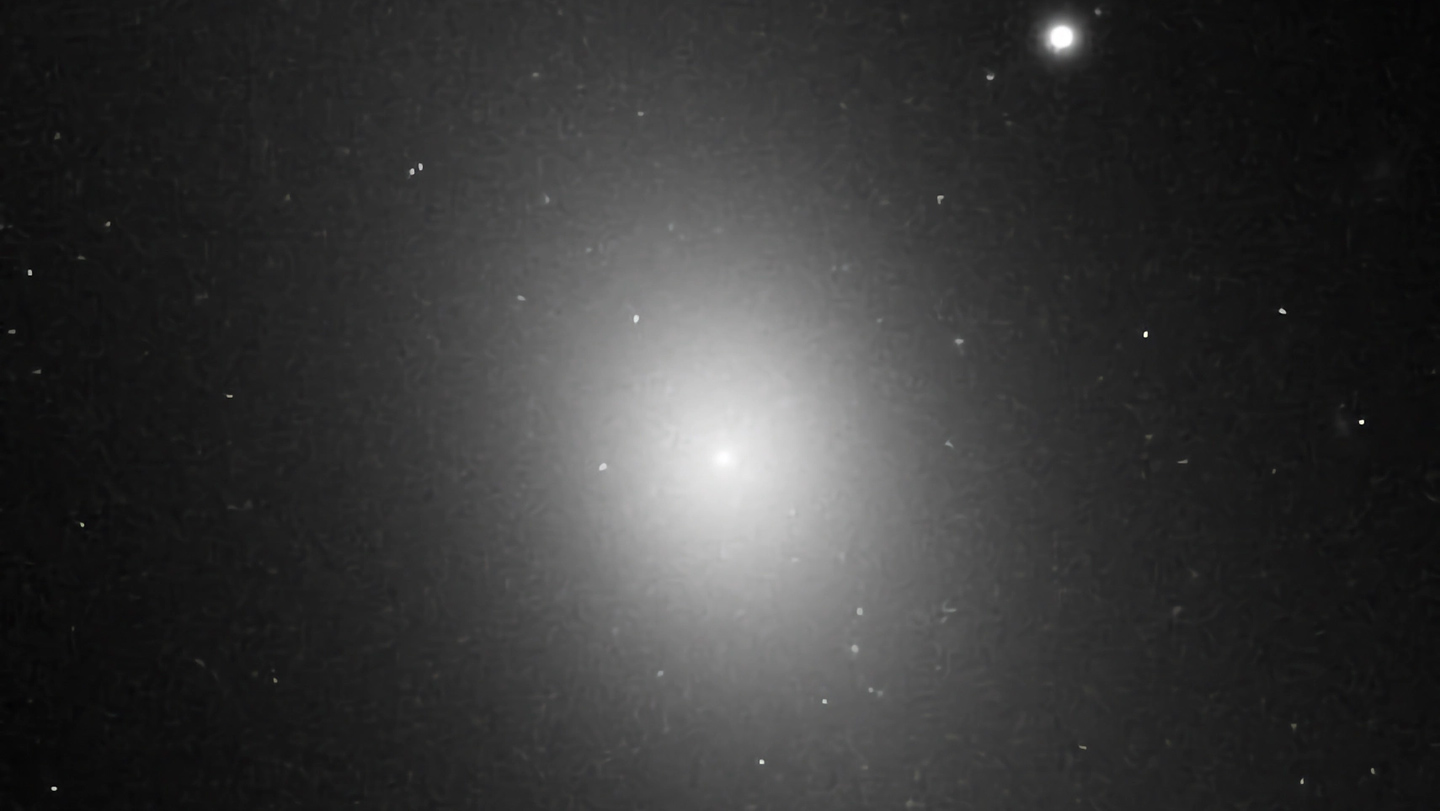
Capturing the true boundaries of such a distant giant is one of the most demanding tasks in modern astrophysics, requiring an extraordinary blend of technological precision, pristine environmental conditions, and immense human patience. To accomplish this, researchers turned to the historic Isaac Newton Telescope, perched high above the clouds at the Roque de los Muchachos Observatory on the Spanish island of La Palma. In 2022, astronomers used the telescope to capture the deepest, longest-exposure images of IC 1101 ever recorded, gathering ancient photons of light that had traveled for over a billion years to reach Earth. For decades, mapping the exact shape and size of such immense galaxies was nearly impossible because their outermost boundaries are incredibly faint. The stars at the edges of IC 1101 are spread so thin that they whisper against the darkness, slowly dissolving into the diffuse, glowing fog of the cluster surrounding them. By analyzing these ultra-deep images, scientists were finally able to peel back the cosmic veil, pinpointing the faint, elusive edge where the galaxy’s physical structure transitions into the empty expanse of intergalactic space.
The secret behind the staggering size of IC 1101 lies in a long, dramatic history of cosmic mergers—a process astronomers call “galactic cannibalism.” Galaxies rarely live in quiet isolation; instead, they are bound together by gravity into massive cosmic communities called clusters. IC 1101 sits at the absolute heart of the Abell 2029 galaxy cluster, acting as the anchor for thousands of smaller neighboring galaxies. Because of its central position, the gravity of this giant behaves like an inescapable whirlpool, slowly dragging in smaller stellar systems that venture too close. Over billions of years, these smaller galaxies are subjected to immense gravitational forces that stretch and shred them, scattering their stars, gas, and dark matter. This debris is then slowly digested and integrated into the massive, bloated body of the host. This relentless process has transformed IC 1101 into what astronomers classify as a “brightest cluster galaxy,” representing a unique class of evolutionary giants that have grown fat on the remnants of their peers.
Far from being a static relic of a bygone cosmic era, new research submitted to arXiv.org reveals that IC 1101 is still actively growing and feeding today. When astrophysicists analyzed the new deep-space imagery, they discovered faint, massive, taillike structures stretching outward from the galaxy’s edges. These cosmic tails are essentially the glowing embers of recent stellar collisions—the stretched, ghostly remains of smaller galaxies currently being pulled apart and absorbed by the titan. Carlos Marrero de la Rosa, an astrophysicist at the Instituto de Astrofísica de Canarias who led the study, points out that these features are living proof of ongoing accretion. “It’s still accreting things… It has not finished,” he notes, painting a picture of a dynamic, breathing giant that continues to reshape itself by swallowing the star systems in its vicinity, demonstrating that cosmic evolution is an ongoing, active force.
This continuous cycle of consumption makes IC 1101 a fascinating window into the deep future of our own celestial neighborhood. Marrero de la Rosa famously describes IC 1101 as a “galaxy of the future,” because it showcases the ultimate fate of galactic structures when gravity is left to run its course over billions of years. Our own Milky Way is currently on a slow-motion collision course with our neighbor, the Andromeda galaxy; billions of years from now, our two homes will merge, eventually forming a giant elliptical galaxy much like IC 1101. By studying this distant giant, we are looking at a preview of our own cosmic destiny—a mature universe where individual, elegant spiral galaxies have long since merged into quiet, massive, and peaceful stellar metropolises. In these aging giants, the frantic birth of new stars has mostly ceased, leaving behind a tranquil, slow-burning glow of trillions of ancient stars that will quietly illuminate the dark for trillions of years to come.
Ultimately, the story of IC 1101 is not just a tale of massive numbers and incomprehensible physical scales, but a testament to the power of human curiosity and our drive to understand the unknown. It is a profoundly humbling realization that a fragile species, bound to a small rocky planet orbiting a quiet star, can build instruments capable of reaching out across billions of light-years to weigh a monster of 3.4 trillion suns. Supporting science journalism, public outreach, and astronomical research is more important than ever because these endeavors foster scientific literacy and ensure that our society makes decisions with a sense of wonder and scientific truth in mind. By continuing to look up, fund telescopes, and share these awe-inspiring discoveries, we keep the spark of human curiosity burning brightly against the vast, beautiful, and infinite dark of the cosmos.