

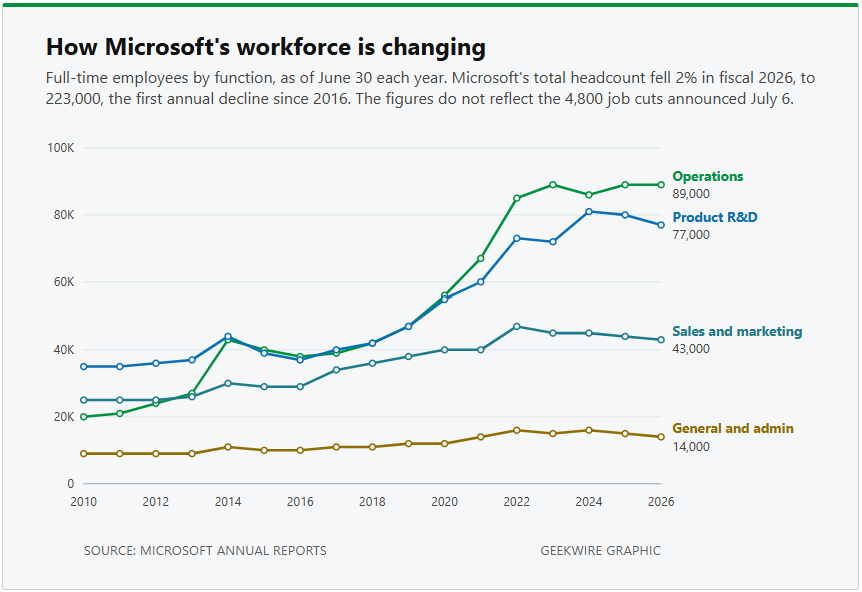
The contemporary technology sector is currently navigating one of the most paradoxical eras in its history, a phenomenon vividly illustrated by Microsoft’s recent annual regulatory filing. In a year that saw the Redmond-based giant orchestrate the largest one-year revenue surge in its corporate existence—skyrocketing by an astonishing 18 percent, or over $50 billion, to a breathtaking total of $331.8 billion—the company simultaneously reduced its global workforce by 5,000 people. This brought its total employee headcount down to 223,000 as of June 30, marking the first annual decline in employment since 2016, a year when the company was painfully dismantling its failed Nokia smartphone division. For the thousands of professionals walking the hallways of Microsoft’s sprawling campuses, this financial triumph coupled with human contraction creates a deeply surreal daily reality. It is a striking reminder that in the modern corporate landscape, record-breaking prosperity no longer serves as an absolute shield against organizational downsizing. Instead, it signals a profound, systemic realignment of priorities, where the traditional metrics of corporate health are being decoupled from headcount growth as the tech industry aggressively positions itself for an artificial intelligence-driven future.
At the very heart of this workforce contraction is a significant retreat from traditional product research and development, historically considered the sacred engine of innovation within any major software enterprise. Microsoft’s Form 10-K filing revealed that product R&D roles experienced the sharpest decline, dropping by 3,000 positions to a total of 77,000, representing a clear retreat from the peak of 81,000 R&D employees recorded just two years prior in 2024. While other sectors like operations remained relatively stable at 89,000 employees—a category that encompasses the high-demand, physical construction of massive global datacenters, alongside product support, consulting, and manufacturing—the cuts were felt acutely across sales, marketing, and administrative teams, which collectively lost 2,000 positions. This restructuring fell with disproportionate weight upon Microsoft’s domestic operations, where the United States workforce shrank by 4,000 employees to 121,000, while international offices saw a comparatively modest reduction of 1,000 jobs. For many American software engineers, program managers, and designers who had long viewed the domestic tech sector as an impregnable fortress of stability and wealth, these localized cutbacks serve as a sobering wake-up call, emphasizing that even the most talented creators are subject to the shifting tides of global corporate strategy.
The dry, annualized numbers presented in regulatory filings often mask the slow-moving emotional storm of rolling layoffs and sudden departures that Microsoft’s workforce has lived through over the past twenty-four months. The reported metrics reflect the painful elimination of roughly 9,000 jobs initiated on July 2, 2025, a mere forty-eight hours into that fiscal year, but they do not yet capture the full magnitude of more recent disruptions, such as the 4,800 job cuts announced on July 6 of this year that swept through Xbox, sales, and consulting divisions. Adding to this atmosphere of transition was Microsoft’s introduction of its first large-scale voluntary retirement program, an initiative that quietly ushered thousands of experienced, long-serving U.S. employees out of the corporate door in early July. This multi-layered strategy of targeted layoffs paired with incentivized retirements has transformed the company culture, creating a landscape of empty desks, disrupted project pipelines, and a lingering sense of survivor’s guilt among those who remain. For the human beings behind these statistics, every organizational chart update represents lost mentors, disrupted family routines, relocated households, and the psychological burden of constantly adapting to a workplace that is actively shedding its institutional memory in pursuit of a leaner, more agile operating structure.
This dramatic evolution in how software is conceptualized and built is happening under the silent, pervasive influence of generative artificial intelligence, which has rapidly transitioned from an experimental novelty into an indispensable utility on the developer’s desktop. Tools like GitHub Copilot, Microsoft’s proprietary AI-assisted coding companion, are now deeply woven into the daily workflows of engineering teams, fundamentally altering the economics of software development by enabling individuals to write, debug, and deploy code at unprecedented speeds. Although Microsoft’s leadership, including Chief People Officer Amy Coleman, has consistently and carefully avoided linking employee layoffs directly to the rise of automated intelligence, the company openly acknowledges that these advanced tools are revolutionizing the velocity and scope of corporate labor. The executive narrative insists that AI is not actively replacing human beings, but rather changing the nature of how work gets done, allowing smaller teams to accomplish objectives that previously required vast, multi-disciplinary organizations. For the individual software engineer, this shift creates a challenging professional paradox: while AI tools can alleviate the tedious, repetitive elements of coding and unlock new creative possibilities, they also raise the baseline expectation for individual productivity, effectively reducing the total number of human hands required to bring a new product to market.
The underlying financial catalyst driving this aggressive human restructuring is a massive, capital-intensive pivot toward physical infrastructure, as Microsoft engages in a high-stakes global arms race to build the hardware foundation for the AI era. Chief Financial Officer Amy Hood highlighted this transition during a recent earnings call, linking a 10 percent increase in operating expenses directly to aggressive investments in R&D compute capacity, specialized talent, and the massive data acquisition necessary to power next-generation models. The scale of this investment is staggering, with Microsoft’s capital expenditures climbing to an eye-watering $41 billion in the June quarter alone, as the company funnels astronomical sums of cash into land acquisition, specialized silicon chips, cooling systems, and massive, energy-hungry datacenters. To offset these monumental capital demands and appease Wall Street’s expectation of robust profit margins, the company must exert incredibly tight control over its operating expenses, resulting in a direct trade-off where human payroll is sacrificed to fund the silicon and steel of AI infrastructure. This fiscal reality illustrates a profound shift in corporate value, where the premium is increasingly placed on the ownership of scarce, high-performance computing power and massive datasets, rather than simply maintaining a large, highly compensated army of traditional software developers.
Rather than merely reducing its headcount, Microsoft is also aggressively re-engineering the very roles its remaining employees occupy, redirecting technical talent away from speculative, long-term internal research and toward immediate, customer-facing applications. A prime example of this strategic pivot is the creation of the Microsoft Frontier Company, a massive $2.5 billion initiative that has reassembled more than 6,000 existing engineers and forward-deployed specialists into a unified force dedicated to embedding directly within client organizations to help them construct their own custom AI ecosystems. This shift represents a fundamental transformation in what it means to be an engineer at a premier tech firm; the era of the isolated developer working quietly in a laboratory on abstract code is giving way to an era that demands highly communicative, consultative professionals who can bridge the gap between complex machine learning models and real-world business needs. As Microsoft navigates this historic transition, its workforce is learning that adaptability is the ultimate currency for survival in the modern tech ecosystem. Ultimately, the story of Microsoft’s shrinking yet increasingly profitable workforce is not merely one of corporate downsizing, but a preview of a broader societal shift—a world where human talent must constantly evolve, learn to collaborate seamlessly with artificial intelligence, and pivot toward direct value creation in an economy that is being rewritten in real-time.