



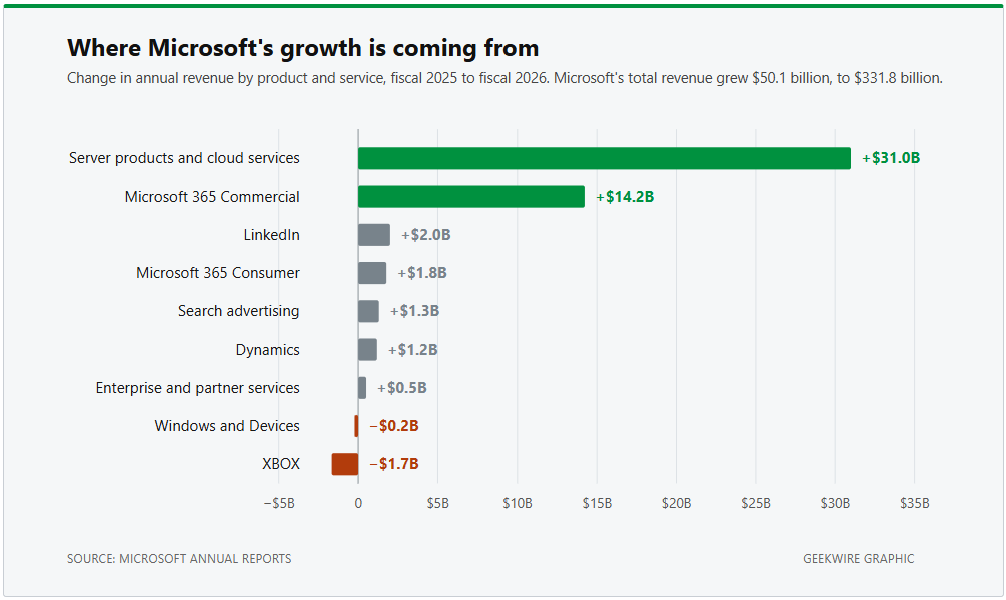
Every year, when Microsoft drops its massive annual financial disclosures—the dreaded, dry 10-K filing—most Wall Street analysts rush to scribble down the headlining, aggregated numbers. But if you want to understand the beating heart of Redmond’s empire, you have to bypass the sanitized, highly polished public relations copy and perform a quick “Ctrl-F” search on your keyboard. By scrolling deep down into the gut of the report, specifically arriving at Page 85, you encounter a treasure trove titled “Revenue, classified by significant product and service offerings.” This single, meticulously organized table is the holy grail for anyone trying to decipher what Microsoft is actually selling to human beings and businesses in the real world, rather than dealing with the corporate, heavily packaged jargon of official reporting segments like “Intelligent Cloud” or “More Personal Computing.” Normally, Microsoft neatly folds its distinct properties—such as Windows, Azure, Xbox, and LinkedIn—into three massive, opaque buckets that obscure individual tracking. Peeling back those layers reveals the raw truth of a company that, in its fiscal year 2026, managed to skyrocket its total annual revenue by a mind-boggling 18 percent, adding an astonishing $50.1 billion in fresh sales to land at a historic grand total of $331.8 billion. When you look closely at this detailed product breakdown, the narrative of Microsoft’s year shifts from a generic story of corporate success to a dramatic tale of a tech giant aggressively transforming itself into an artificial intelligence utility, leaving several of its legendary, legacy consumer products to collect dust in the corners of its empire.
The true engine powering this massive financial expansion is Microsoft’s juggernaut: Server products and cloud services. This single category represents the nerve center of the global digital migration, boasting an eye-watering $129.4 billion in annual revenue. To put its sheer size in perspective, this sector alone contributed $31 billion of Microsoft’s total $50.1 billion in growth over the fiscal year, representing an overwhelming 62 percent of the corporate-wide expansion. Within this technical umbrella sits Microsoft’s crown jewel, Azure, alongside developer tools like GitHub, enterprise databases like SQL Server, and the AI voice-tech acquisition Nuance. While the company strategically keeps the exact, isolated profit margins of Azure confidential within its official line items, CEO Satya Nadella pulled back the curtain during the earnings call, proudly announcing that Azure has officially crossed the monumental milestone of $100 billion in annual revenue for the first time in history. This milestone is not just a numbers game; it is a clear testament to how successfully Microsoft has commoditized cloud infrastructure and harnessed the skyrocketing corporate demand for artificial intelligence tools. It proves that despite the immense capital expenditure and Wall Street’s nervous jitters about the long-term profitability of AI investments, the commercial world is writing massive checks to build, host, and scale their next-generation algorithmic tools directly on Microsoft’s cloud foundations.
Running a close second in this duopoly of growth is Microsoft 365 Commercial, the quiet giant that forms the administrative backbone of modern professional life. This division, which covers the software suites we use daily—including regional installations of Office, collaborative networks like Teams, cloud storage via SharePoint, email systems on Exchange, security integrations, and the premium Microsoft 365 Copilot AI system—witnessed an impressive 16 percent leap, adding $14.2 billion to arrive at an incredible total of $102 billion. When you combine this productivity suite with the Server and Cloud segment, these two divisions account for an unbelievable 90 percent of Microsoft’s total growth for the entire fiscal year. This staggering concentration of success highlights a vital reality of today’s tech landscape: companies are not just experimenting with artificial intelligence; they are integrating it directly into their operational payrolls through developer tools like GitHub Copilot and operational aids like Microsoft 365 Copilot. By packaging AI not as a whimsical, standalone gimmick but as a necessary productivity upgrade baked right into the tools white-collar workers already use for hours every day, Microsoft has successfully bypassed the adoption hurdles that plague its rivals, turning theoretical technological advances into a massive, highly predictable stream of recurring monthly subscription revenue.
While the cloud and corporate AI are soaring to unprecedented heights, Microsoft’s historic, consumer-facing foundation is undergoing a quiet, somewhat bittersweet decline. Windows and Devices, the very brand that defined Microsoft’s identity and global dominance for decades, saw its annual revenue slip by $230 million down to a modest $17.1 billion. Under Microsoft’s current reporting classifications, the PC operating system segment has remained effectively flat for nearly four years, illustrating that the global consumer market has fundamentally saturated and matured beyond the era of the traditional desktop license. The symbolic passing of the torch becomes even more profound when comparing Windows to LinkedIn, Microsoft’s professional social network. LinkedIn quietly managed to rake in a massive $19.8 billion in revenue, growing by a healthy 11 percent and extending a lead over the Windows operating system that it first achieved back in fiscal year 2025. It is a striking reality of the modern digital landscape: a platform once mockingly viewed as an online resume repository has officially outpaced the ubiquitous operating system that put a computer on every desk in the world, reflecting how profoundly Microsoft’s financial gravity has shifted from hardware-bound operating systems to active, living digital communities.
Perhaps the most dramatic and painful operational shift outlined in the 10-K lies within the company’s gaming division. Despite the earth-shattering, highly scrutinized $69 billion acquisition of gaming monolith Activision Blizzard, Xbox revenue contracted by an unexpected $1.7 billion, dropping to $21.8 billion. This contraction marks the first annual revenue dip since the blockbuster regulatory hurdle of the acquisition was cleared, signaling a deep, complex hangover from the historic deal. Instead of immediate synergy and easy profits, this decline exposes a division in a state of chaotic transition, working behind the scenes to shed excess baggage. Over the past fiscal year, this struggle has manifested in high-profile mass layoffs, painful studio closures, a total reevaluation of hardware versus subscription publishing strategies, and massive, unspecified financial write-downs on Xbox assets. It serves as a stark reminder to investors and gamers alike that buying massive intellectual property portfolios is only half the battle; integrating sprawling corporate cultures, managing the high costs of game development, and adjusting to a changing market where hardware unit sales are declining requires a painful, messy, and lengthy structural overhaul that can severely drag down even the deepest pockets in the tech industry.
And yet, away from these massive corporate battlegrounds, several smaller, unsung segments of Microsoft’s portfolio are quietly executing their own remarkable strategic plays. For instance, Microsoft 365 Consumer subscriptions emerged as the second fastest-growing segment in the entire company, ballooning by a spectacular 24 percent to reach $9.2 billion as average people increasingly adopt premium cloud storage and basic digital assistance plans. At the same time, Microsoft’s search advertising division, powered by Bing and growing integration of AI search, continued to defy skeptics by jumping 9 percent to $15.2 billion, putting it within striking distance of the legacy Windows operating platform. Elsewhere, the company’s enterprise management software Dynamics grew 15 percent to cross $9 billion, and its high-end consulting and partner services brought in a steady $8.3 billion. Taken as a whole, this detailed look beneath the hood of the 10-K reveals a Microsoft that is far more dynamic than a simple three-box accounting category suggests. By shedding its heavy reliance on the physical PC market and successfully weathering gaming integration pain, Microsoft has managed to re-architect its entire identity around recurring, institutional utility—building a resilient, multi-hundred-billion-dollar empire that is uniquely positioned to dominate the modern software landscape for years to come.