



Time is an undefeated opponent in the world of professional sports, yet every so often, an athlete emerges who treats the ticking clock not as an existential threat, but as a partner in a slow, elegant dance. Lionel Messi, who is scheduled to celebrate his thirty-ninth birthday in just over a week, finds himself in this rarefied atmosphere as he navigates the expansive fields of the 2026 World Cup in North America. For a man who has captured every individual accolade imaginable, won multiple league titles across Europe, and finally secured the elusive, career-defining World Cup trophy in Qatar four years ago, one might wonder what could possibly be left to wish for. When you have already ascended to the absolute peak of sporting immortality, the traditional desires of fame, wealth, and validation begin to fade into the background. Instead, Messi’s birthday wish boiled down to something far more intimate, human, and fiercely competitive: the thrill of the chase, a brilliant hat trick to ignite his tournament, and a rightful share of one of the game’s most sacred records. Watching Messi step onto the pitch in this twilight chapter of his career is a deeply emotional experience for football fans worldwide, who recognize that they are witnessing the final, precious moments of a golden era. It is a poignant reminder of our own mortality and the passing of decades, yet his continued brilliance offers a comforting, beautiful illusion of permanence. He no longer possesses the explosive, defense-shredding speed of his twenties, but he compensates with a refined, near-telepathic understanding of space, tempo, and geometry. His presence at this tournament is not a vanity project or a victory lap; it is a testament to an enduring love for the game that refuses to be extinguished by the natural course of aging, proving that the human spirit, when fueled by genius, can still find new heights to conquer even on the cusp of forty, captivating millions in stadiums across the United States, Canada, and Mexico who chant his name with a mixture of reverence, hope, and deep nostalgia.
The fierce competitive fire that burns within Messi has always required a worthy foil, and in the modern era, that role belongs undisputedly to Kylian Mbappé. The complex, fascinating relationship between the two superstars—one the established king of the beautiful game, the other his incredibly ambitious successor—took another dramatic turn earlier on the very same day of Messi’s match. Mbappé, leading the French national team with his signature blend of explosive pace and clinical finishing, had put on a dazzling display against Senegal, scoring a ruthless brace that momentarily catapulted him ahead of Messi in the all-time World Cup scoring records. The young Frenchman dismantled the African champions with two goals of sheer power and precision, sending a clear message across the Atlantic that he was coming for the ultimate throne. For a few brief hours, the global narrative shifted, pointing toward a future where the young French phenom would inevitably eclipse his former Paris Saint-Germain teammate on the grandest stage of all. Watching a younger rival rewrite history in real-time can be a harrowing psychological experience for an aging athlete, threatening to cast them into the shadows of yesterday. Yet, for Messi, Mbappé’s virtuoso performance did not inspire dread; rather, it acted as a catalyst, sparking a deep-seated competitive instinct that has defined his entire legendary career. The shadow of their iconic duel in the 2022 World Cup Final in Lusail, Qatar, still hangs heavily over the footballing landscape, and this modern-day goal-scoring race serves as a beautiful, high-stakes sequel. It demonstrates how greatness feeds on greatness, showing that even at thirty-eight years old, Messi still monitors the horizon, ready to answer the drumbeat of his younger challenger with a breathtaking performance of his own, reminding the world that while the future may eventually belong to Mbappé, the present still bends to the will of the aging master.
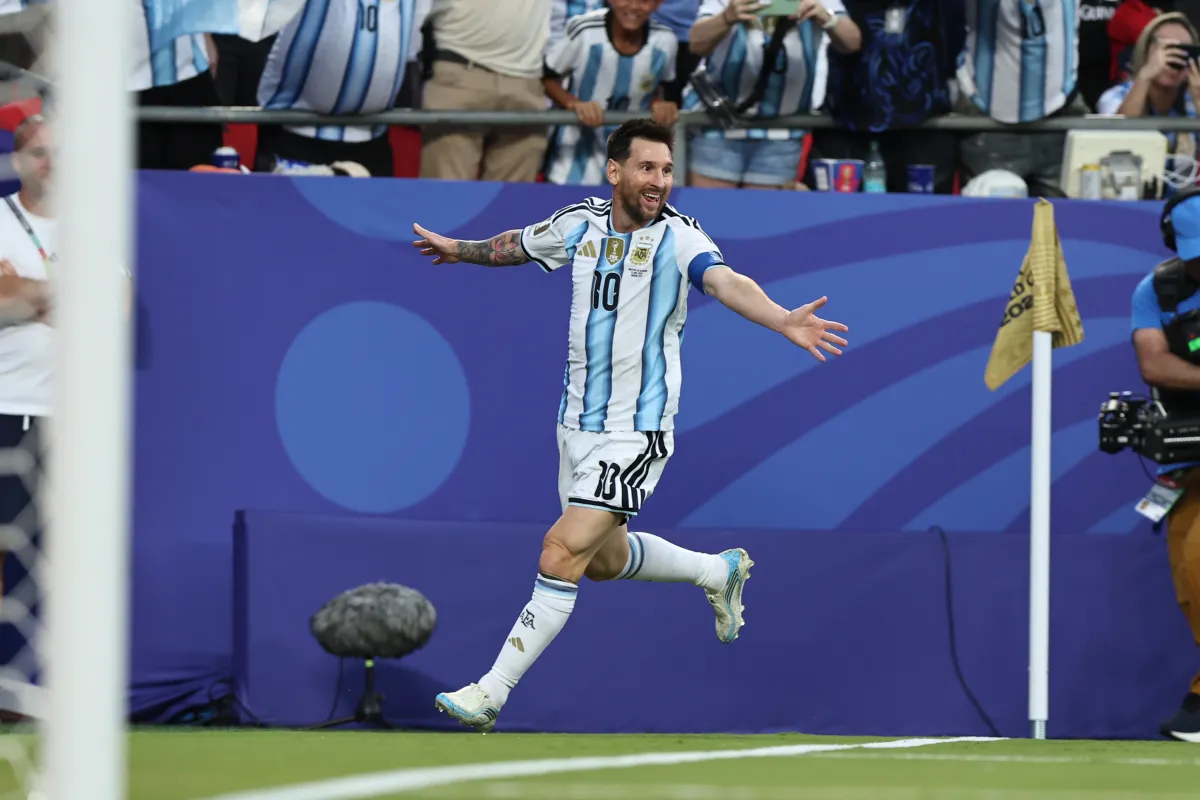
When Argentina took the field against an organized and highly motivated Algerian side, the air in the stadium was thick with a mixture of nervous tension and romantic expectation. Messi, carrying the immense weight of defending champions on his shoulders, responded to Mbappé’s challenge with a masterclass in footballing artistry that will be talked about for generations. Algeria had set up a highly disciplined low block, hoping to suffocate Messi’s space and physical passing lanes, yet he navigated their defensive forest with the grace of a ghost, showcasing that tactical physical barriers are ultimately meaningless against supreme soccer intellect. He did not rely on raw physical output, but rather on the subtle shifts of weight, the drop of a shoulder, and the immaculate timing that have become his artistic signature. His first goal was an exercise in pure instinct, finding a pocket of space inside a crowded penalty area and sliding the ball into the corner with the casual ease of a man walking through his own living room. The second goal arrived through a brilliant, trademark free-kick, a curling, majestic arc of leather that bypassed the leaping Algerian wall and kissed the inside of the post before settling in the net, sparking pure pandemonium in the stands. The crescendo of the match came late in the second half when Messi completed his hat trick, latching onto a delicate through-ball, calmly rounding the onrushing goalkeeper, and passing the ball into the empty net with sublime composure. This was the moment the world stood still—a virtuoso performance that answered the call of history, secured three vital points for his country, and humanized a legend who, despite having won it all, still celebrated with the pure, unadulterated joy of a young boy playing on the dusty dirt pitches of Rosario, kissing his jersey and pointing to the heavens in a salute of pure gratitude.
With this stunning hat trick, Messi did not just secure a victory; he wrote his name alongside one of the most stubborn landmarks in football history, tying Germany’s legendary clinical striker, Miroslav Klose, at sixteen World Cup goals. There is a profound, almost poetic symmetry to this achievement that stretches back twelve years to the Maracanã Stadium in Rio de Janeiro during the 2014 World Cup. It was during that fateful tournament that Klose cemented his record-breaking sixteenth goal, ultimately tasting ultimate glory as Germany defeated Messi’s Argentina in a heartbreaking, extra-time final. For over a decade, that night in Rio remained one of the few dark shadows over Messi’s otherwise glittering career, a painful memory of what could have been as his own stellar performance fell just short of the ultimate prize. Now, twelve years later, under the warm summer skies of North America, Messi has clawed his way back to level terms with the German giant who once denied him his ultimate dream, proving that perseverance can mend even the deepest wounds of the past. While Klose was a traditional, aerial, and clinical penalty-box predator who achieved his record through mechanical consistency, Messi represents the complete virtualization of football, making their shared record an intriguing clash of sport philosophy. Tying Klose’s record is not merely a statistical milestone; it is a symbolic closure of a circle, a redemption arc writ large across the canvas of World Cup history. It highlights the incredible endurance required to sustain world-class excellence over four separate World Cup cycles, transitioning from the heartbroken young genius of 2014 to the triumphant, elder statesman who now stands on the brink of sole possession of the goal-scoring crown, a progression that makes his journey feel deeply human, flawed, and ultimately victorious.
The race for the ultimate World Cup goal-scoring crown has now transformed into a living, breathing drama that will captivate sports fans across Canada, Mexico, and the United States for the remainder of this historic summer. What makes this journey so incredibly human is that it is not taking place in a vacuum; it is unfolding in real-time between a veteran icon playing his final major tournament and a prime-era superstar determined to claim the throne. At sixteen goals, Messi finds himself tied with Klose, but he cannot afford to look back, because Mbappé is breathing down his neck with fourteen goals, possessing plenty of time, youth, and matches ahead of him to make the record his own. This cross-continental golden run turns every single group stage match and knockout tie into a high-stakes theatrical performance, where every touch of the ball carries historical weight. Fans are treated to a rare sporting luxury: witnessing two distinct eras of footballing genius clash in a statistical and stylistic duel that may never be replicated. The cultural impact of this race in North America is immense, drawing in casual spectators who are mesmerized by the sheer human drama of a thirty-nine-year-old maestro, who has extensively charmed local crowds in the MLS, attempting to hold off a charging young lion who represents the absolute peak of modern, athletic football. The massive, state-of-the-art arenas in Miami, New York, and Los Angeles are serving as epic backdrops to this historic wrestling match for supremacy, amplifying the drama of every single touch, pass, and goal. Every spectator in these venues knows they are watching living history, and the tickets have become the hottest commodities on earth, driven by the desire to catch one last glimpse of the Argentine maestro as he attempts to rewrite the record books one final time.
The next chapter of this epic saga of human ambition is scheduled for next Monday, a day that promises to be one of the most compelling dates in modern sports history. Messi will take the field against a resilient Austria side, knowing that a single goal—his seventeenth overall in World Cup play—will break his tie with Klose and place him alone at the apex of football history, all just forty-eight hours before he officially turns thirty-nine. On the very same day, Kylian Mbappé and France will line up against Iraq, with the French star chasing his own destiny, aiming to close the gap on Messi or perhaps even leapfrog both him and Klose in a single, explosive afternoon. This parallel schedule database creates a beautiful tension, a cinematic split-screen experience where two great artists, separated by miles of geography but united by an obsession with greatness, push each other to the absolute limits of human capability. When the dust finally settles on this North American summer, gold medals will be handed out and trophies lifted, but the true legacy of the tournament will be the human memory of watching a legendary elder statesman and a young king-in-waiting refuse to yield, giving everything they have to the game they love. The fans will look back not just at the cold numbers and Wikipedia entries, but at the emotions of a Monday afternoon where two legends chased immortality, painting their names into the cosmos of the world’s most beautiful game. It is this relentless pursuit, this beautifully chaotic and highly emotional race against time and each other, that elevates football from a simple sport into a profound reflection of the human condition, where we all strive to leave an indelible mark before our own final whistle blows.