


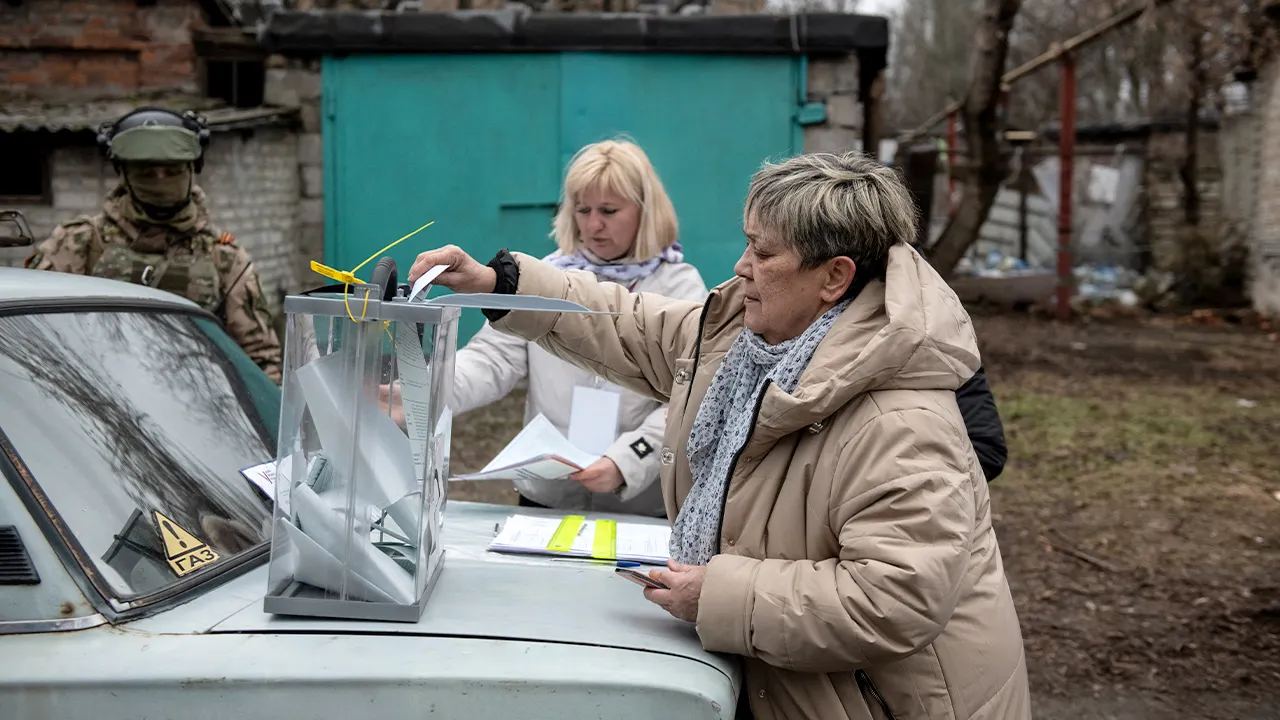
In the fading autumn light across the Russian-occupied corners of Ukraine’s Donetsk, Luhansk, Kherson and Zaporizhzhia regions, a strange and heavy ritual is underway. Russian soldiers, carrying rifles and ballot boxes, move through villages and towns, knocking on doors and asking residents to participate in elections that much of the world refuses to recognize. These are Russia’s State Duma elections, the first parliamentary vote to be held since Moscow launched its full-scale invasion of Ukraine in 2022, and they are taking place on land that Ukraine and the international community still consider illegally occupied. For the Kremlin, the vote is a carefully staged performance meant to create the illusion of normal life, popular support, and democratic legitimacy. For the people living under occupation, it is something else entirely: a moment of fear, pressure, and impossible choices. They are told that voting is safe, that their participation proves they belong to a new Russian world, but they know that refusing can bring consequences, and that even casting a ballot under armed guard is not a civic act but an act of submission. The election is not a celebration of choice; it is a weapon of control. The last time such a vote took place in these territories was in 2024, when Vladimir Putin secured another term with a staggering percentage of the vote, and the world saw how the machinery works. Now the same machinery is being deployed again, this time to elect a parliament that will rubber-stamp the war and the annexation.
The absence of independent observers is perhaps the clearest sign that this election is not what it pretends to be. The Organization for Security and Cooperation in Europe, which has long monitored elections across the continent and served as a pillar of democratic accountability, was not invited to send a mission. Russian officials simply refused. As OSCE Parliamentary Assembly President Pere Joan Pons said, Russia’s refusal to invite an election observation mission “seriously breaches its international commitments and shows a worrying disregard for democratic standards.” He went on to say that election observation is not optional, but “a cornerstone of transparency and accountability.” Behind this refusal lies a vast structure of suppression that has tightened around Russia since the invasion. Strict censorship laws now criminalize any dissent about the war or the armed forces, and the media is saturated with state propaganda designed to shape every thought and quiet every question. The case of Lev Shlosberg is a stark reminder of what happens to those who resist. A prominent critic and leader of one of Russia’s few real opposition parties, Shlosberg was sentenced to more than eleven years in a penal colony for speaking out against the war. Even his party, Yabloko, was banned by Russia’s Supreme Court from participating in the September elections. Voters are left with nine parties, all of them loyal to the Kremlin, with Putin’s own United Russia sitting comfortably at the center of the stage. In this climate, the very concept of a free and fair election becomes a hollow phrase. Ordinary Russians may understand that the system is rigged, but they also understand that saying so out loud can ruin their lives.
Nowhere is the brutality of this election more visible than in the occupied territories of Ukraine. In September 2022, after a series of sham referendums that the world dismissed as illegal, Moscow unilaterally annexed the regions of Donetsk, Luhansk, Kherson and Zaporizhzhia. The following year, Putin signed legislation that allowed Russian elections to be held on these stolen lands, and the process of integrating them into Russia’s political fiction began. Residents were forced to obtain Russian passports, often under the threat of losing jobs, pensions, or even their freedom. Those passports became the basis for voter lists, ensuring that the state would have a way to measure participation and track those who stayed away. On election days, soldiers accompany election officials from door to door, carrying ballot boxes in what is officially described as a security measure against Ukrainian partisan attacks. But as Jaroslava Barbieri, a research fellow at Chatham House, explained, this is not protection; it is intimidation. She described the atmosphere in occupied Ukraine as “a total regime of terror.” The presence of armed troops at the ballot box is a flagrant violation of international law, and it transforms voting into a survival strategy rather than a political choice. Keti Korkiya of the Foundation for Defense of Democracies notes that while many Russians are willing to symbolically support Putin and the war, they are not willing to pay a personal or economic price for it. That is why the Kremlin has avoided another wave of mobilization. It knows that if the war begins to demand too much from ordinary citizens, even the most carefully managed election cannot hide the cracks.
Ukrainian leaders have been unequivocal in their response to these staged elections. Volodymyr Ariev, a member of the Ukrainian Parliament, said that any election held in temporarily occupied Ukrainian territories is illegal and a breach of international law. He vowed that Ukraine will never recognize anyone “elected” as a member of parliament in those regions, no matter how many ballots are cast. His advice to residents living under occupation was simple: do not be there on election day. Leave your homes, spend the day somewhere else, anywhere, to avoid being pressured into participation. It is a heartbreaking suggestion, because for many people, especially the elderly, the disabled, or those with young children, leaving is not always possible. Yet even the attempt to stay away is a form of resistance, a quiet refusal to give legitimacy to an occupying power. In the meantime, Russia has worked to project an image of democratic reach beyond its own borders. The Ministry of Foreign Affairs announced that 326 polling stations have been set up at embassies and consulates in 152 countries, so that Russian citizens abroad can take part in the vote. But the international community is not fooled. The United States, Europe and many others have consistently rejected the annexations and refused to accept any electoral outcome in occupied Ukrainian territory. For Kyiv, these elections are not a measure of public opinion but a propaganda exercise, an attempt to launder the theft of land through a fake process. The real statement of these elections is not made by ballots, but by soldiers, by checkpoints, by forced passports, and by the climate of fear in which every decision is shaped by survival instincts.
Vladimir Putin has tried to frame the vote as a sign of Russia’s resilience and political maturity. In August, he said the State Duma elections would demonstrate Russia’s stability on the world stage and its ability to withstand foreign aggression. The Central Election Commission approved new rules for voting in occupied Ukraine, stressing the importance of early and at-home voting to avoid large gatherings that could be targeted by Ukrainian strikes. On the surface, this sounds pragmatic. In reality, it is another way to tighten control. When voting is brought into people’s homes and accompanied by armed soldiers, the private act of casting a ballot becomes a public encounter with the state. There is no anonymity, no secret booth, no privacy to choose without fear. Ivana Stradner, who studies Russian information security and influence operations, says that as battlefield momentum stalls and the costs of war continue to mount, Putin is desperate to manufacture political legitimacy. The Duma elections, she explains, are a chance for the Kremlin to show support not just for United Russia, but for the continuation of the war. “When the battlefield gets harder to sell, the ballot box becomes another way to sell the war,” she said. This helps explain the absurd numbers that come out of these votes. In the 2024 presidential election, the occupied regions of Donetsk and Luhansk delivered more than 90 percent of their votes for Putin, far above the already inflated national target of 70 percent. Such results are not evidence of enthusiasm; they are evidence of an election machine that can produce whatever number the narrative requires. In Putin’s version of democracy, as Stradner put it, voters get to choose, just not the result.
As the three days of voting come to an end on September 20, the image left behind is not one of a confident nation exercising democratic rights, but of a regime that no longer trusts its own people. The election requires an enormous apparatus of coercion, censorship and fear to function. It cannot allow international observers because they would expose the emptiness behind the facade. It cannot tolerate genuine opposition because genuine opposition would reveal the fractures in the regime. And it cannot permit true choice because true choice might lead to something other than what the Kremlin wants. For the people of occupied Ukraine, the ballot box has become another weapon of occupation, a way to force them into complicity with their own subjugation. Yet even in the darkest circumstances, human dignity finds ways to assert itself. Some will spend the day at the homes of friends, hiding from the knock on the door. Some will open the door, take the ballot, and leave it blank. Some will simply sit in silence, hoping not to be noticed. Their stories may never be told on the news, but they are the real story of this election. The Kremlin may count the votes, announce the results, and proclaim a victory for stability and tradition, but it cannot force anyone to believe the lie. The international community, Ukraine, and millions of ordinary Russians know that this is not democracy. It is a performance staged under armed guard, with a script written in Moscow and an audience denied the freedom to look away. In the end, the election changes nothing about the truth of the war, the illegality of the annexation, or the courage of those who refuse to bow.