


Paragraph 1: The Flight That Became a Nightmare
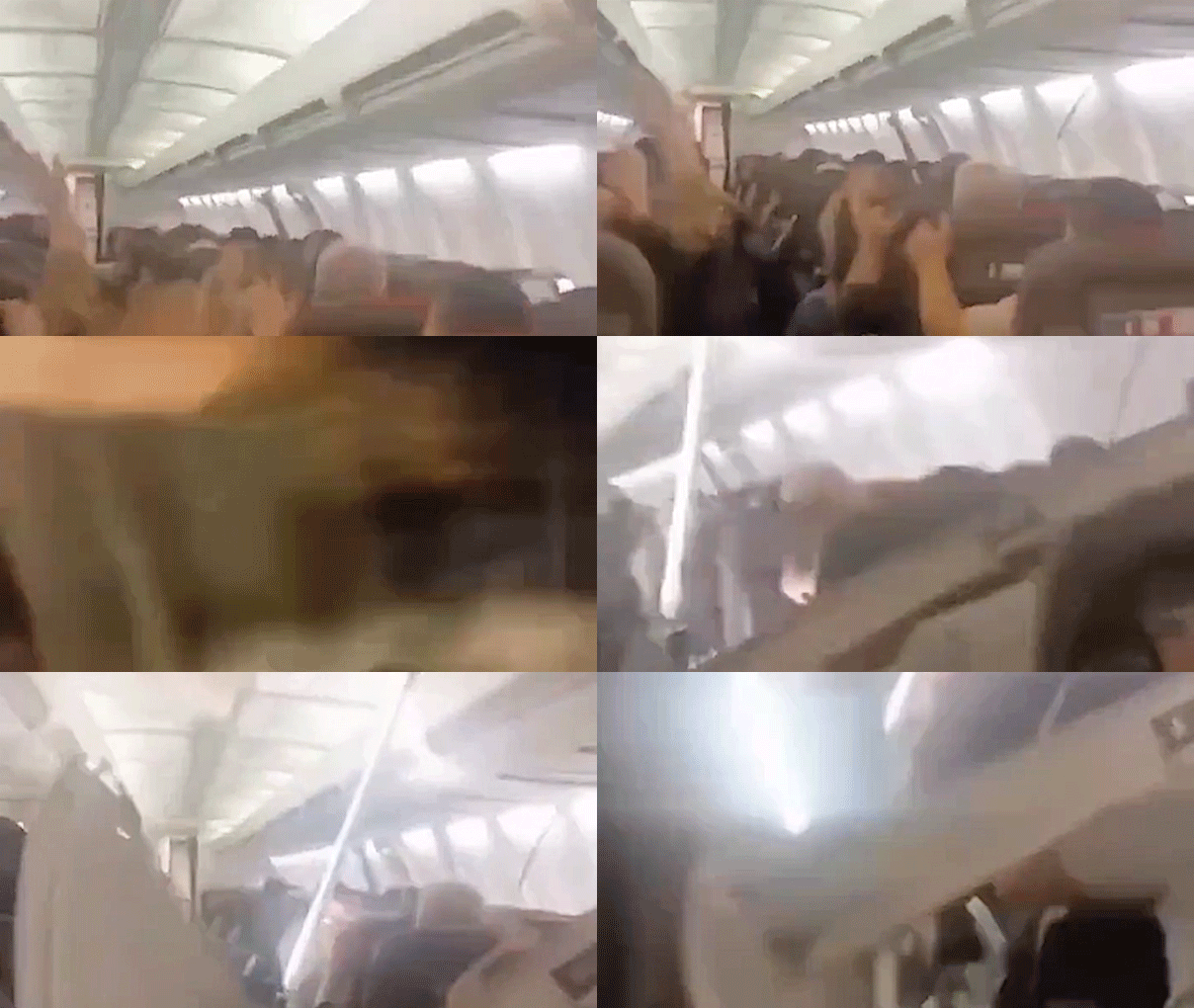
It was supposed to be an ordinary domestic flight, a short hop across the rugged landscape of Iran from the holy city of Mashhad to the western province of Kermanshah. Passengers settled into their seats, some closing their eyes, others quietly chatting or scrolling through their phones, expecting little more than a routine hour in the sky. But within moments of leaving the ground, that quiet normalcy shattered. Video captured on board a Sepehran Airlines Boeing 737 shows a scene of sudden, violent chaos: the aircraft began to shake with a terrifying intensity, as if it were being torn apart by forces far beyond what any passenger should ever have to bear. The footage, shared widely in the wake of the incident, reveals a cabin in the throes of structural breakdown. Overhead compartments burst open, ceiling panels ripped free from their fittings, and heavy debris came crashing down onto the startled travelers below. The air was filled with the sounds of crumpling metal, cracking plastic, and the shrill screams of people who feared they were living through their final moments. Some passengers raised their arms above their heads in a desperate, instinctive attempt to shield themselves from the falling wreckage. Others began to pray aloud, their voices trembling with fear and faith. The video is difficult to watch, not because of graphic violence, but because it captures something deeply human: the raw terror of people confronting the fragility of their own lives at thirty thousand feet. The cozy, familiar world of airline travel, with its little bags of pretzels and safety cards, had dissolved into a primal struggle for survival. For those on board, what had begun as a mundane commute was now a memory they would carry forever, etched in fear and relief.
Paragraph 2: The Sickening Moment the Cabin Began to Fall Apart
The details of the incident, as reported by Jam Press and echoed by global news outlets, point to a chain of mechanical failures that began before the aircraft even left the runway. The Boeing 737, operated by Sepehran Airlines, was departing Mashhad Hashemi Nejad International Airport when something went badly wrong. Investigators and aviation officials suspect that the plane may have suffered engine damage and a tire blowout during the takeoff roll, though the exact sequence of events remains under review. What is beyond dispute is what the passengers experienced once the plane was in the air. The cabin of the aircraft began to disintegrate around them. The overhead luggage bins, which should have remained firmly sealed for the duration of the flight, came crashing open in a chaotic cascade. Ceiling panels, no longer anchored to their frame, swung down like broken stage scenery. Loose wires dangled from exposed gaps, adding to the apocalyptic atmosphere. Debris rained down onto the aisle and seats, striking passengers who had nowhere to hide. In the footage, the scene resembles something from a disaster movie rather than a commercial airliner. The shaking was so violent that it seemed to twist the structure of the plane itself, as if the fuselage were being wrung by some invisible giant. Screams echoed through the narrow cabin, mixing with cries of prayer. Several passengers can be seen clutching their seats, their knuckles white, their faces frozen in shock. One woman covers her head with her hands as a panel crashes down just inches away from her. Another man repeatedly murmurs a prayer, his eyes squeezed shut. The sheer physicality of the moment, the shaking, the noise, the impact of debris, is almost impossible to convey. It is rare to see such raw fear captured so clearly, and even rarer for a video like this to remind us how quickly the thin skin of a modern aircraft can become a deadly storm of plastic and metal.
Paragraph 3: A Pilot’s Quick Thinking and a Safe Return
Amid the chaos, one figure remained focused on a single mission: getting the plane back on the ground safely. The pilot, whose name has not been released to the public, reportedly declared an emergency and immediately began the process of returning to Mashhad Hashemi Nejad International Airport. With a damaged aircraft and a terrified cabin, the crew had to contend not only with the technical realities of flying a wounded machine but also with the psychological weight of knowing that every passenger behind the cockpit door was depending on them. The decision to turn back, rather than attempt to continue to Kermanshah or divert to another airport, was the only reasonable choice under the circumstances. Every second in the air with a compromised structure was a gamble. The passengers, still reeling from the shock of the falling debris, could only wait and pray as the pilot executed the emergency return. The flight back to Mashhad must have felt like an eternity, a tense, uncertain interval in which the sounds of the aircraft were the only score to an invisible drama unfolding in the cockpit. When the wheels finally touched down on the runway, the relief was palpable. The aircraft landed safely, according to Jam Press, which cited reports from NeedToKnow. There were no injuries among the 127 passengers and crew members on board, a fact that can only be described as miraculous given the visible damage to the cabin interior. The plane had been battered, but it had held together long enough to deliver its occupants back to solid ground. As the aircraft came to a stop, emergency vehicles were likely already on the move, ready to assist. The passengers, some shaking, some crying, some laughing with nervous relief, were no doubt eager to feel the runway beneath their feet. They had survived a brush with catastrophe, and the pilot’s calm professionalism had made that survival possible in the most trying of circumstances.
Paragraph 4: Aftermath, Investigation, and a Temporary Closure
In the immediate aftermath of the landing, the full extent of the ordeal began to sink in. The aircraft, which had carried 127 souls through a terrifying ordeal, had to be inspected thoroughly before anyone could even begin to understand what had gone wrong. The incident caused the temporary closure of one of the two runways at Mashhad Hashemi Nejad International Airport, grounding certain operations while the damaged aircraft was cleared and investigators began their work. For passengers, the journey was not over. They were reportedly placed on another flight to complete their trip to Kermanshah, a decision that speaks to the resilience of the human spirit even in the face of such trauma. Many may have boarded the new plane with trembling hands, their confidence in air travel shaken but their determination to reach their destination intact. The airport, meanwhile, worked to return to normal operations as quickly as possible, reopening the affected runway after the necessary checks were completed. An investigation into the incident is now underway, with authorities looking at everything from the aircraft’s maintenance history to the possibility of mechanical failure during takeoff. The tire blowout and engine damage that were initially suspected could point to a challenging set of circumstances that the flight crew had to overcome, but the official findings will not be released until the investigation is complete. For the passengers, however, the questions may be less technical. They will want to know why a routine flight turned into a scene of terror, and whether such an event could happen again. The video of the cabin falling apart will remain a powerful reminder of just how close they came to disaster, and how much they owe to the skill of the pilot and the crew who brought them home.
Paragraph 5: The Broader Context of Iran’s Struggling Aviation Industry
This incident, while frightening, is not entirely surprising to those who follow the state of Iran’s aviation sector. Decades of international sanctions have taken a devastating toll on the country’s ability to maintain and modernize its fleet. As Jam Press noted, Iran has struggled to access newer Western-built aircraft, genuine spare parts, and the latest in aviation technology. Local carriers have been forced to rely on aging aircraft, many of which have been in service for decades, and to perform complex maintenance with whatever resources they can obtain through restricted channels. The result is a commercial aviation fleet that operates under enormous pressure, with airlines doing their best to keep planes flying safely despite systemic shortages. This Boeing 737, operated by Sepehran Airlines, is part of that fleet. The suspected tire blowout and engine damage may turn out to be the result of worn components that could not be replaced as quickly as safety standards would demand. The cabin ceiling panels that came crashing down during the flight are a visual representation of the structural fatigue that can affect older aircraft, especially when maintenance schedules are stretched to their limits. While Iranian aviation authorities and pilots are known for their skill and resourcefulness, they cannot fully compensate for the lack of access to new aircraft and parts. Passengers in Iran often have little choice but to fly on airplanes that would have been retired long ago in other parts of the world. This flight was a stark reminder of the risks that come with such constraints, a real-world illustration of how geopolitical tensions can trickle down to the most personal level: a passenger praying for safety as the ceiling falls around them.
Paragraph 6: A Story of Survival and the Weight of What Could Have Been
In the end, the story of this flight is one of survival, but it is also a story about the weight of what did not happen. No one died. No one was seriously injured. The plane landed, the passengers walked away, and the investigation will strive to prevent a recurrence. But for the people on board, the memory of those harrowing moments will not fade easily. They will replay the sound of the shaking, the sight of the ceiling collapsing, the touch of debris against their heads and shoulders. They will remember the screams and the prayers, and the profound silence that must have filled the cabin when the plane finally came to a stop. There is a tendency in aviation coverage to move quickly from one incident to the next, but for those involved, the aftermath is personal and lasting. The passengers who boarded the replacement flight to Kermanshah did so with a new understanding of their own mortality. Their luggage might have been damaged, their plans disrupted, but their lives were unchanged in all the ways that truly matter. And that is the most human part of this story: the quiet gratitude of ordinary people who came home, who texted their families, who held their loved ones a little longer that night. The video will be studied, the investigation will produce reports, and the debate over sanctions will continue. But behind all of that are the faces of passengers who knew, for a brief and terrifying moment, what it meant to lose everything, and who were given the grace of a second chance. They are the reason why the pilot’s steady hands, the crew’s calm presence, and the resilience of a battered old airframe are more than just technical details. They are the heart of a story that could have ended so differently, and a reminder that every flight, no matter how routine, carries with it the hopes and fears of everyone on board.