

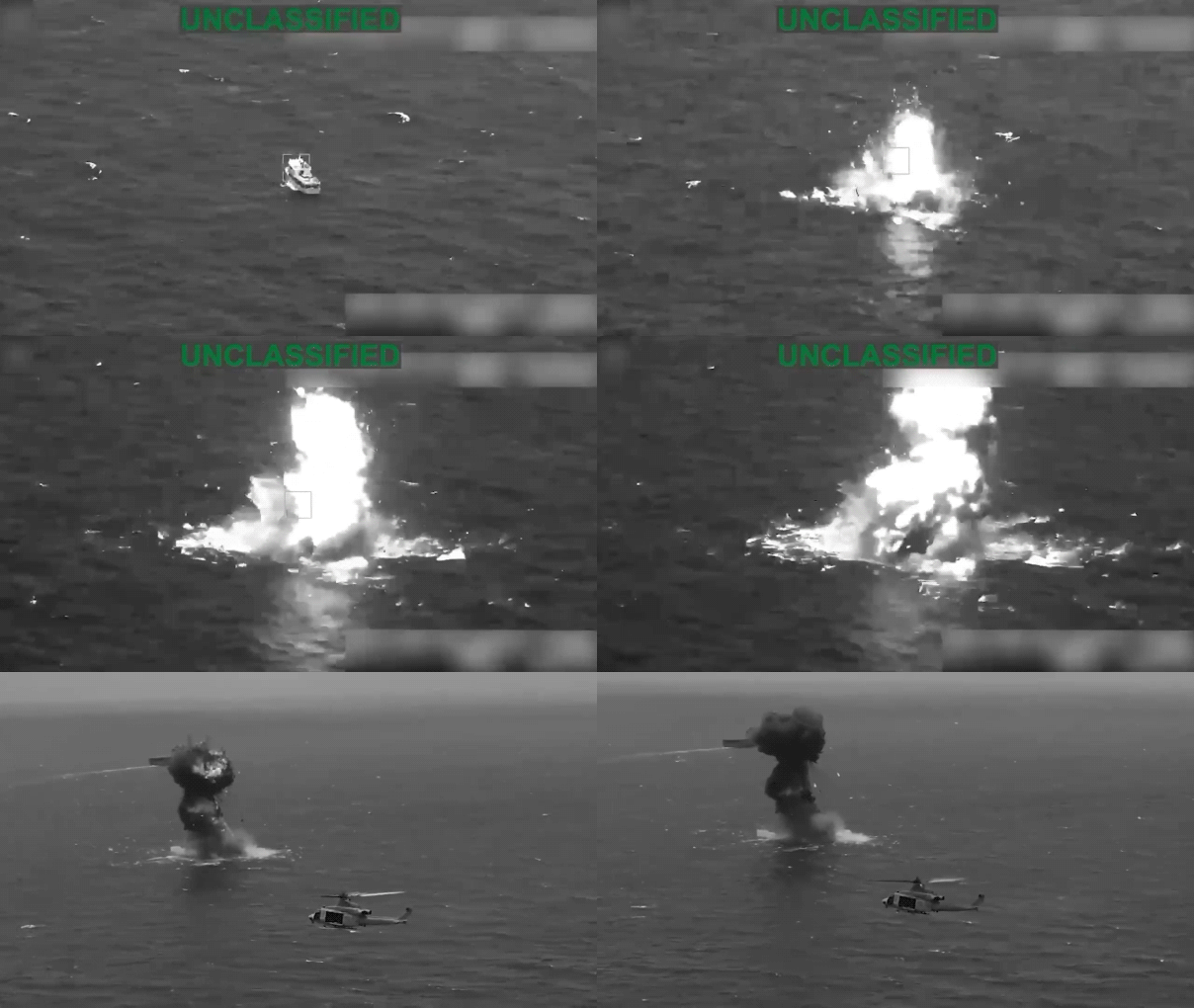
The sea is vast, silent, and often indifferent. On September 8, somewhere in the Eastern Pacific, a group of U.S. personnel from Joint Task Force Western Hemisphere, working under the direction of U.S. Southern Command, closed in on a vessel that looked nothing like the sleek cigarette boats often shown in movies. It had a more mundane but crucial mission: to serve as a floating refueling station for a drug-moving convoy. According to intelligence, the ship was tied to Los Choneros, an Ecuadorian organization the United States has classified as a narco-terrorist network. When the Americans boarded, they found no dramatic pile of cocaine, just the equipment to pump fuel and perhaps supplies to the fast attack craft and semisubmersibles that shuttle millions of dollars’ worth of narcotics northward. The crew was removed, then transferred to Ecuadorian authorities. After everyone was off the vessel, U.S. forces sank it, removing another node from a criminal supply chain that stretches across continents and oceans. The announcement from SOUTHCOM was concise, but it represented many moving parts: surveillance, intelligence, coordination with partner nations, and a dangerous close-quarters operation on the open water. These are not abstract maneuvers. They are carried out by men and women who have trained for years, who know that in the wrong moment, everything can go wrong. They are also part of a larger fight against an enemy that rarely appears on a map—an enemy that hides in shipping lanes, along coastlines, and in the shadows of legitimate commerce.
To understand why the U.S. military would bother to track down and sink something as unglamorous as a refueling boat, you have to understand the criminal economy of the ocean. Smugglers moving cocaine from South America to the United States and beyond cannot simply pull over at the next gas station. The Pacific is enormous; a go-fast boat loaded with drugs may have to cover hundreds of miles between safe landing spots. Fuel is the limiting factor. It is the difference between a successful run and being left drifting in a shipping lane with millions in contraband. That is where the floating refueling station comes in. It is an illegal oasis, a pre-positioned tanker or supply vessel that waits in a designated spot, often for weeks, ready to transfer fuel, food, and perhaps extra radios or engines to traffickers. Without these ships, drug fleets would have to risk coming ashore or meeting with fishing boats, which are easier for patrols to watch. The September 8 operation ripped one such oasis from the network. It also sent a message: even in the middle of nowhere, these networks are not invulnerable. The crew members who were taken into custody, by contrast, are likely to tell a more personal story. Many are poor, recruited for dangerous work because they have no better options. They may have spent days on the water, in bad weather and cramped conditions, for money that often goes to someone else higher up the chain. The U.S. forces treated them according to procedure, transferred them to Ecuadorian authorities, and moved on to the next mission. But for those individuals, the encounter will be a rupture in their lives—an ending, or perhaps an unexpected rescue, depending on how their story unfolds. It is easy to forget that behind every statistic in the drug war there are faces, names, and complicated histories, and that the people who serve on these missions are not just battling an idea; they are confronting human beings caught in a brutal economy.
What makes this particular network important is the organization behind it. Los Choneros is not a simple gang of street criminals; it is a recognized foreign terrorist organization and a key engine of the violence that has shaken Ecuador in recent years. According to counterterrorism analyses, its members have carried out hired killings, kidnappings, political assassinations, and the smuggling of weapons, explosives, and drugs. The group operates from prisons, where it often maintains control over inmates and coordinates activities from behind bars, and from illegal gold mines, which provide cover for other illicit ventures. It works closely with Mexico’s Sinaloa Cartel to move drugs through Central America to the United States, and it has relationships with Albanian criminal organizations that help distribute cocaine into Europe. All of this means that a rusty fuel ship in the Pacific is not an isolated artifact; it is one of the logistical strands of a global web that links rural Ecuador to American cities, European markets, and international financial systems. When SOUTHCOM calls the vessel “a floating refueling station supporting illicit at-sea drug trafficking operations,” it is describing a support node for terrorism, murder, and corruption. The U.S. designation of Los Choneros as a narco-terrorist group is not a rhetorical flourish. It reflects how drug money fuels organized violence in Ecuadorian cities, prisons, and border regions, displacing thousands, corrupting institutions, and threatening regional stability. Taking away their refueling capability forces them to adapt, spend money, lose time, and expose themselves to greater risk. It also sends a signal to their allies in other countries that the United States is paying attention to the full network, not just the loads of cocaine that happen to be intercepted at checkpoints or at sea.
The operation on September 8 was far from unique. It came after a string of similar missions in which U.S. forces boarded, searched, and sank vessels linked to Los Choneros and other traffickers. Previous announcements from SOUTHCOM describe the same pattern: a vessel identified through intelligence, a coordinated interdiction by Joint Task Force Western Hemisphere, personnel moved into the proper legal channel, and the ship sent to the bottom. In some cases, the U.S. military has made public statements with headlines such as “US FORCES SINK NARCO-REFUELING STATION LINKED TO ECUADORIAN CARTEL IN PACIFIC” and “US MILITARY BOARDS, SEARCHES AND SINKS VESSEL ALLEGEDLY SUPPORTING LOS CHONEROS NARCO-TERRORISTS.” These repetitive operations speak to the scale of the problem. There are many such vessels and many crews willing to take the risk. The cartels are adaptive, and their logistical chains are resilient. But they are not infinite. Each sinking eats into their capital and their pool of trained personnel. It also demonstrates a policy of persistent pressure: no body of water is too isolated for the U.S. to monitor, no vessel too inconsequential to chase. For the service members involved, these operations are grueling. They involve long days of tracking, boarding at sea, often in swells and darkness, and making split-second judgments under stress. The fact that the public usually hears about them only in a short post on X, or in a brief dispatch, is a sign of the professionalism and quiet competence that define the work. It is also a reminder that military success in this arena is measured not by body count or parades but by the silent removal of assets—a sunken fuel station, a disrupted route, a shipment of cocaine that never makes it to its destination.
Beyond the strategic calculations, there is a human dimension that deserves attention. For every refueling station that is intercepted, there are people whose daily lives are shaped by the traffic it supports. In Ecuador and neighboring countries, Los Choneros and similar groups have brought waves of violence that affect ordinary people: families caught in crossfire, women and migrants threatened with extortion or kidnapping, indigenous communities near illegal mines forced to accept the presence of armed groups. These are the people who may never hear about the U.S. Southern Command operation but who will feel its effect as a small interruption in a cycle of fear. Meanwhile, for the crew of the refueling vessel, the experience is also personal. They are likely not the kingpins; they are often workers—possibly coerced, possibly volunteers who saw an easy paycheck. Being captured at sea can be terrifying. The U.S. personnel who board such vessels are trained to do so carefully, clearing the ship and avoiding unnecessary violence. This is a point worth emphasizing: the mission was accomplished without bloodshed, and the crew members were handed over to Ecuadorian authorities rather than harmed. That matters, because the rule of law is part of what distinguishes these counter-drug operations from the criminality of the gangs they target. The ultimate goal is not just to sink boats but to preserve a system of order and human dignity in a region where that system is under constant assault. When a military operation is conducted in this way, it can serve as a modest example of how power can be wielded with restraint, even in the messy and dangerous world of international drug trafficking. The people who carry out these missions have to hold themselves to a higher standard, and that is not always easy when the adversary operates without any rules at all.
Still, it would be dishonest to claim that one patrol, or even a dozen, will stanch the flow of illegal drugs or end the violence that ripples outward from the Pacific trade routes. The forces of SOUTHCOM and Joint Task Force Western Hemisphere are engaged in a long, grinding campaign, not a quick war. Drug demand in the United States and other wealthy nations, corruption in source and transit countries, and brutal criminal groups like Los Choneros all ensure that vessels will continue to be seized for years to come. Yet the September 8 mission is also a reminder that there are people on the front lines of this fight who carry out the nation’s commitment to its neighbors and to the broader ideal of security. They are not just military operators; they are also diplomats, trainers, and partners, working to strengthen institutions and reduce the harm these networks cause. When a refueling station disappears beneath the Pacific, it sends a ripple of consequence through a criminal system that prefers to work invisibly. It is proof that the ocean is not an open highway for those who choose to exploit it. And for us on land, it is an opportunity to honor the quiet courage of those who go to sea, to remember the victims of narco-terrorism, and to think about our own responsibility in reducing the demand that fuels this trade. The announcement from SOUTHCOM was only a few sentences. The reality it describes is much larger—a story of hard choices, hidden sacrifices, and the slow, unglamorous work of holding back a tide that never stops rising. But for a moment, at least, one vessel lay at the bottom of the Eastern Pacific, and that is one fewer way for the cartels to keep moving forward.