


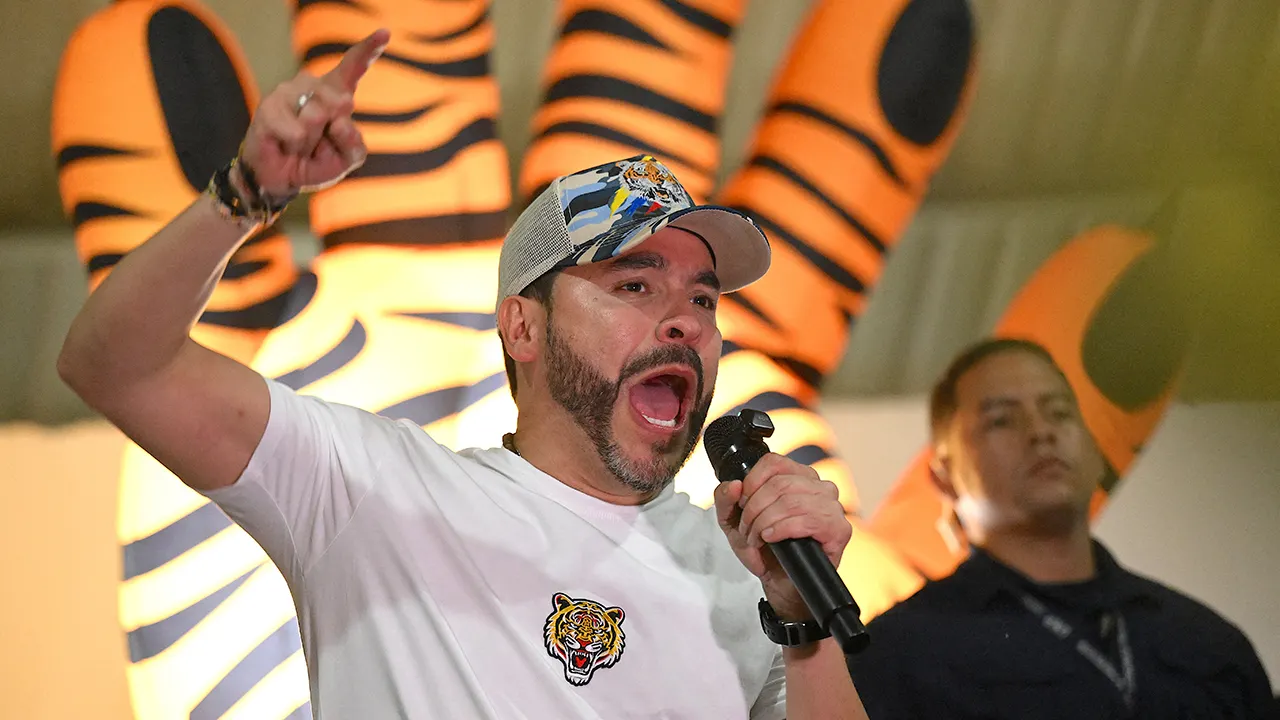
The halls of the White House on a chilly Monday morning became the unlikely stage for a geopolitical victory lap that reverberated all the way to the Andes. President Donald Trump, sporting his characteristic confidence during an official signing ceremony, wasted no time in congratulating conservative attorney and businessman Abelardo de la Espriella on capturing the Colombian presidency. The announcement, delivered with Trump’s signature bravado, came despite the fact that Colombian electoral officials had not yet formally certified the final results of one of the closest and most fiercely contested elections in the nation’s modern history. With a staggering 99.9% of the ballots counted, de la Espriella, affectionately and fiercely dubbed “El Tigre” by his loyal base, held a razor-thin lead of 49.7% against the 48.7% claimed by his left-wing rival, Senator Ivan Cepeda. The geographical distribution of the votes painted a vivid picture of a deeply polarized nation; “El Tigre” established an impregnable fortress in the rugged, deeply conservative mountainous interior and the economically powerful state of Antioquia, while Cepeda successfully rallied his supporters in the bustling streets of the capital city of Bogotá and across the vibrant, culturally distinct coastal regions. This stark division perfectly mirrored the historical political fault lines of Colombia, leaving the country suspended in a state of breathless anticipation. As Cepeda’s legal team immediately began lodging formal complaints, alleging widespread voting irregularities at thousands of polling stations, the nation found itself on the precipice of an unprecedented constitutional moment. In Colombia’s long democratic history, the formal overturning of a presidential election has zero precedent, suggesting that while the post-election atmosphere remains incredibly tense and legally fraught, the momentum of “El Tigre” seems almost impossible to halt, signaling a profound and disruptive shift in the balance of power across South America.
To understand how a political outsider could come so close to claiming the highest office in Colombia, one must look at the mesmerizing and theatrical rise of Abelardo de la Espriella himself. Known for his impeccable, custom-tailored Italian suits, his unapologetic love for high culture, and his fierce, razor-sharp legal mind, de la Espriella has long been a household name in Colombia, though historically in the courtrooms and television studios rather than the halls of congress. By running an insurgent, highly personalized campaign that explicitly bypassed the traditional, often ossified political parties, “El Tigre” successfully positioned himself as an authentic voice of the people, tapping into a deep-seated public fury with established elites. Much like his political ally in Washington, de la Espriella had never held an elected or appointed public office prior to his presidential run, a fact that he wore like a badge of honor on the campaign trail to prove his immunity to systemic corruption. His supporters did not see an inexperienced novice; instead, they saw a self-made, highly successful legal warrior who possessed the financial independence and raw courage required to dismantle the old guard. When Donald Trump publicly embraced de la Espriella, the endorsement did not feel like foreign interference to his base, but rather a vital validation of their candidate’s global stature and promise. Trump’s enthusiastic confirmation of their warm post-election phone call, during which de la Espriella expressed his gratitude for the American president’s backing, sent a clear message to the international community that a new era of unyielding, right-wing leadership was dawning in Bogotá, fueled by a shared populism that values strength, capitalism, and uncompromising law and order above all else.
In stark contrast to de la Espriella’s flashy, business-centric crusade stands Senator Ivan Cepeda, a man whose entire life story is woven directly into the painful, blood-soaked tapestry of Colombia’s internal conflict. For over twelve years in the Senate, preceded by a prominent four-year term in the Chamber of Representatives, Cepeda has been the intellectual and moral anchor of the Colombian left, advocating tirelessly for human rights, land reform, and negotiated peace. His political ideology is not merely academic; it is deeply personal and defensive. In 1994, during a notoriously dark chapter of state-sanctioned violence and paramilitary brutality, Cepeda’s father, Manuel Cepeda—a charismatic leader of the Colombian Communist Party—was assassinated in cold blood, an event that permanently forged Ivan’s commitment to defending the marginalized and seeking justice through democratic institutions. Throughout the campaign, Cepeda represented the continuity of the progressive vision championed by outgoing President Gustavo Petro, prioritizing dialogue with guerrilla factions and addressing the root socio-economic inequalities that have fueled rural violence for half a century. To Cepeda’s passionate supporters in the coastal regions and the universities of Bogotá, the prospect of a de la Espriella presidency is not just a political defeat, but a terrifying regression to a dark era of militarism and elite dominance. This existential dread explains why Cepeda’s camp is fighting so tooth and nail against the preliminary results, viewing the minor irregularities at the polling stations not as mere administrative errors, but as potentially systemic efforts to steal the election from a fragile left-wing coalition that had only recently tasted executive power.
The campaign’s central battlefield, however, was not fought over tax codes or educational systems, but over the terrifyingly tangible issue of public safety, which ultimately tipped the scales in favor of de la Espriella’s law-and-order platform. Under the previous administration of Gustavo Petro, many ordinary Colombians grew deeply disillusioned with the “Total Peace” initiative, a highly controversial strategy that emphasized ceasefire negotiations and social programs over aggressive military confrontation with armed groups. Critics argue that Petro’s perceived restraint acted as a lifeline for weakened criminal syndicates, allowing notorious organizations like the National Liberation Army (ELN) and highly armed dissident factions of the demobilized FARC to aggressively regroup, forcibly recruit rural youth, and reclaim lucrative drug-trafficking corridors across the country. Sensing the public’s mounting desperation and fear of returning to the chaotic days of the early 2000s, “El Tigre” capitalized on this vulnerability by cultivating a commanding, almost mythic strongman image. He promised a sweeping and aggressive return to the military tactics of former President Alvaro Uribe, pledging to unleash the national security forces to reclaim every square inch of territory lost to terrorist organizations and powerful drug cartels. Crucially, de la Espriella struck a chord with voters by pointing directly to El Salvador’s President Nayib Bukele as his primary policy inspiration, promising the construction of high-security “mega-prisons” designed to permanently house tens of thousands of suspected gang members and cartel operatives, prioritizing collective societal peace over the delicate nuances of international human rights critiques.
Beyond the immediate theater of military campaigns and massive prison compounds, a certified victory for de la Espriella will trigger a profound, systemic pivot in Colombia’s economic trajectory and its vital relationship with the United States. For the past several years, the once-unshakeable alliance between Washington and Bogotá had cooled dramatically, characterized by public, highly publicized clashes on social media between the progressive Petro and a skeptical U.S. leadership. Historically, Colombia has functioned as the primary geopolitical anchor for American interests in South America, serving as the frontline of both the global war on drugs and regional security initiatives. Under a de la Espriella administration, this partnership is poised to return with a vengeance, a prospect that was eagerly anticipated by U.S. Secretary of State Marco Rubio, who warmly congratulated “El Tigre” and emphasized a shared commitment to regional security and curbing illegal immigration pipelines. On the domestic front, de la Espriella plans to dismantle Petro’s state-centric economic experiments, replacing them with aggressive, free-market reforms designed to court foreign investment, slash corporate taxes, slice through bureaucratic red tape, and revitalize the nation’s traditional mining and energy sectors. This economic philosophy promises prosperity to a middle class battered by inflation, offering a stark alternative to the left-wing model by arguing that the most effective way to lift Colombians out of poverty is not through government subsidies, but through uninhibited capitalist expansion and the ironclad protection of private property.
Finally, the ripple effects of this election extend far beyond Colombia’s borders, marking a historic and potentially long-lasting rightward shift across the entire South American continent. Over the past few years, a fragile “pink tide” of left-wing governance had swept through Latin America, but de la Espriella’s ascent, alongside parallel conservative surges in Chile, Ecuador, Bolivia, and the anticipated rise of Keiko Fujimori in Peru, suggests that the pendulum is swinging back with immense force. Globally, all eyes will now be fixed on the highly volatile border between Colombia and Venezuela. The incoming Colombian administration will undoubtedly abandon Petro’s conciliatory approach toward Caracas, lining up directly behind the Trump administration’s fierce stance against the newly established Venezuelan government led by Delcy Rodriguez. De la Espriella is expected to aggressively demand a clear, internationally monitored timeline for free and democratic elections in Venezuela, while simultaneously placing direct military pressure on the Marxist ELN guerrillas who have historically utilized the porous Venezuelan border regions as a safe haven under the protection of Nicolás Maduro’s regime. As the official ballot review in Colombia grinds to its inevitable conclusion, the nation stands on the threshold of a dramatic transformation. Whether de la Espriella can successfully unite a fractured population under his banner of “law, order, and liberty” remains to be seen, but one reality is undeniably clear: the fierce spirit of “El Tigre” has completely redrawn the geopolitical map of South America.