


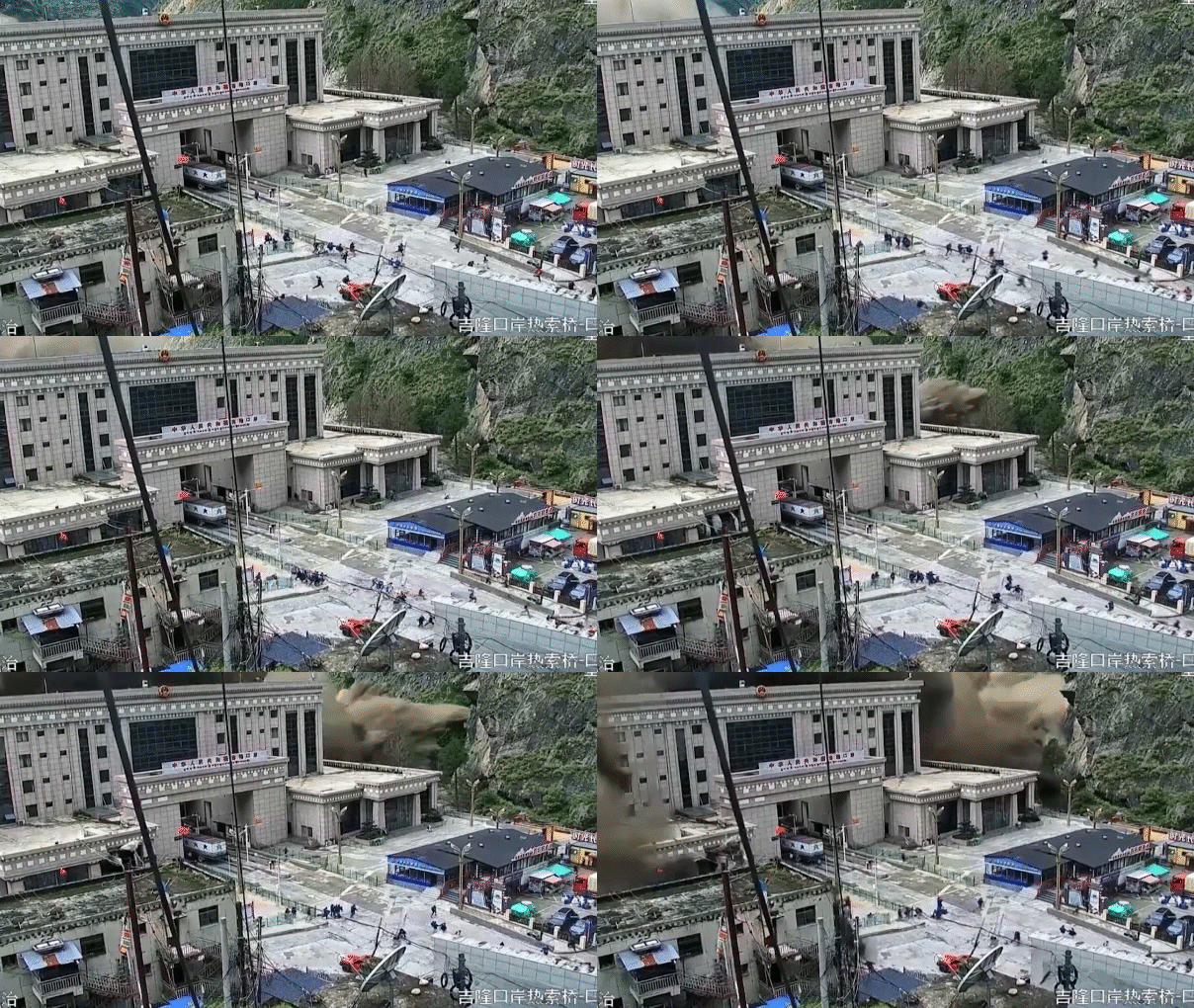
**One moment, the mountain valleys along the Nepal-China border were alive with the quiet rhythm of daily life. The next, they were swallowed by a roaring wall of mud and stone. A video taken after flash flooding in Gyirong, Tibet, near China’s border with Nepal captures the terrifying instant when mudslides began enveloping multiple buildings, sending residents sprinting for their lives. The footage is raw and chaotic—people scrambling, voices shouting, the earth itself seeming to crumble beneath them. Just seven minutes before the deluge, a 4.4-magnitude earthquake had shaken the region, according to the German Research Centre for Geosciences. That tremor, authorities believe, triggered an ice-rock avalanche that cascaded into the Lhende Khola River in Nepal, turning a normally tranquil waterway into a deadly torrent. For the people in its path, there was almost no warning. Homes, guesthouses, and small businesses—structures that had stood for generations—were suddenly gone, buried under layers of mud and debris. In the span of minutes, an ordinary day became a nightmare, and a landscape known for its breathtaking beauty became a site of unimaginable loss.
**The scale of the tragedy is only beginning to emerge, and it is staggering. Rescue authorities in Nepal have confirmed at least 95 deaths, recovering body after body from the wreckage. But the numbers only hint at the human suffering behind them. Nepal’s tourism authority reports that at least 484 tourists are missing, including at least three American citizens. Unofficial reports suggest that several dozen more Americans could be unaccounted for, though no official count has been released by the U.S. government. These are not just statistics—they are fathers and mothers, siblings and friends, travelers who came to see the Himalayas and locals who welcomed them. Every missing person represents a family somewhere, waiting by a phone, refreshing news websites, hoping for a name to appear on a list of survivors. In Nepal, a country that has known more than its share of earthquakes and landslides, this disaster cuts especially deep. Communities along the border are tight-knit, and the loss of even one neighbor is felt by all. The uncertainty is perhaps the cruelest part. While some families have received the devastating confirmation of a loved one’s death, countless others remain in a painful limbo, not knowing whether their missing relative is trapped, injured, or simply unable to reach a phone.
**In Washington, the Trump administration moved quickly to address the crisis, emphasizing that the safety of Americans abroad remains a top priority. A State Department spokesperson told Fox News Digital, “The Trump administration has no higher priority than the safety and security of Americans.” The spokesperson continued, “The State Department is aware of Americans impacted by the floods in Nepal and is closely tracking the situation. The embassy is working closely with local tour agencies and local authorities to assist Americans in the affected areas. We extend our deepest condolences for the victims and to the families of all those affected.” These words, while formal, carry a weight of genuine concern for the families still searching for answers. The department also urged U.S. citizens in the affected regions to monitor local news, follow emergency instructions, and enroll in STEP.state.gov to receive critical updates. In a separate travel advisory, the Consular Affairs office warned that the floods had destroyed buildings and damaged roads, bridges, electricity infrastructure, and communications. Nepali authorities ordered people living along riverbanks and in low-lying areas to move to safer locations, a precautionary measure that underscores the continued volatility of the situation. The advisory also listed specific routes to avoid until further notice, including the Prithvi Highway and several other critical roads, and asked Americans in Rasuwagadhi, Timure, Syafrubesi, Langtang, or other affected areas to contact the U.S. Embassy as soon as it was safe to do so. For the families of the missing, these updates are both a lifeline and a reminder of how far away their loved ones are.
**On the ground, the aftermath is a scene of both heartbreak and heroic effort. Sixty-five people are being treated at hospitals in and around Nepal’s capital, Kathmandu, according to local officials. Some have physical wounds; others are suffering from shock and the trauma of watching their world wash away. Medical teams are working around the clock, but the challenges are immense. Roads have been torn apart, bridges swept away, and power lines downed, making it difficult to move the injured to safety or deliver supplies to those in need. And the danger is far from over. Authorities have warned that a second flood could be possible because a blockage remains on the Lhende Khola River. That warning hangs over the region like a dark cloud, forcing rescue workers to balance their desperate search for survivors against the need to keep themselves and the displaced safe. People who lost their homes are now camped on higher ground, looking down at the valleys they once called home. In the midst of this, there are small acts of humanity: a rescued child wrapped in a blanket, a shared meal among strangers, a rescue worker pausing to hold the hand of an elderly woman who has lost everything. These moments, though fleeting, remind us that even in the darkest hours, the human spirit endures. The mudslides did not just destroy buildings; they shattered lives. But they also revealed the resilience of communities that have learned to lean on one another in times of crisis.
**As the world watches, an international response is taking shape. China, which shares the border where the disaster struck, has deployed 574 rescuers to Tibet’s Gyirong land crossing. One rescuer told CCTV that it would take hours to reach the deluged site, a sobering reminder of how remote and unforgiving the terrain is. Despite the obstacles, they are pressing forward, determined to find anyone who might still be alive. Beyond China’s immediate efforts, neighboring India and the European Union have publicly offered support to both Nepal and China. Indian Prime Minister Narendra Modi wrote on X, “Spoke to Prime Minister Balendra Shah and conveyed condolences on the loss of lives due to the floods in Nepal. The people of India stand in solidarity with their sisters and brothers in Nepal at this difficult time. India is ready to provide all possible humanitarian assistance to Nepal. Our teams are coordinating closely on rescue and relief efforts.” The warmth of his words was echoed by Nepal’s Prime Minister, who responded that Modi’s gesture was “a reflection of the enduring bonds of friendship between our two countries, which we profoundly value.” Meanwhile, European Commission President Ursula von der Leyen expressed her solidarity, saying, “Devastating floods have struck communities in Nepal and China. My thoughts are with all those affected, especially the families who have lost loved ones or are still waiting for news… Copernicus has been activated to help map the affected areas in Nepal and support the response on the ground. We stand ready to mobilise further European assistance.” The EU’s Copernicus satellite program will help assess the damage from above, offering a clearer picture of a landscape that has been changed forever. In times like these, national borders seem less important than the shared humanity that connects us all.
**This tragedy is a stark reminder of nature’s unpredictable power and the fragility of life in some of the world’s most beautiful—and dangerous—places. The Himalaya region has always been a land of extremes, where towering peaks and deep valleys create a landscape of breathtaking splendor and constant geological activity. Earthquakes, avalanches, and landslides are part of life here, but that does not make the losses any easier to bear. As recovery teams continue their painstaking work, the world can only offer its condolences and support. The U.S. State Department’s message to citizens in the area to “monitor local news, follow the emergency instructions provided by local authorities, and enroll in STEP.state.gov” is practical advice, but behind it lies a deeper hope: that no more names are added to the list of the missing. Fox News Digital has reached out to Nepal’s Ministry of Foreign Affairs for more information, but the full scale of the destruction may not be known for days. For now, the focus remains on the survivors, the rescuers, and the families still waiting for answers. In the midst of grief, there is also gratitude—for the first responders who risk their lives, for the neighbors who help one another, for the friends and strangers around the world who offer prayers and assistance. The road ahead will be long, and every recovery will be painful. But as the people of Nepal and China have shown time and again, they will rebuild. They will honor the memories of those they have lost by caring for those who remain. And they will find, even in the mud and rubble, the strength to begin again.