


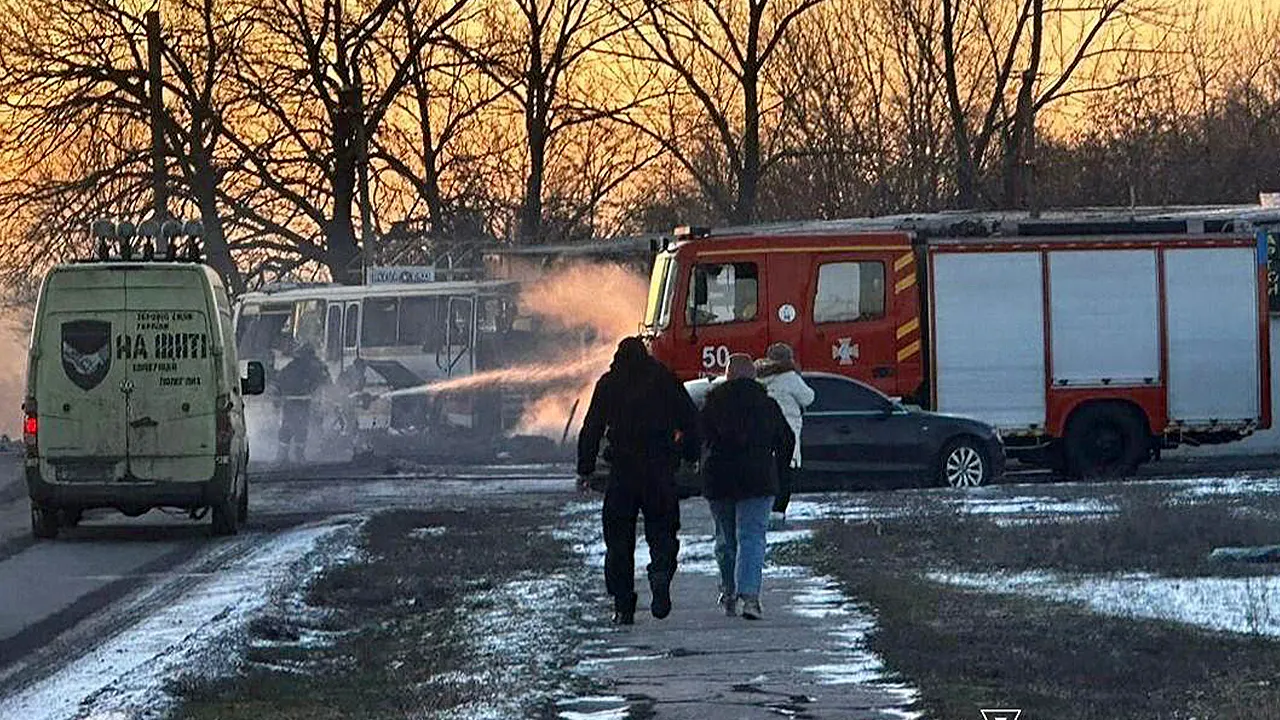
On a deceptively ordinary morning in the southern Ukrainian city of Kherson, a 52-year-old vegetable vendor named Yuriy and his wife set up their modest market stall, seeking nothing more than to earn a simple living amidst the ruins of their war-torn homeland. The air, usually filled with the quiet rustle of produce crates and the low murmur of early morning shoppers, was suddenly pierced by the high-pitched, mechanical buzz of a modern instrument of death: a Russian First-Person View (FPV) military drone. What followed was a nightmarish, intimate pursuit captured on video, showing the robotic assassin hovering menacingly over Yuriy beside his white minibus. In a state of sheer desperation, Yuriy did not reach for a weapon, but instead pulled out his humble wares—red tomatoes, green cucumbers, and dark purple eggplants—holding them up toward the drone’s cold camera lens in a heartbreaking attempt to prove his innocence and humanity to the unseen pilot operating the machine from miles away. The merciless drone, completely indifferent to his plea, mimicked the curious movements of a hunting predator, even ducking beneath the market umbrella as Yuriy tried to run to the other side of the vehicle, before diving sharply toward the front of the minibus and detonating in a violent, fiery explosion that left Yuriy wounded and clinging to life on the blood-stained pavement.
This chilling encounter, which Yuriy miraculously survived, has shed a harsh light on a deeply disturbing tactic that Ukrainian authorities and terrified locals have grimly dubbed “human safaris.” Unlike traditional artillery shells or cruise missiles that are launched blindly from hundreds of miles away, these FPV drones are guided in real-time by operators wearing virtual-reality goggles, giving them a crystal-clear, high-definition view of their targets’ faces, movements, and desperate attempts to flee. The psychological terror of this style of warfare is paralyzing; it transforms the sky itself into an active surveillance grid where ordinary civilians are hunted like game in their own neighborhoods. Even more abhorrent to Ukrainian officials and international observers is the reaction of the perpetrators, who have reportedly uploaded these hunting videos to social media platforms, boasting of their actions and showing a complete lack of remorse or basic human empathy for the defenseless civilians they terrorize. This deliberate, face-to-face malice elevates the conflict from a geopolitical struggle into a deeply personal campaign of psychological and physical torment designed to break the collective spirit of the Ukrainian people.
The graphic footage of Yuriy’s near-fatal encounter prompted a passionate and urgent response from Ukrainian President Volodymyr Zelenskyy, who took to social media to accuse the Russian military of losing all semblance of sanity and moral boundaries. In a deeply emotional post on X, Zelenskyy shared the video of the attack, urging the global community to look closely at the footage to understand the true, unvarnished nature of the adversary Ukraine is fighting. Zelenskyy argued that the assault on Yuriy was not an isolated incident of battlefield collateral damage, but rather a calculated act of cruelty that serves as a dire warning to the rest of the world. He cautioned that if this campaign against human life and basic decency is not decisively stopped within the borders of Ukraine, the contagion of lawless aggression will inevitably spread to other neighboring sovereign nations, specifically naming Poland, Finland, Kazakhstan, the Baltic states, Romania, Moldova, and the countries of the South Caucasus. For Zelenskyy, the survival of these nations and the preservation of global order depend entirely on a united, global coalition that values human peace and is willing to demand real, enforceable security guarantees to bring Russia’s war of aggression to a definitive end.
The systemic and widespread nature of these drone strikes is heavily documented by Ukraine’s Prosecutor General’s Office, which has opened a staggering 5,303 criminal cases investigating drone attacks specifically targeting civilian infrastructure and non-combatants in the Kherson region alone. These statistical figures tell a devastating story of human loss, with at least 287 civilians killed and another 2,549 wounded—including 41 children—by these remote-controlled weapons of terror. Ukrainian prosecutors have pointed out that these attacks are part of a highly coordinated, systematic campaign designed to disrupt the basic rhythms of daily life by striking public gathering places, private residences, busy transport hubs, and civilian vehicles. In a particularly cruel tactical maneuver known as a “double-tap” strike, drone pilots will often hover near an initial blast site, waiting for neighbors, emergency medical crews, and firefighters to arrive to assist the wounded, only to send in a second wave of explosive drones to maximize the casualties among those performing heroic acts of rescue. This deliberate targeting of first responders represents a severe violation of international humanitarian law and highlights a profound disregard for the sanctity of human life.
This climate of persistent fear in Kherson evokes the painful memories of previous tragedies, most notably the heartbreaking loss of a one-year-old boy who was killed a year prior by a Russian drone strike while playing in his playpen in his grandmother’s backyard. The contrast between a innocent toddler playing in a garden and a highly sophisticated military drone delivering a lethal payload illustrates the terrifying erasure of safe spaces in contemporary conflict zones, where even the sanctuary of a family home is no longer secure. For the residents of Kherson, the constant, low-frequency hum of overhead drones has become a permanent soundtrack to their lives, forcing parents to keep their children indoors and turning simple, everyday tasks like hanging laundry, walking to a local grocery store, or tending a garden into life-threatening endeavors. The enduring trauma of this constant state of vigilance is rewriting the psychological landscape of an entire generation of Ukrainians, who must navigate a world where death can descend silently from the clouds at any given moment.
In the wake of this latest outrage, Ukrainian Foreign Minister Andrii Sybiha has vehemently condemned the market attack as a barbaric war crime, issuing an urgent appeal to international courts and global leaders to intervene and hold the perpetrators legally accountable. The survival of Yuriy, who continues to recover in a local hospital, stands as a powerful symbol of human resilience in the face of mechanized, high-tech brutality, but his scars serve as a permanent reminder of the urgent need for global solidarity. The international community now faces a critical moral crossroads: to treat these acts of targeted violence as distant, unavoidable tragedies of a foreign war, or to recognize them as an existential threat to the shared values of human rights, dignity, and international law. Ultimately, bringing an end to this conflict is not merely about achieving a political truce or redrawing borders on a map; it is about restoring a world where a person can stand in a open-air market, selling the fruits of their labor beneath the summer sun, without having to plead for their life to a machine in the sky.