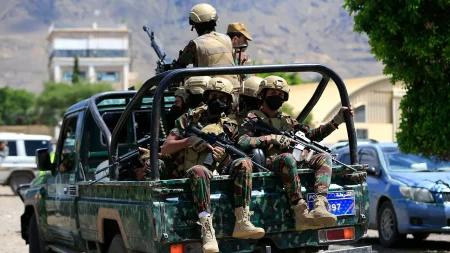







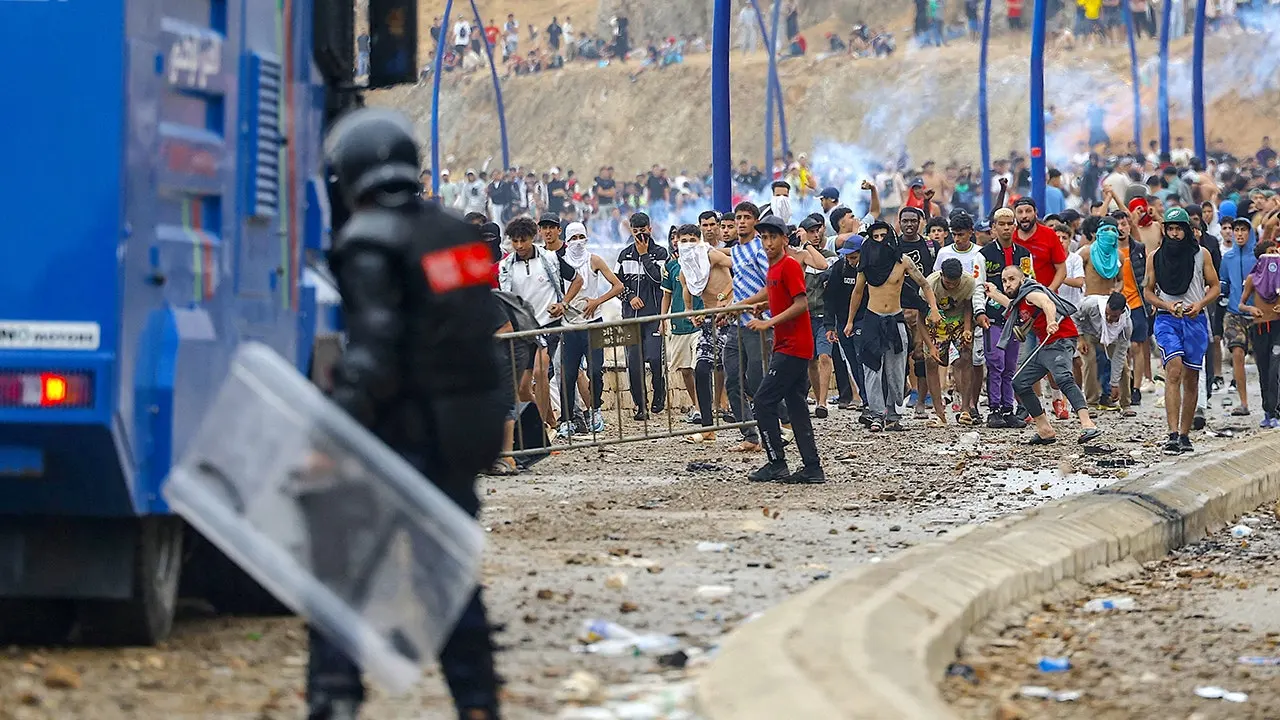
The sun crept over the Spanish enclave of Ceuta on a tense Friday morning, but the light did little to soften the mood. Soldiers in camouflage stood guard outside commercial buildings and government offices, their presence a silent acknowledgment that the city was no longer living in ordinary times. Police cruisers moved slowly along the main avenues, their headlights sweeping across streets that had become a stage for one of Europe’s most dramatic migration crises. On the Moroccan side, just a short swim away, security forces dressed entirely in black lined the beaches of Fnideq, the very stretch of coast where thousands of people had plunged into the water just weeks earlier, desperate to cross into Spanish territory. The reason for this extraordinary security presence was not hard to find. Social media platforms were alive with calls for another mass rush, an attempt to repeat the terrifying and chaotic event of July 30, when more than 70,000 people surged into Ceuta from Morocco in a single day. For the city’s residents, the announcement felt like a threat to their fragile peace, a reminder that their home, a small piece of Europe on Africa’s northern coast, could be overwhelmed again in a matter of hours. The air was thick with anxiety, and every patrol and every check was not just an operation, but a prayer that Saturday would pass without another flood of human desperation.
To understand why Ceuta was holding its breath, one has to look back at the events of that July morning. The city, which has a population of fewer than 85,000 people, was suddenly faced with an onslaught unlike anything it had ever seen. People came from every direction—over the border fences, through gaps in the barriers, along the rocky shoreline, and through the shallow waters that separate Morocco from Spanish soil. They were not a single face or a single story; they were mothers carrying children, teenagers traveling alone, and fathers who had left everything behind in search of something better. The Spanish authorities, caught completely off guard, scrambled to respond. Schools and gymnasiums were turned into makeshift shelters, and streets that usually heard the sound of morning commuters were filled with the noise of a city struggling to contain a crisis. By the time it was over, at least 96 people had died, not in the city itself, but along the brutal routes that led there—drowned in the sea, crushed in the chaos, or lost in the stampede-like movement of desperate bodies. For the people of Ceuta, the shock of that day went far beyond the headlines. It was the sight of strangers sleeping in their public squares, the sound of children crying in languages they did not understand, and the knowledge that their own comfortable lives could be turned upside down in an instant. And for the migrants themselves, there was no victory in crossing the border. There was only the exhaustion of survival and the long, uncertain wait for an answer about whether they would ever be allowed to call this place home.
Now, in the aftermath of that trauma, both Spain and Morocco are trying to show that they have learned a lesson. The Spanish government has deployed soldiers to protect key locations throughout Ceuta, including commercial areas and government buildings, and police officers have been stationed on the city’s main avenues in numbers that make their intentions clear. The enhanced police presence on the Moroccan side is just as visible, with black-clad security personnel patrolling the beaches of Fnideq, the same stretch of sand where many migrants began their illegal crossing on July 30. The beaches, once scenes of chaotic departures, are now under watch, with officers scanning the water and watching for any signs that another attempt is about to begin. Morocco’s Ministry of Interior has also issued a stark warning, stating that it had detected anonymous publications and messages on social networks calling on people to rush Ceuta and Melilla, Spain’s other African enclave. The ministry described these calls as dangerous provocations that “instrumentalize migration issues” in acts of incitement, and it made clear that such behavior is criminalized by law. The response was not just verbal. Interior Ministry spokesperson Rachid El Khalfi confirmed that multiple people who had circulated the inciting statements had been arrested. The message from Rabat was direct: the Moroccan state would not allow its territory to be used as a launching pad for another mass border breach, and it would not tolerate the social media campaigns that helped turn desperation into a collective stampede.
Yet even as the security forces tightened their grip on borders and beaches, the human consequences of the July event remained far from resolved. Of the more than 72,000 people who rushed into Ceuta that day, the overwhelming majority have already been returned to Morocco, according to statements from Spanish and Ceuta officials. But for the roughly 5,000 people who remain, the nightmare is not over. They are caught in a suspended existence, living in temporary shelters and processing centers, uncertain of what will happen to them next. Spanish officials have been working through the backlog of cases, screening the remaining migrants and processing their claims. The results have been deeply discouraging for those who had hoped to stay. According to a Reuters report, around 500 asylum applications had been processed at the time of the announcement, and the vast majority of them were rejected. What does that mean in human terms? It means families who packed their lives into plastic bags must now pack them again, this time for a return to the very conditions they fled. It means young men who risked drowning in the cold sea will have to explain to their mothers why their journey ended in failure. It means children who have already weathered months of danger will now face the possibility of displacement once more. Behind the official numbers are human beings with dreams, with memories of loss, and with a stubborn hope that they cannot simply turn off. The statistics are easy to digest, but the reality is far more painful.
The tension at the Ceuta border is not just a local problem; it is the result of decades of complicated history between Spain and Morocco, two nations that share a border in Africa but live in very different worlds. Ceuta and Melilla are European Union territory on the African continent, the only land borders between Europe and Africa, and they have always been magnets for migration. The events of July 30 were unique in their scale, but they were also part of a recurring pattern, a cycle in which thousands of people attempt to cross, authorities respond with force, the situation stabilizes for a while, and then the pressures build again. Morocco has always played a delicate game in this relationship. It wants to be seen as a reliable partner in controlling migration, but it also uses the specter of migration as leverage in its broader political disputes with Madrid. Spain, for its part, needs Moroccan cooperation to stem the flow, but it also has to answer for the conditions that drive people to risk their lives. The Spanish government has installed floating barriers in the waters where migrants previously swam across, hoping that physical obstacles will be enough to stop future attempts. But barriers are only one answer, and they do nothing to address the despair that makes a person look at a razor-wire fence and decide that the other side is worth dying for. The social media calls for a new rush are not the root cause; they are just a match thrown onto a pile of kindling. The real fire is poverty, lack of opportunity, and the widening gap between life in Morocco and life in Europe.
As Saturday arrived, the people of Ceuta could only wait, listen, and hope that the show of force would be enough to keep their city safe. Moroccan authorities made it clear that they would not permit another attempt, and Spanish troops stood ready to respond to any breach. But beyond the soldiers and the barbed wire lies a more difficult question: how do you balance security with humanity, and how do you protect a city without erasing the dignity of the people at its gates? The 96 deaths from the July crossing are a haunting reminder of what happens when migration is left to explode into an uncontrolled rush. Every measure that prevents another tragedy is necessary, but every measure that treats migrants only as threats is a failure of compassion. The young people who ran toward the sea were not just statistics; they were someone’s child, someone’s friend, someone’s last chance at a different life. The same is true of the thousands still waiting in Ceuta, and the countless others watching from the Moroccan shore, trying to decide whether the risk is worth taking. The border between Spain and Morocco will always be more than a line on a map. It is a mirror of Europe’s struggle to reconcile its values with its fears, and a reminder that there are no simple solutions to a problem rooted in the deepest inequalities of our world. For now, the reinforcements have arrived, the patrols are in place, and the immediate danger may have passed. But the true test is not whether another rush can be stopped. It is whether the nations involved can build a future in which no one feels compelled to risk death in order to live. That is a challenge no barrier, no soldier, and no arrest can solve. It will require the kind of courage and compassion that so often seems lacking when the cameras turn away.