





On a Saturday in the Caribbean Sea, a routine patrol ended in sudden violence. A vessel, described by U.S. military officials as a suspected drug-smuggling boat, was targeted by American forces in a lethal strike that left four people dead. The boat was moving through waters long known for illicit trafficking, and the operation was framed as another step in an ongoing campaign against the networks that move narcotics toward the United States. Yet for the families of those killed, there will be no neat official summary to soften the loss. They are left with questions, grief, and the cold finality of an attack carried out from the air or sea, far from any courtroom. This was not an isolated incident, but the latest in a series of strikes that have become a defining feature of the current administration’s approach to the drug trade. Since the White House began describing cartels as a military threat, the U.S. military has struck boats in the eastern Pacific and the Caribbean with increasing frequency. Each strike is announced in terse official language, with numbers and coordinates replacing the human lives involved. The dead are rarely named. Their stories are rarely told. And the broader question of whether this campaign is making anyone safer remains uncomfortably open.
The numbers are striking, and they deserve a moment of quiet acknowledgment. According to the most recent accounting, the attack on Saturday pushed the total number of people killed in such boat strikes to at least 231, spread across 69 separate operations since the campaign began nearly a year ago. That is an average of more than three deaths per strike. These are not battlefields in any traditional sense; they are open waters, often far from shore, where boats are intercepted based on patterns of movement and suspicion. U.S. Southern Command, the military body overseeing operations in the region, said the latest target was a vessel operating along known smuggling routes. The phrase suggests precision, but the reality is more uncertain. The military has not provided evidence that the boat was actually carrying drugs. No cargo manifest, no photographs of seized cocaine, no testimonies from survivors have been offered to the public. Instead, there is only the official assertion that the boat was a threat. In previous incidents, officials have pointed to the presence of multiple fuel barrels, the lack of navigation lights, or the refusal to stop as indicators of illicit activity. But those are circumstantial signs, and they have been used repeatedly to justify deadly force. The administration’s broader argument, that these strikes are dismantling trafficking networks and saving American lives, has been repeated often. Yet the evidence trail remains thin, and skepticism has grown among human rights advocates, legal scholars, and even some former military officers who worry that the campaign is being waged without transparency or accountability.
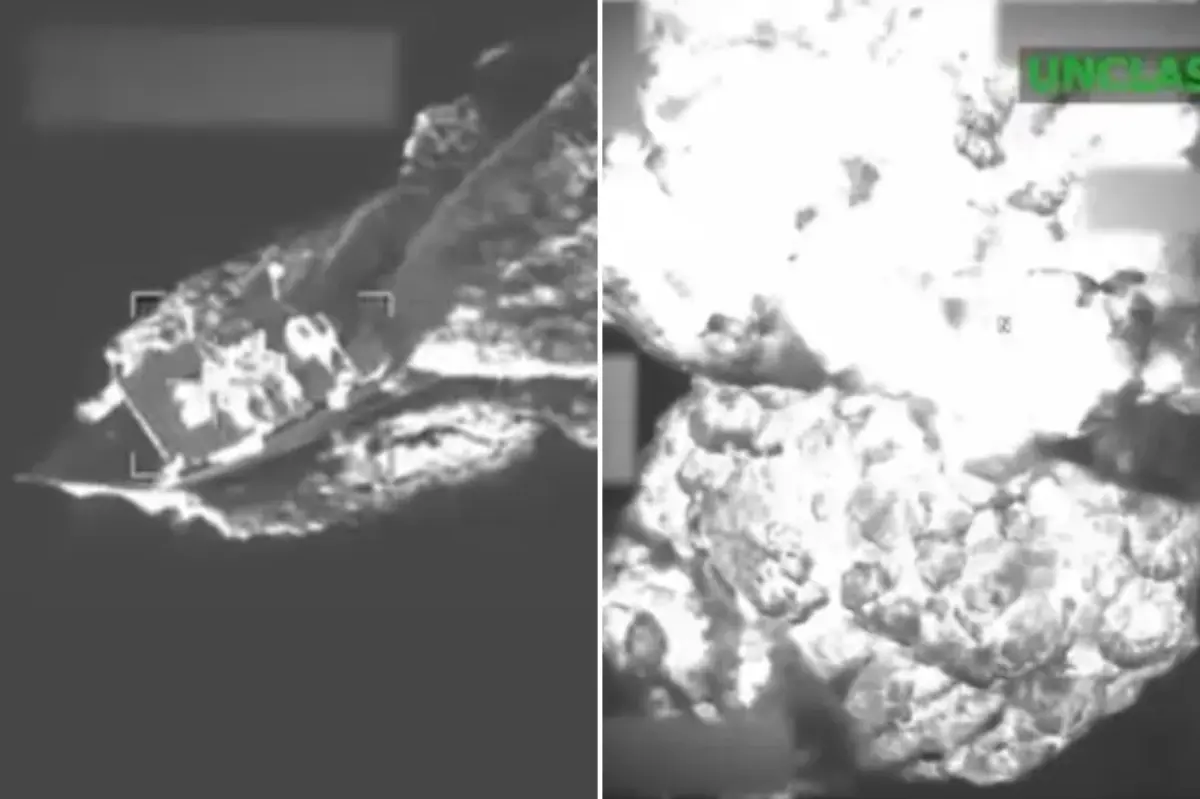
A piece of digital evidence has added to the unease. In the aftermath of the latest strike, a video posted on the social media platform X showed what appeared to be a moving boat on dark water, followed by a sudden flash of light. The clip is brief, grainy, and ambiguous. It does not show the moments before or after the flash. It does not reveal who was on board or what they were carrying. It simply shows a moment of destruction, stripped of context. U.S. Southern Command later published its own statement, describing the operation as a “lethal, kinetic strike” carried out by the Joint Task Force Western Hemisphere on September 19. The statement said confirmed intelligence revealed the vessel’s active involvement in trafficking, but again, no concrete proof was released. The reliance on such vague language is becoming a pattern. Terms like “lethal, kinetic strike” and “confirmed intelligence” are meant to convey authority and certainty, but they often function as placeholders for the kind of detailed evidence that would allow independent verification. In a democracy, the decision to use lethal force should be subject to scrutiny, especially when the targets are not uniformed soldiers but people in small boats, often poor, often desperate, and often far from the centers of power where such decisions are made. The video, rather than settling questions, has only sharpened them. Who were these four individuals? Were they armed? Were they actually smugglers, or were they fishermen caught in the wrong place at the wrong time? The public may never know, and that lack of clarity is itself a form of violence.
The campaign, however, is not confined to the sea. The administration is now attempting to extend its offensive onto land, across multiple Latin American countries. Defense Secretary Pete Hegseth, during a visit to Panama last month, stated that Colombia, Guatemala, and Honduras had agreed to allow the United States to carry out joint military operations against criminal groups on their soil. It was a striking declaration, suggesting that the boundaries of national sovereignty were being redrawn to accommodate a broader war on drugs. But the response from at least one of the named countries was swift and unequivocal. Guatemalan officials denied that any such agreement existed. This discrepancy raises uncomfortable questions about how the administration is conducting its foreign policy. Is it announcing agreements that have not been finalized, hoping to present them as accomplished facts? Is it pressuring vulnerable governments into accepting military cooperation that their citizens oppose? Or is it simply misrepresenting the situation to create a sense of inevitability? Whatever the explanation, the episode underscores the aggressive nature of the administration’s approach. The expansion to land operations would represent a significant escalation, with the potential for far greater casualties and far deeper entanglements. Unlike boat strikes in the open sea, ground operations would involve raids on communities, airstrikes on buildings, and the possibility of civilian deaths. The history of such campaigns, from the war on drugs in Colombia to more recent counterterrorism efforts, suggests that violence often breeds more violence, and that the underlying conditions fueling the drug trade, poverty, corruption, weak institutions, and immense demand in the United States, remain largely unaddressed.
The administration’s rhetoric leaves little room for nuance. President Donald Trump has repeatedly described the situation as an “armed conflict” with cartels in Latin America. He has justified the attacks as a necessary escalation, a way to stem the flow of drugs into the United States and to prevent the fatal overdoses that continue to devastate communities across the country. There is no question that the opioid crisis and the broader drug epidemic have caused immense suffering. Every year, tens of thousands of Americans die from overdoses, and the pain of those losses is real and profound. But whether military strikes on small boats in the Caribbean will solve that crisis is another matter entirely. The logic of the administration’s approach assumes that killing traffickers at sea will disrupt supply chains and raise the cost of smuggling to a point where the trade becomes unsustainable. Yet the drug trade has proven remarkably resilient, adapting to every enforcement measure thrown at it. When one route is closed, another opens. When one leader is killed, another takes their place. The demand for drugs remains, and as long as it does, there will be people willing to risk their lives to meet it. The administration’s campaign, for all its lethal intensity, seems designed more to demonstrate strength than to achieve a sustainable outcome. It offers the appearance of action, the satisfaction of a strike, but it does little to address the systemic issues that make the drug trade so profitable and so persistent. Meanwhile, the human cost continues to grow, measured not only in American overdose deaths but in the anonymous casualties of a conflict that is rarely seen and even more rarely questioned.
Perhaps the most troubling aspect of the campaign is the absence of accountability. The military’s statements are issued with confidence, but they are rarely accompanied by independent verification or detailed explanations. When the administration says it killed drug smugglers, it asks the public to take that claim on faith. Yet the evidence presented so far has been thin, and the few cases that have been examined closely have raised more questions than they have answered. Human rights organizations have documented incidents in which fishing boats or civilian vessels may have been mistaken for smugglers, leading to deaths that were never properly investigated. The military has a system for investigating civilian casualties, but in these remote waters, far from independent observers, the truth is difficult to establish. The families of those killed have little recourse. Their loved ones are listed as suspected traffickers, a label that often sticks even in the absence of proof. The administration, for its part, seems uninterested in these concerns. It has framed the campaign as a defense of the American people, and in the name of that defense, it has authorized strikes that kill people who will never have a chance to tell their side of the story. The result is a campaign that operates in the shadows, justified by a crisis that is real but exploited for political purposes. There is a deeper tragedy here, one that goes beyond the specific numbers and statistics. Every death in this campaign is a human life, with a name, a history, and people who mourned them. They may have been smugglers, or they may have been something else entirely. They may have been desperate, or criminal, or both. But they were human, and their deaths deserve more than a bureaucratic statement. They deserve a reckoning. Until that happens, until the administration is willing to open its operations to scrutiny and accept responsibility for the lives it takes, the campaign will remain what it has always been: a violent exercise in power, wrapped in the language of duty, and carried out far from the eyes of those who ordered it. And the waters of the Caribbean, once again, will close over another lost life, with no justice, no transparency, and no peace.