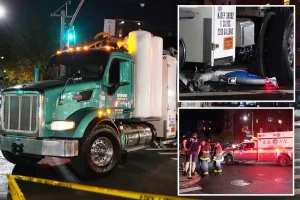





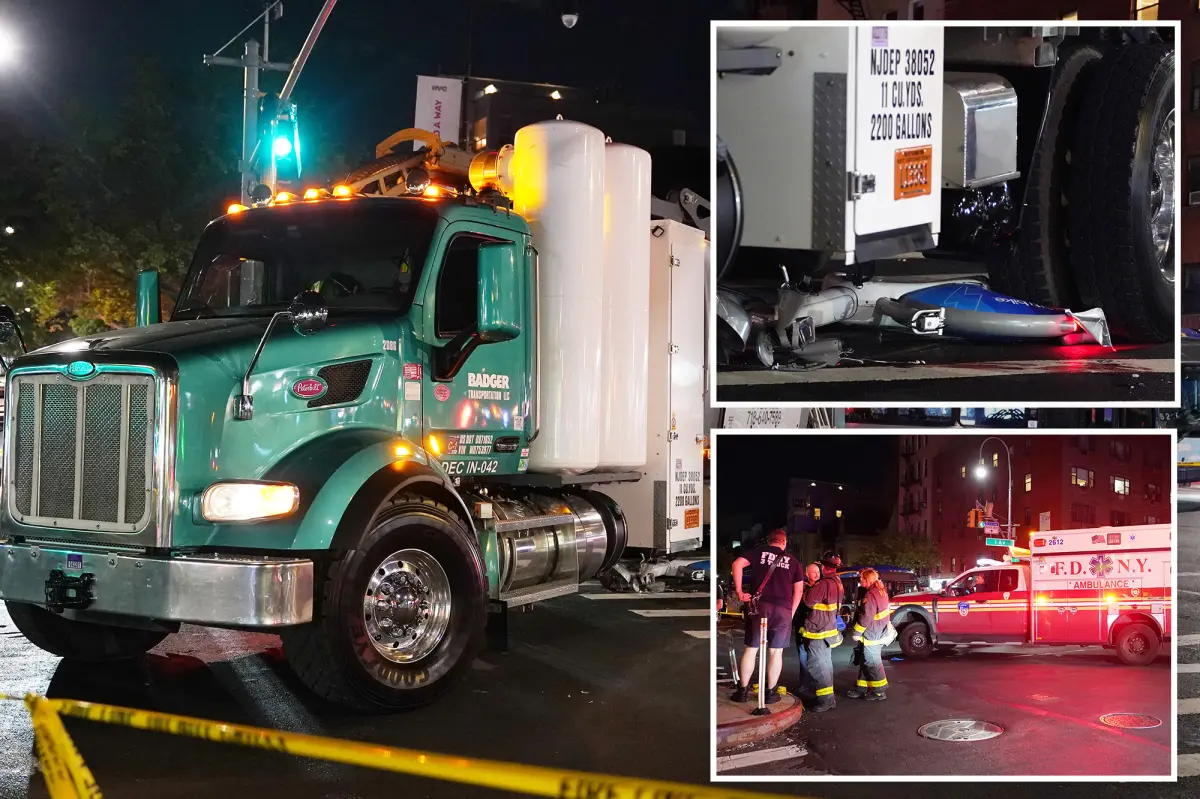
The name Daria Serkov now belongs to a tragedy that unfolded on a Manhattan street corner, a name that will be remembered not only for how her life ended but for all the ordinary, precious things that came before. Police confirmed Saturday that the 15-year-old was the girl killed Friday night when a hydro excavation truck struck the Citi Bike she was riding in the East Village. She was not alone. Beside her, on the same blue bike, was her 16-year-old friend, also hurt, also rushed to Bellevue Hospital, and now listed in stable condition. What began as a casual evening ride through one of New York City’s liveliest neighborhoods turned, in a single instant, into a scene of chaos, grief, and desperate attempts to save a young life. It is the kind of loss that makes a city stop and catch its breath, because it could have been anyone’s daughter, anyone’s best friend, anyone’s first taste of city freedom. Daria was just fifteen. She should have had decades ahead of her—school dances, late-night talks, college, first jobs, and all the small adventures that make up a life. Instead, her story is now told through witness accounts, police reports, and a flood of sorrow from people who never knew her but felt the weight of what happened.
The crash happened just before nine o’clock Friday night at East 14th Street and First Avenue, an intersection that is busy even when the city is winding down. The truck, a large industrial vehicle operated by Badger Daylighting, was attempting to make a right turn onto First Avenue when it struck the teenagers. Right turns are among the most dangerous maneuvers a driver can make in a city filled with cyclists and pedestrians, especially when the vehicle is massive and the rider is small. The girls were riding the same Citi Bike, and witnesses later noted that neither was wearing a helmet. In the chaotic moments after the impact, bystanders began screaming at the driver to stop, but he apparently could not hear them over the noise of his truck and the street. One witness, who chose not to give his name, described the aftermath as “dramatic” in the most heartbreaking sense. Two bystanders tried to pull the girl on the right side out from under the wheel, but police quickly ordered them to stop because moving her could have caused even more damage. The witness watched as blood leaked across the pavement toward the other side of the vehicle. Firefighters arrived and began performing CPR, but the scene had already taken on a terrible clarity. The driver remained at the scene, and no charges were immediately filed, but the emotional wreckage was visible on his face and in the trembling voices of everyone who had tried to help.
At Kati Thai restaurant on 14th Street, the owner Bdin Puangsawasdi heard about the accident from his wife, who had heard a “loud noise” and rushed outside. He followed, and what he saw would stay with him forever. The truck driver had gotten out of his cab and was crying uncontrollably, a grown man shattered by the knowledge that his vehicle had just altered lives forever. In that moment, the driver was not a faceless villain or a symbol of dangerous roads; he was a human being drowning in shock and remorse, standing in the middle of a nightmare he could not undo. Puangsawasdi’s account reminds us that tragedies like this do not happen in isolation. They ripple outward, touching the victims, their families, the first responders, the eyewitnesses, and even the person behind the wheel. The driver’s tears do not diminish the loss of Daria, but they remind us that the failure of a single moment can be carried for a lifetime. The witness who watched the bystanders and firefighters struggle to save the girl described the blood, the screams, the frantic effort to stop the truck, and then the sudden, hollow order from police for everyone to walk away. There is no way to unsee that. There is no way to rewind the night. There is only the aftermath—a street corner marked by grief, a family left to bury their daughter, a friend recovering in a hospital bed, and a city that must ask itself how many more evenings like this it will allow.
At Bellevue Hospital, doctors did everything they could, but Daria Serkov was pronounced dead. Her 16-year-old friend was treated for injuries and remained in stable condition, but stable is not the same as okay. She will carry the physical scars of the crash, and likely the emotional ones too, for a long time. Police confirmed that the driver stayed at the scene and that there were no charges, which means the investigation is still unfolding and the legal system has not yet assigned blame. But for the people who loved Daria, no investigation will bring her back. The company behind the truck, New Jersey-based Badger Daylighting, released a statement saying they were “devastated” and sending “heartfelt condolences to her family and friends.” Those words, however sincere, can feel hollow against the enormity of a lost child. Witnesses noted that the girls were not wearing helmets, and that they were riding one bike together—choices that are common among teenagers, who often see biking as a simple pleasure rather than a risk. But a helmet alone would not have saved Daria from the weight and force of a hydro excavation truck. The real protection comes from safer streets, better design, slower speeds, and a collective commitment to treating every cyclist as someone’s beloved child.
Lyft, which owns and operates Citi Bike, told The Post that they were “deeply saddened by this tragedy” and offered their thoughts and condolences to the family. They said they were ready to work with law enforcement and provide any assistance needed, adding that safety is their top priority and that they remain committed to working with city partners to make streets safer for everyone. These are the words we always hear after a tragedy, and they are necessary, but they are not enough. Citi Bike has become a symbol of urban mobility, a way for people to move through the city without a car, to feel the wind on their faces and the pavement under their wheels. But moments like this expose the fragile line between freedom and danger. A right turn by a massive truck can erase a young person in seconds, and no amount of corporate grief can undo that. The broader questions loom large: Are our intersections designed with enough protection for cyclists? Are trucks equipped with the right mirrors, cameras, and sensors to see vulnerable road users in their blind spots? Are drivers trained to look for people, not just traffic lights? And are we, as a city, willing to accept that bike lanes and painted lines are not enough? Daria’s death is not a standalone incident; it is a symptom of a system that too often prioritizes speed and convenience over human life.
In the days ahead, there will be vigils, flowers, and candles left at the corner of East 14th Street and First Avenue. Friends will post photos of Daria, laughing on a summer day, looking just like any other teenager with her whole life ahead of her. Strangers will argue in comment sections about helmets, truck drivers, bike share programs, and the dangers of riding double. Politicians will release statements about safety and promise to do better. But none of that will bring Daria back. What we can do is honor her memory by insisting on change—real change, not just words. We can demand safer intersections, more protected bike lanes, stricter rules for commercial vehicles, and a culture that sees every cyclist as a person with a name, a family, and a future. We can remember the witness who tried to pull her out from under the wheel, the firefighters who performed CPR, the restaurant owner who saw the driver break down, and the friend in a hospital bed whose life will never be the same. Daria Serkov was fifteen years old. She went out for a ride on a Friday night and never came home. Her story is now part of the city’s painful memory, and the least we can do is let it move us to act, so that no other family has to hold a vigil on a street corner where their child’s life ended too soon.