





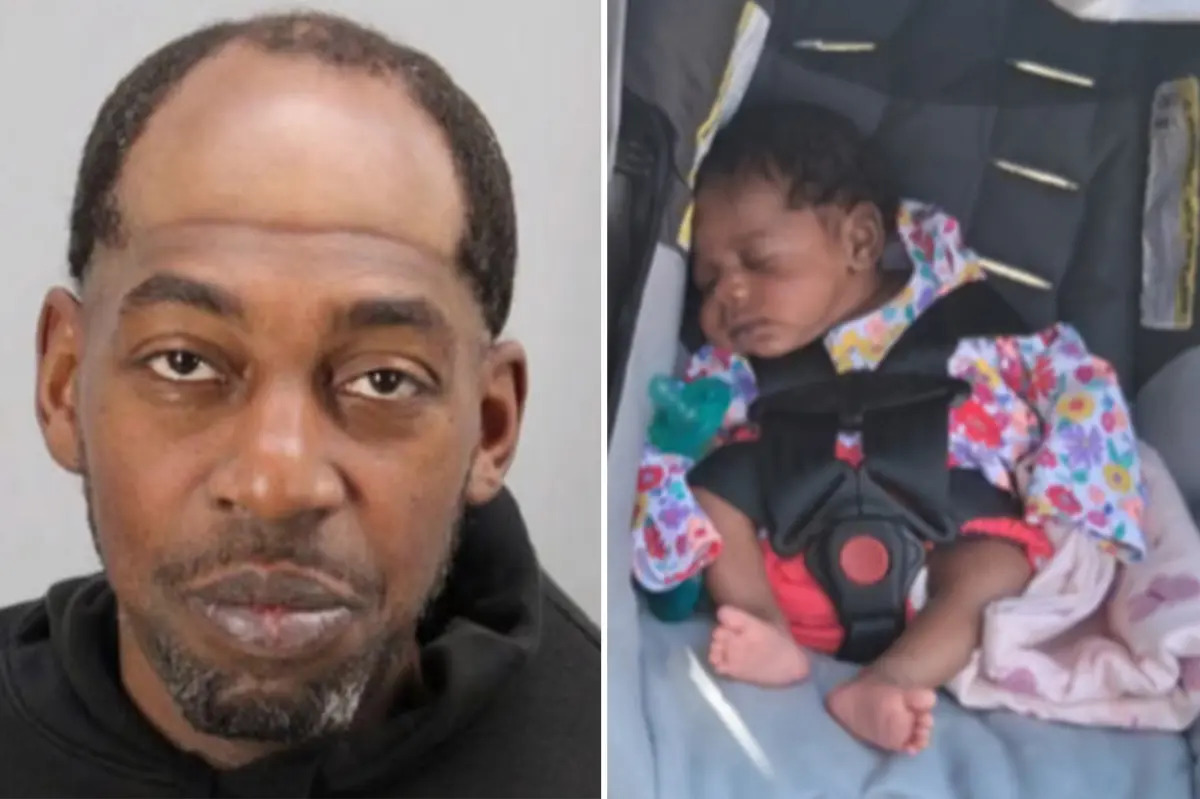
On an ordinary August afternoon in Washington, DC, a tiny life ended in violence that no one who knew her could fully comprehend. The victim, two-month-old Khamyah Honesty, was a newborn with a twin sister, a mother who loved her, and a future that was stolen before it truly began. Her alleged killer is Demetrius Beatty, a 40-year-old man who was supposed to be watching over her while her mother ran an errand. Instead, according to prosecutors, he beat her so severely that she suffered multiple fractures and catastrophic head trauma, and then he tried to shift the blame onto the most vulnerable person in the room: his own six-year-old son, a nonverbal autistic child. The charge of first-degree felony murder now hangs over Beatty, but the story that has emerged from court documents is not just a legal case—it is a portrait of a household overwhelmed by jealousy, neglect, drugs, and fear, where a baby became the victim of a rage that should never have been turned on her. It is a story that leaves a trail of unanswered questions, unbearable grief, and the painful recognition that so many adults failed this child long before her last breath.
The first attempt to hide the horror came in the form of a 911 call that was chaotic, desperate, and riddled with inconsistencies. Beatty told the dispatcher that his autistic son had “got to the 2-month-year-old daughter” and had been “fighting her,” claiming that he had “damaged her pretty good.” He described the baby’s face as swollen and her nose bleeding, and pleaded for help. Yet even in that moment of panic, the details did not add up. He gave the wrong apartment unit, offered the wrong age for his son, and referred to the baby by the wrong name, calling her “Maya” instead of Khamyah. He said he had stepped out into the hallway for a moment with the other children, leaving the baby and his son alone, and that when he returned, he found the infant face down on the floor, with his son clapping and smiling nearby. He told officers that his son had always shown “negative behavior toward his siblings” and that the boy was “out of this world strong,” seemingly trying to build a case against a child who could not speak for himself. But the story began to unravel almost immediately. No one who heard the description of the injuries could believe that a six-year-old, no matter how strong, could have caused that kind of damage. And Beatty’s own words, captured in the call and in later interviews, revealed something else: a man who was not simply a grieving caregiver, but someone who had already been warned, already been suspected, and already had reason to resent the babies he was supposed to protect.
The medical evidence would prove to be the most damning truth of all. When paramedics and police arrived, Khamyah was unresponsive, her body bearing wounds that no child should ever endure. She had multiple fractures, a nose bridge that was described as “flattened,” and severe trauma to her head. She was rushed to a hospital, where doctors fought to save her, but her injuries were too extensive, too brutal. Within hours, she was gone. A forensic pathologist later reviewed the case and concluded that the injuries could not have been inflicted by a child. This was the work of an adult, someone who had used far more force than any reasonable person could explain as an accident or a tantrum. The baby’s tiny body, so fragile and new, had been broken by rage. The medical finding also destroyed Beatty’s story about his son, turning his attempted frame into something even more sinister: not only had he allegedly killed a helpless infant, but he had tried to destroy the life of his own disabled child to escape responsibility. That child, who could not speak, who could not defend himself, who had already been cast as the villain in a narrative his father invented, would have been branded a murderer if not for the cold, objective evidence of the autopsy. It is a cruel irony that a child who likely never understood what was happening was used as a shield by the very man who should have been his protector.
Why would anyone do such a thing? The motive that prosecutors have outlined is rooted in jealousy and betrayal. Beatty was not Khamyah’s father; he was the boyfriend of the baby’s mother, and he was also the father of two of her other children. The mother had become pregnant with twins—Khamyah and her sister—through an affair with another man, and Beatty did not hide his bitterness. He told police that he was not “happy” about the pregnancy and that he felt “bitter” about the situation. According to the mother, he had warned her just days before the killing that if she left the twins alone with him while she went to visit their biological father—who was incarcerated—the babies would be dead. She recalled his chilling words: “If you leave them b–ches here, them b–ches are going to be dead.” Yet despite that threat, she left the children in his care, and when she returned from the grocery store, her daughter was dying. She told police that it was “mighty funny” that Beatty had made that comment and then her daughter was dead, but she also apparently struggled to accept that he could be responsible, perhaps out of shock, perhaps out of denial, perhaps because the truth was too horrible to face. Her grief is unimaginable, but so is the question of why a threat so specific and so violent was not enough to keep the babies away from him. In the aftermath, she lost not only a daughter but also custody of her other children, and she must live with the knowledge that she left her twins in the care of a man who had already told her what he would do.
The tragedy of Khamyah Honesty did not begin on that August day. In fact, court documents reveal a disturbing pattern of danger and neglect that surrounded the infant from the very start. Just weeks before her murder, she had fallen roughly 75 feet down an escalator after slipping from a car seat, an incident that her mother allegedly tried to minimize. It is difficult to imagine how a two-month-old survives such a fall, and even harder to understand why more wasn’t done to investigate what had happened. There were other warning signs too: Beatty allegedly locked the twins in a closet because they were crying and smelled bad. The four surviving children showed signs of neglect and unexplained injuries. The family was living in what police described as deplorable and filthy conditions, with pills and marijuana left out in the open. Beatty admitted to using fentanyl in the days before the murder. This was not a stable, loving home; it was a place where children were exposed to drugs, filth, violence, and adults who were too consumed by their own struggles to protect them. What is perhaps most heartbreaking is that someone outside the family had been trying to intervene. A relative of the twins’ father had spent two months calling the city’s Child and Family Services Agency, pleading with them to check on the children because she was concerned for their safety. Those calls, tragically, did not save Khamyah. The system that was supposed to protect vulnerable children failed her, just as the adults in her life failed her, and the result was a small coffin instead of a future.
Now, Demetrius Beatty sits in custody, charged with first-degree felony murder and first-degree cruelty to children. A judge ordered him held without bond, and he is due back in federal court on September 28. The legal process will determine his fate, but no verdict can undo the damage he is accused of causing. Khamyah Honesty is gone. Her twin sister will grow up without the other half of her, without knowing the bond that only twins share. Her siblings will carry the memory of a home that was dark and dangerous, and the youngest among them may never fully understand what happened to their family. The six-year-old boy at the center of the false accusation will have to live with the knowledge, someday, that his father tried to blame him for a murder he did not commit—though perhaps his autism will shield him from the full weight of that betrayal. And the mother, who lost a child and who may never forgive herself for leaving that day, will have to find a way to mourn while facing her own role in the tragedy. This is not a story with a simple villain or a clean resolution. It is a story about how jealousy can poison a home, how addiction and neglect can blind people to the needs of the most innocent among us, and how a baby who deserved love and safety was instead met with violence. Khamyah Honesty’s life was only two months long, but her death demands that we look at the warning signs, the missed calls, the threats, and the chaos, and ask ourselves how many more children must suffer before we act. She cannot speak, but her broken body tells the truth. And now, at last, someone is being held accountable for it.