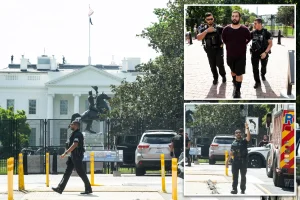





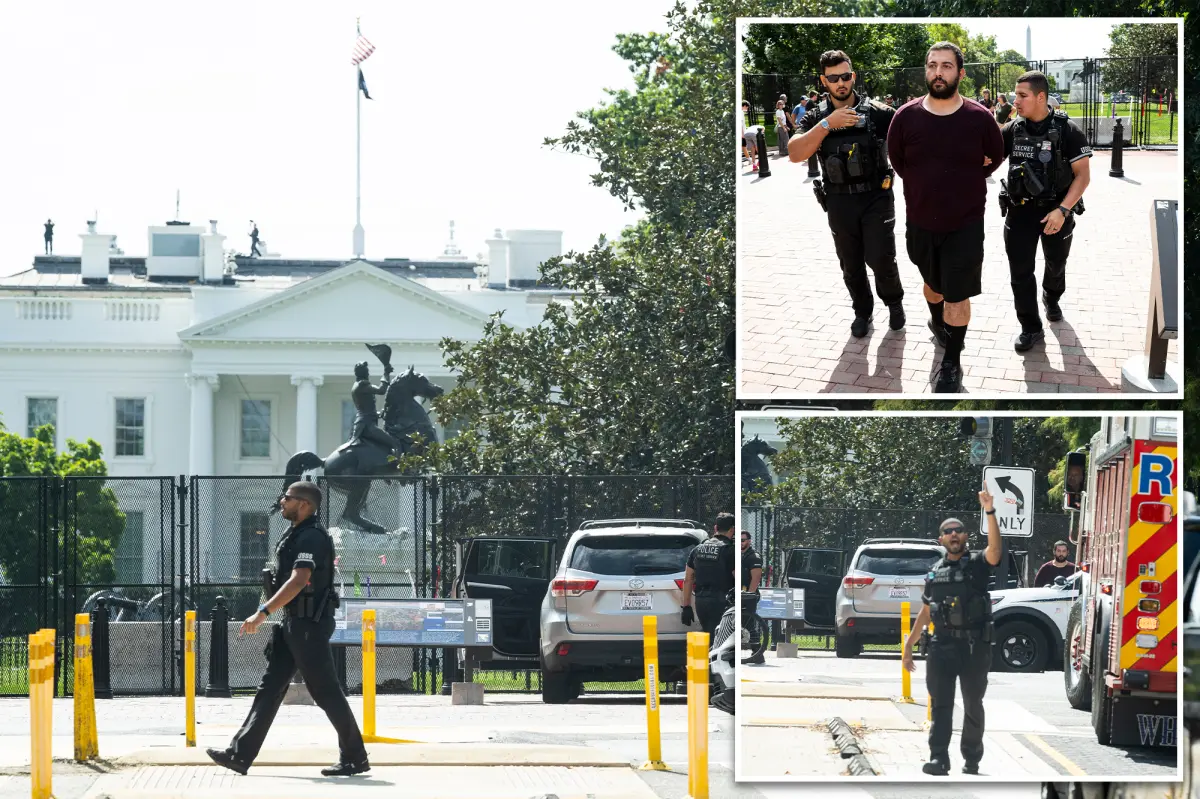
It began as an unremarkable Saturday near noon, with Washington, D.C. going about its normal rhythm of tourists, lunchtime walks, and the quiet hum of government business. Then, at the corner of 16th Street and H Street Northwest, just yards from Lafayette Square and the formidable security perimeter of the White House, a car swerved off the road and mounted the sidewalk. The vehicle came to rest in a place where pedestrians, not automobiles, were meant to stand. Almost instantly, a peaceful patch of the nation’s capital became a scene of controlled chaos. According to reports from The Sun and law enforcement officials, the driver was allegedly deranged, a word that carries with it a mixture of pity and fear. He had apparently driven his car onto the sidewalk near the security barrier with one goal in mind: to speak to President Trump. It was a demand so strange, so divorced from the reality of how power works, that it seemed less like a threat and more like a cry from a fractured mind. Yet in a city where every inch of pavement near the executive mansion is considered sacred ground, motive matters far less than action. Within moments, sirens filled the air and a phalanx of armed officers was converging on the scene, their faces set in the stern, practiced expressions of people who have trained for exactly this kind of unpredictable disruption.
The response was massive, as it always is whenever someone tests the invisible lines surrounding the White House. Metropolitan Police Department officers, members of the military, and Secret Service officers all rushed to the location, creating a layered, intimidating web of authority. The man, according to witnesses and reports, was not aggressive in the way one might expect from an armed assailant. Instead, he was apparently fixated on an impossible request. As officers surrounded his car and began the careful, deliberate work of extracting him, he allegedly kept demanding to speak to President Trump. The irony was almost too cruel to process: the president was not even there. He was vacationing at Camp David, the rustic presidential retreat in Maryland’s Catoctin Mountains, a place so removed from the city’s tension that it might as well have been another planet. The man’s pleas were directed at an empty chair. There is something deeply human about that kind of desperation, the belief that if only you could reach the person at the center of it all, everything would make sense. But the machinery of protection does not care about such delusions. The officers did their job, moving with precision and care, likely speaking to him in calm, measured tones, attempting to de-escalate a situation that could have ended in tragedy. In the end, there were no gunshots, no dramatic chase, no violent struggle. Just a man in custody, still clinging to the idea that the leader of the free world would somehow hear his voice.
After the arrest, the scene shifted from confrontation to assessment. The man was taken to a nearby hospital for a mental health evaluation, according to a spokesperson for the Secret Service. That single phrase—mental health evaluation—speaks volumes. It suggests that those on the ground recognized something beyond criminality, something more akin to illness. The Secret Service also stated that surrounding roads were shut down “out of an abundance of caution,” a stock phrase that has become routine in Washington but still carries real weight. Every closure re-routes traffic, inconveniences thousands, and sends a subtle signal that the threat is never truly gone. A sweep of the man’s car turned up nothing, no weapons, no explosives, no evidence of a broader plot. In a way, that outcome was both a relief and a sobering reminder. It could have been so much worse. The Secret Service expressed gratitude for the swift actions of its own officers and for the prompt response of the Metropolitan Police Department, a statement that reads as protocol but is also genuinely meaningful in a moment when inter-agency coordination can mean the difference between life and death. For those who live and work near the White House, the incident was another jolt of adrenaline, another reminder that the most powerful address in America is also one of the most vulnerable to the chaos of ordinary life. There is no force field, no magical barrier that separates the president from the people. There is only a thin line of flesh and bone, backed by training and vigilance, standing between a normal Saturday and an unthinkable tragedy.
This was not the first time someone has driven dangerously close to the White House, and it almost certainly will not be the last. In October 2025, a driver in a gray Acura was arrested after attempting to smash through a security gate while President Trump was inside the executive mansion. That incident, too, involved a vehicle used not as transportation but as a battering ram, a weapon of speed and metal against barriers designed to stop bullets and bombers. In March of this year, another driver was detained after plowing through a temporary security barricade at Madison Place and H Street Northwest, near Lafayette Park. Each of these events occupies a strange space in the public imagination. They are not full-scale attacks, not the coordinated operations of enemies with flags and ideologies. They are individual, chaotic, often deeply troubled actions that nonetheless force the Secret Service to reevaluate, adjust, and bolster its defenses. The White House is a living symbol of the American presidency, and it is also a physical target. Every road closure, every bollard, every uniformed officer standing in the heat or cold is a testament to the fact that the nation’s leaders are perpetually one unhinged moment away from danger. Yet these incidents also reveal something uncomfortable about the human condition: the line between a citizen with a grievance and a person in crisis is often agonizingly thin. The drivers who try to breach these barriers are not usually masterminds; they are often people in the grip of anger, delusion, or despair, looking for someone to blame or someone to save them.
President Trump has been the target of numerous assassination attempts that came perilously close to taking his life, both while he was in office and during the 2024 campaign. The shadow of those threats looms over every story like this one. In April 2026, a California schoolteacher named Cole Allen, 31, allegedly opened fire one floor above the grand ballroom at the Washington Hilton, where the White House Correspondents’ Dinner was taking place. That shot struck the bulletproof vest of a Secret Service agent, who returned fire but missed. Allen is now in federal custody, awaiting trial. The image of that moment, a bullet hitting a concealed vest, a near-miss that could have rewritten history, is enough to make anyone’s blood run cold. And then there is the attempted assassination in Butler, Pennsylvania, in July 2024, where a gunman named Thomas Matthew Crooks nearly shot Trump in the head while he delivered a campaign rally speech. That incident, captured in dramatic photographs and video, remains seared into the national memory. Crooks was killed by a counter-sniper, but his bullets grazed the president’s ear, leaving a stain of blood on his face and a lasting mark on the nation’s psyche. These events are not abstract statistics. They are vivid, terrifying moments of violence that have become part of the backdrop of modern American politics. They explain why a car on a sidewalk near the White House triggers such an enormous response. They explain why the Secret Service’s gratitude to local police feels so sincere. Every officer who rushes toward a potential threat knows that the next incident could be the one that changes everything. Every citizen who watches the news knows, too, on some level, that the safety of the president is not guaranteed, that it is bought with constant vigilance and the willingness of ordinary people to stand in harm’s way.
In the end, this latest incident is a story about the strange intersection of power, vulnerability, and the broken human spirit. A man drove his car onto a sidewalk and demanded to speak to the president. He was not a soldier, not a terrorist, not a planner of grand conspiracies. He was someone whose mind, at least in that moment, had become untethered from reality. The system did what it was designed to do: it contained the threat, swept the vehicle, closed the roads, and sent the man to receive mental health care. But for the rest of us, the incident leaves an uneasy feeling. It reminds us that the White House is not a fortress in the sky. It sits in the middle of a bustling city, surrounded by ordinary streets and everyday people. The president, no matter how mighty his office, is still a person who can be approached, threatened, or imperiled by someone who simply loses control. And yet, there is also something reassuring in the response. The officers who arrived did not panic. They did not overreact with deadly force. They evaluated the situation, recognized the signs of mental illness, and made a judgment call to protect the man as much as the institution. That is a small mercy, a reminder that even in the high-stakes world of presidential security, the goal is not merely to neutralize threats but to preserve life, including the lives of those who have lost their way. The nation moves on, the roads reopen, and the White House stands as it always has, a symbol of permanence amid change. But the memory of that deranged driver, demanding to speak with an absent president, lingers like an echo, asking us to consider just how thin the line really is between us and the chaos we fear.